Edexcel A Level Physics:复习笔记4.2 Upthrust

Upthrust
Archimedes' Principle
- Archimedes’ principle states:
An object submerged in a fluid at rest has an upward buoyancy force (upthrust) equal to the weight of the fluid displaced by the object
- The object sinks until the weight of the fluid displaced is equal to its own weight
- Therefore the object floats when the magnitude of the upthrust equals the weight of the object
- The magnitude of upthrust can be calculated in steps by:
- Find the volume of the submerged object, which is also the volume of the displaced fluid
- Find the weight of the displaced fluid
- Since m = ρV (density × volume), upthrust is equal to F = mg which is the weight of the fluid displaced by the object
- Archimedes’ Principle explains how ships float:
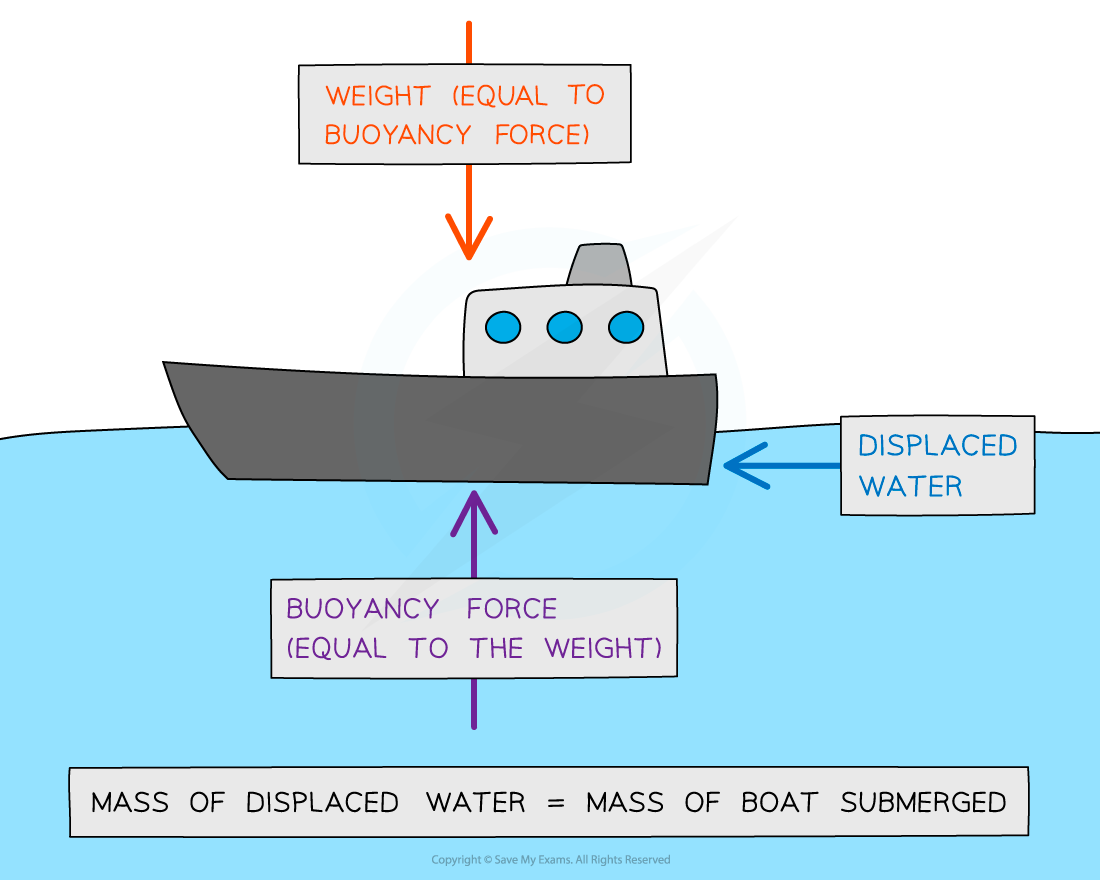
Boats float because they displace an amount of water that is equal to their weight
Worked Example
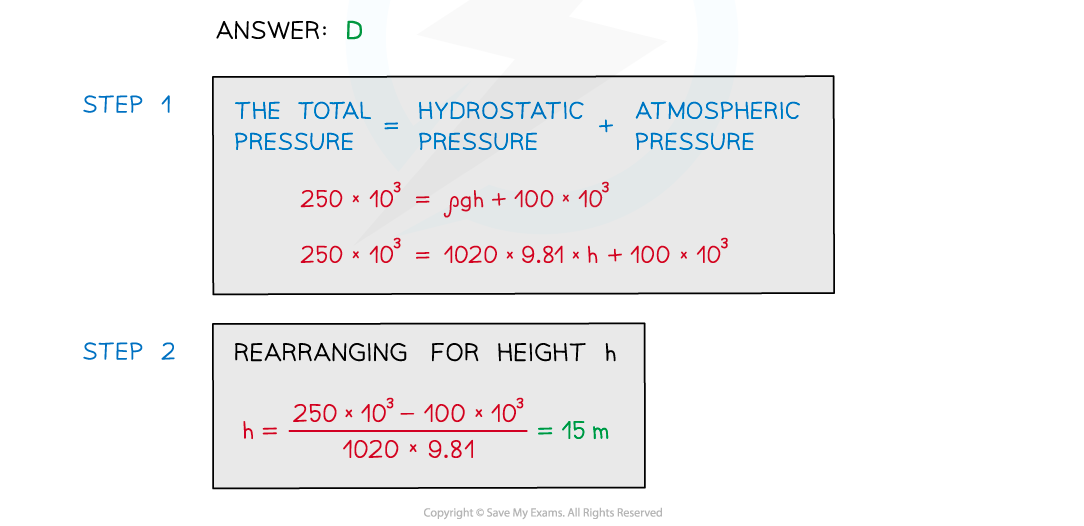
Atmospheric pressure at sea level has a value of 100 kPa. The density of sea water is 1020 kg m-3.
At what depth in the sea would the total pressure be 250 kPa?
A. 20 m B. 9.5 m C. 18 m D. 15 m
Worked Example
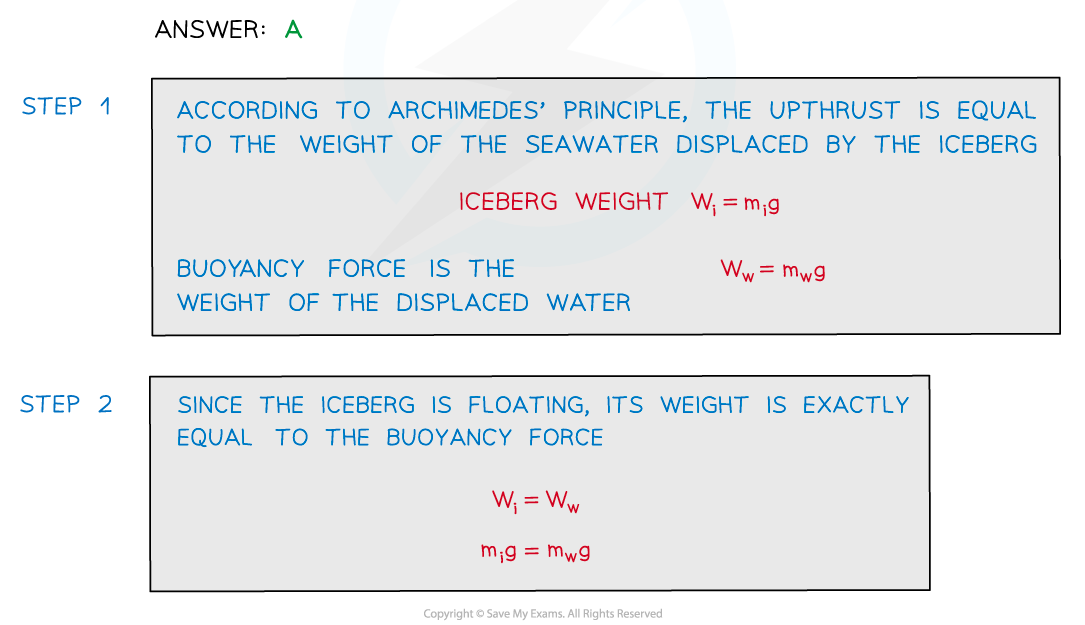
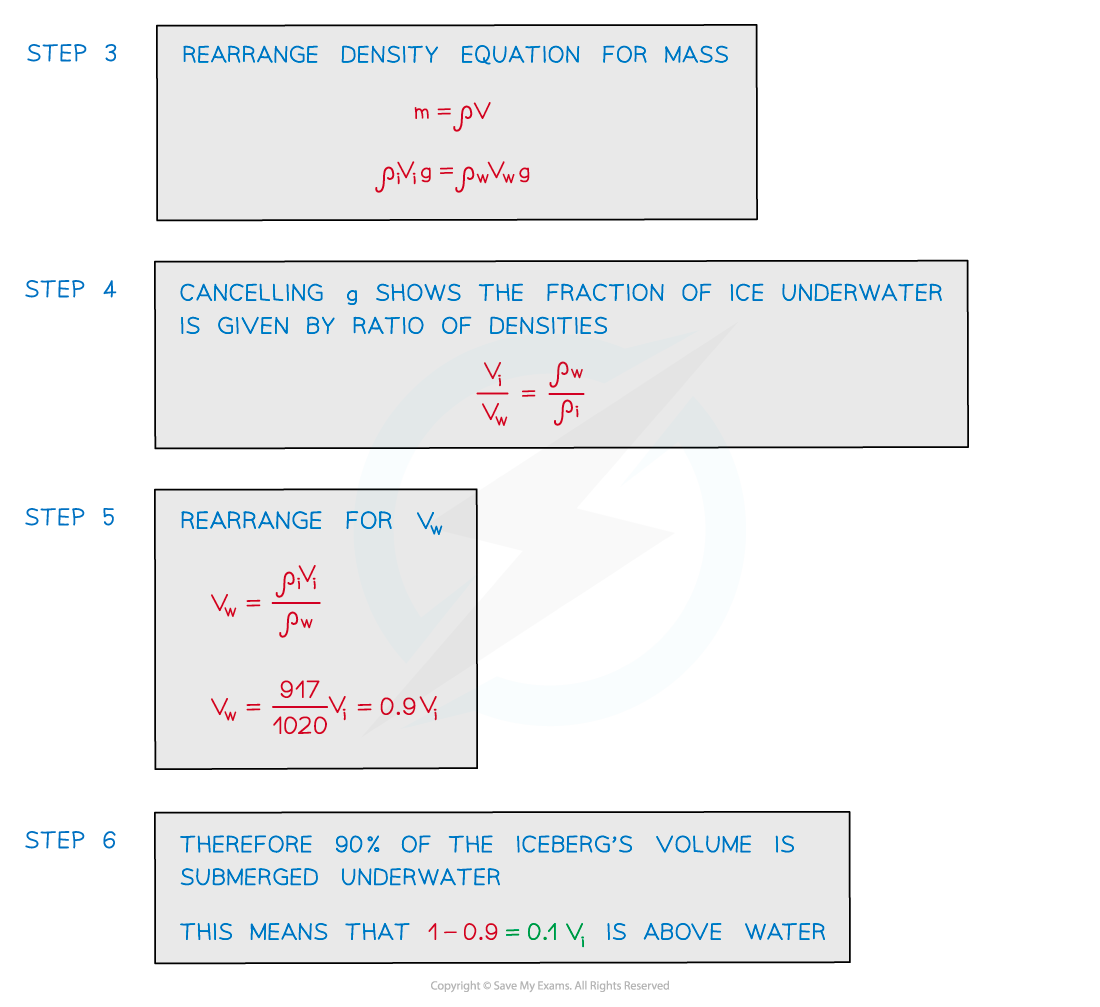
Icebergs typically float with a large volume of ice beneath the water. Ice has a density of 917 kg m-3 and a volume of Vi.
The density of seawater is 1020 kg m-3.What fraction of the iceberg is above the water?
A. 0.10 Vi B. 0.90 Vi C. 0.97 Vi D. 0.20 Vi
Exam Tip
Don't get confused by the two step process to find upthrust.
- Step 1: You need the volume of the submerged object, but only because you want to know how much fluid was displaced
- Step 2: What you really want to know is the weight of the displaced fluid.
A couple of familiar equations will help;
- m = ρV to get mass (and that's the V from step 1 out of the way),
then
- W = mg to get weight
If you are feeling particularly mathematical, you can combine your equations, so that W = ρVg
转载自savemyexams
以上就是关于【Edexcel A Level Physics:复习笔记4.2 Upthrust】的解答,如需了解学校/赛事/课程动态,可至翰林教育官网获取更多信息。
往期文章阅读推荐:
翰林独家 | 经济学竞赛核心精讲,一册打通NEC/IEO/USAEBO!
2026 ALEVEL 夏考A率出炉!爱德思vs牛津AQA,哪些科目真的“好出分”?


翰林AMC8视频课重磅上线!

国际竞赛真题资源免费领取






