Edexcel A Level Physics:复习笔记4.3 Viscous Drag

Stoke's Law
Viscous Drag
- Viscous drag is defined as
the frictional force between an object and a fluid which opposes the the motion between the object and the fluid
- Viscous drag is calculated using Stoke’s Law;
F = 6πηrv
- Where
- F = viscous drag (N)
- η = coefficient of viscosity of the fluid (N s m−2 or Pa s)
- r = radius of the object (m)
- v = velocity of the object (ms−1)
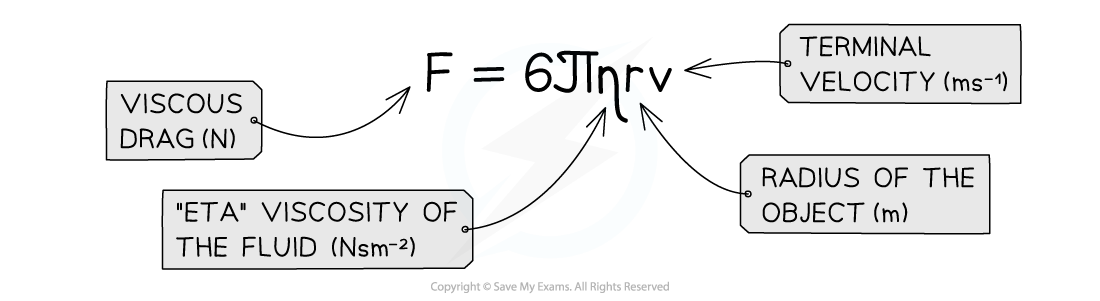
- The viscosity of a fluid can be thought of as its thickness, or how much it resists flowing
- Fluids with low viscosity are easy to pour, while those with high viscosity are difficult to pour

- The coefficient of viscosity is a property of the fluid (at a given temperature) that indicates how much it will resist flow
- The rate of flow of a fluid is inversely proportional to the coefficient of viscosity
Drag Force at Terminal Velocity
- Terminal velocity is useful when working with Stoke’s Law since at terminal velocity the forces in each direction are balanced
Ws = Fd + U (equation 1)
- Where;
- Ws = weight of the sphere
- Fd = the drag force (N)
- U = upthrust (N)
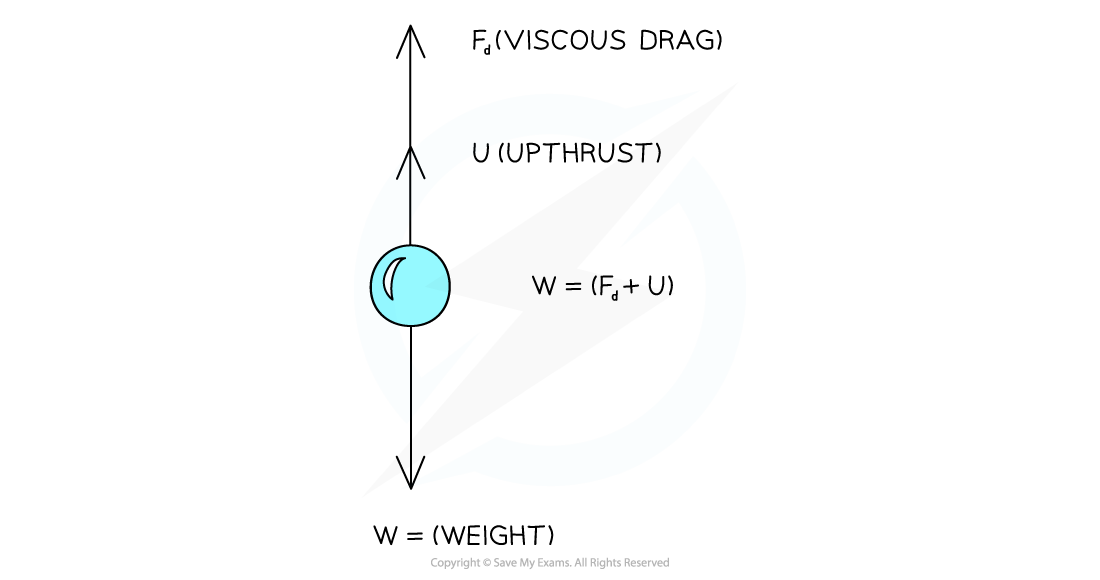
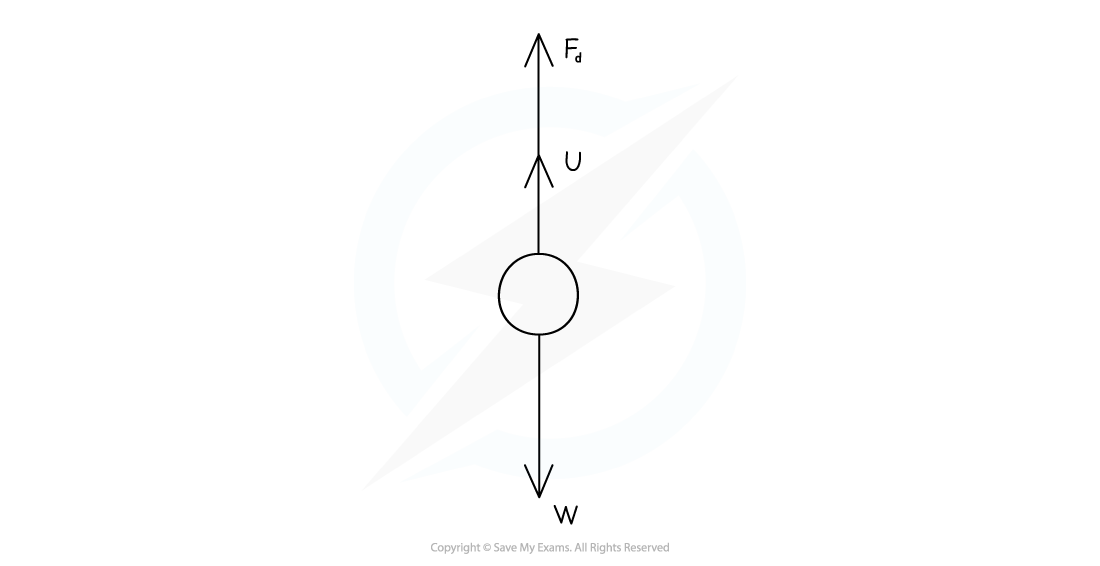
At terminal velocity forces are balanced: W (downwards) = Fd + U (upwards)
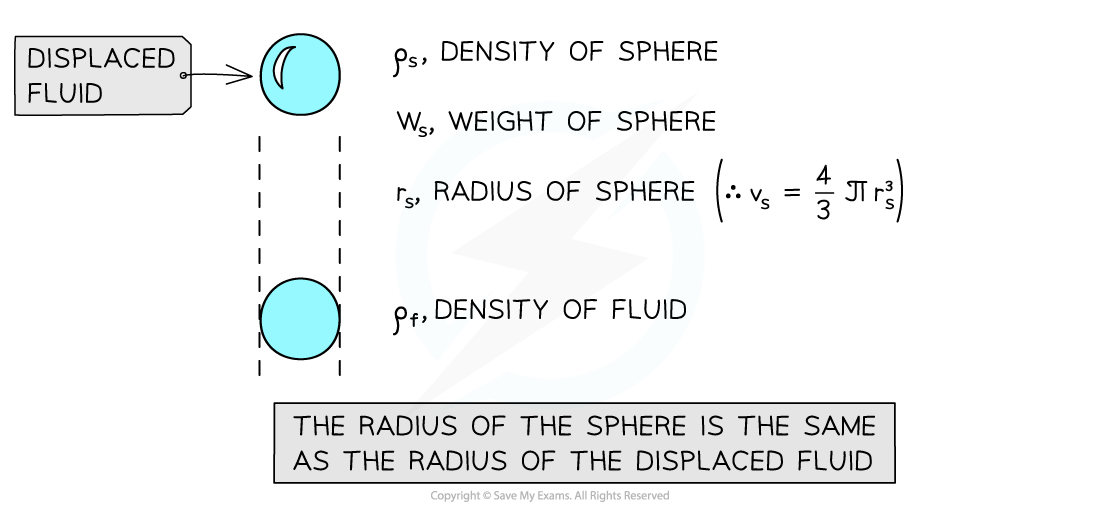
- The weight of the sphere is found using volume, density and gravitational force
Ws =vsρsg
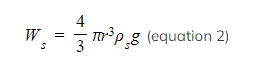
- Where
- vs = volume of the sphere (m3)
- ρs = density of the sphere (kg m–3)
- g = gravitational force (N kg−1)
- Recall Stoke’s Law
Fd = 6πηrvterm (equation 3)
- Upthrust equals weight of the displaced fluid
- The volume of displaced fluid is the same as the volume of the sphere
- The weight of the fluid is found from volume, density and gravitational force as above
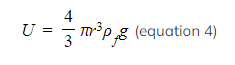
- Substitute equations 2, 3 and 4 into equation 1
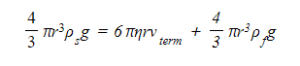
- Rearrange to make terminal velocity the subject of the equation

- Finally, cancel out r from the top and bottom to find an expression for terminal velocity in terms of the radius of the sphere and the coefficient of viscosity
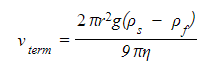
- This final equation shows that terminal velocity is;
- directly proportional to the square of the radius of the sphere
- inversely proportional to the viscosity of the fluid
Understanding Viscosity & Stoke's Law
Conditions for Stoke’s Law Equation
- The equation can only be used when certain conditions are met;
- The flow is laminar
- The object is small
- The object is spherical
- Motion between the sphere and the fluid is at a slow speed

Laminar and Turbulent Flow
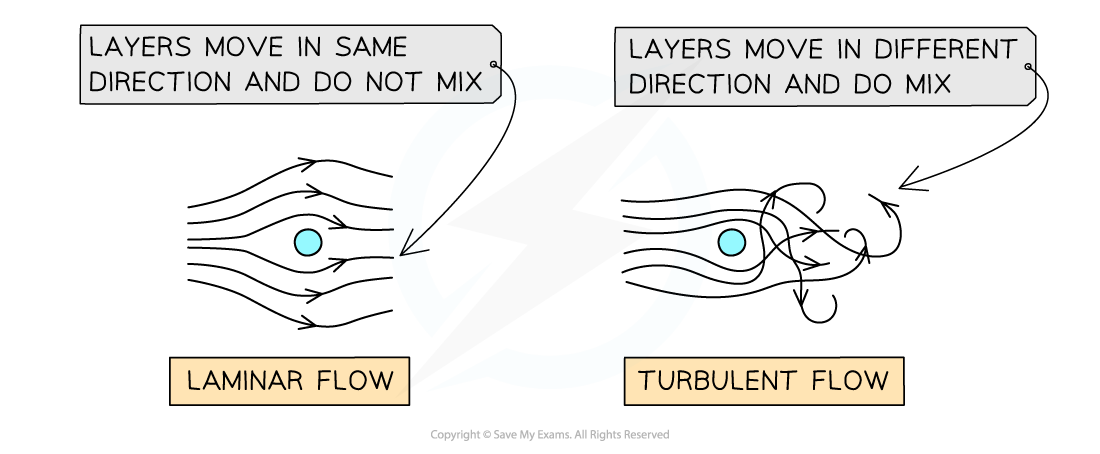
- As an object moves through a fluid, or a fluid moves around an object, layers in the fluid are created
- In laminar flow all the layers are moving in the same direction and they do not mix
- This tends to happen for slow moving objects, or slow flowing liquids
- The equation above only applies for laminar flow
- In turbulent flow the layers move in different directions and the layers do mix
Changing Viscosity
- Viscosity is temperature-dependent
- Liquids are less viscous as temperature increases
- Gases get more viscous as temperature increases
Worked Example
A ball bearing of radius 5.0 mm falls at a constant speed of 0.030 ms–1 through a oil which has viscosity 0.3 Pa s and density 900 kg m–3.
Determine the viscous drag acting on the ball bearing.
Step 1: List the known quantities in SI units
-
- Radius of the sphere, rs = 5.0 mm = 5.0 × 10⁻³ m
- Terminal velocity of the sphere, v = 0.03 m s-1
- Viscosity of oil, η = 0.3 Pa s
- Density of oil, ρf = 900 kg m−3
Step 2: Sketch a free-body diagram to resolve the forces at constant speed
Ws = Fd + U
Step 3: Calculate the value for viscous drag, Fd
Fd = 6πηrv = 6 × π × 0.3 × 5.0 × 10-3 × 0.03 = 0.008482
Step 4: Write the complete answer to the correct significant figures and include units
-
- The viscous drag, Fd = 8.5 × 10⁻⁴ N
Exam Tip
You may need to write out some or all of the derivation given in the first part above.
It is really important to keep clear whether you are talking about density of the sphere or the fluid, and mass of the sphere or the fluid.
Practice using subscripts and do try this at home. It isn’t one to do for the first time in an exam!
转载自savemyexams
以上就是关于【Edexcel A Level Physics:复习笔记4.3 Viscous Drag】的解答,如需了解学校/赛事/课程动态,可至翰林教育官网获取更多信息。
往期文章阅读推荐:
翰林独家 | 经济学竞赛核心精讲,一册打通NEC/IEO/USAEBO!
2026 ALEVEL 夏考A率出炉!爱德思vs牛津AQA,哪些科目真的“好出分”?


翰林AMC8视频课重磅上线!

国际竞赛真题资源免费领取






