AQA A Level Physics复习笔记2.2.5 Quarks & Antiquarks

Properties of Quarks & Antiquarks
Quarks
- The three most common flavours of quarks are: up, down and strange
- The majority of hadrons are made up of different combinations of these quarks

The three main quarks that make up most hadrons
- Each quark has a charge, baryon number and strangeness
- These will be provided on the data sheet
Quarks Table provided on the datasheet
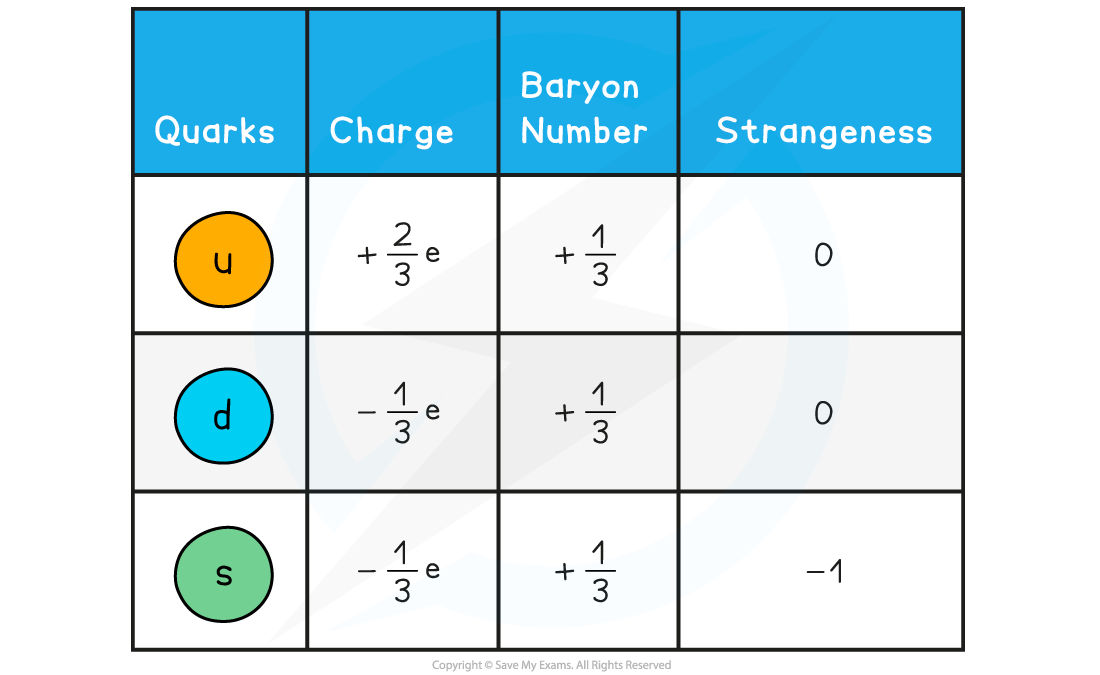
- The charge of a hadron is determined by the sum of the charges of its quarks
- For example, a proton is made up of two up quarks and a down quark. Adding up their charges gives the charge of a proton:

- Equivalently, the baryon number and strangeness of a hadron is determined by the sum of the baryon numbers and strangeness of its quarks
Anti-quarks
- The equivalent antiparticle of the quark is the anti-quark

The three main anti-quarks that make up most hadrons
- These are identical to quarks except with opposite relative charges, baryons numbers and strangeness
Anti-quarks Table
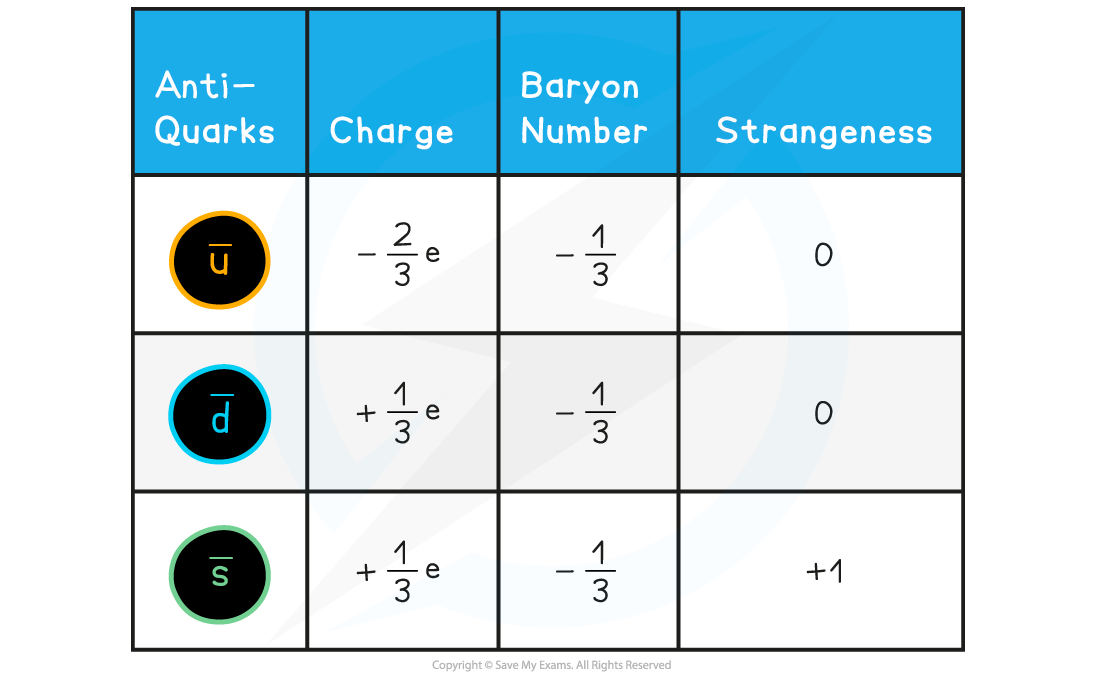
- Quarks have a baryon number of +1/3
- Anti-quarks having a baryon number of –1/3
- Strange quarks have a strangeness of –1
- Anti-strange quarks have a strangeness of +1
- This is unique to the strange quark
Worked Example
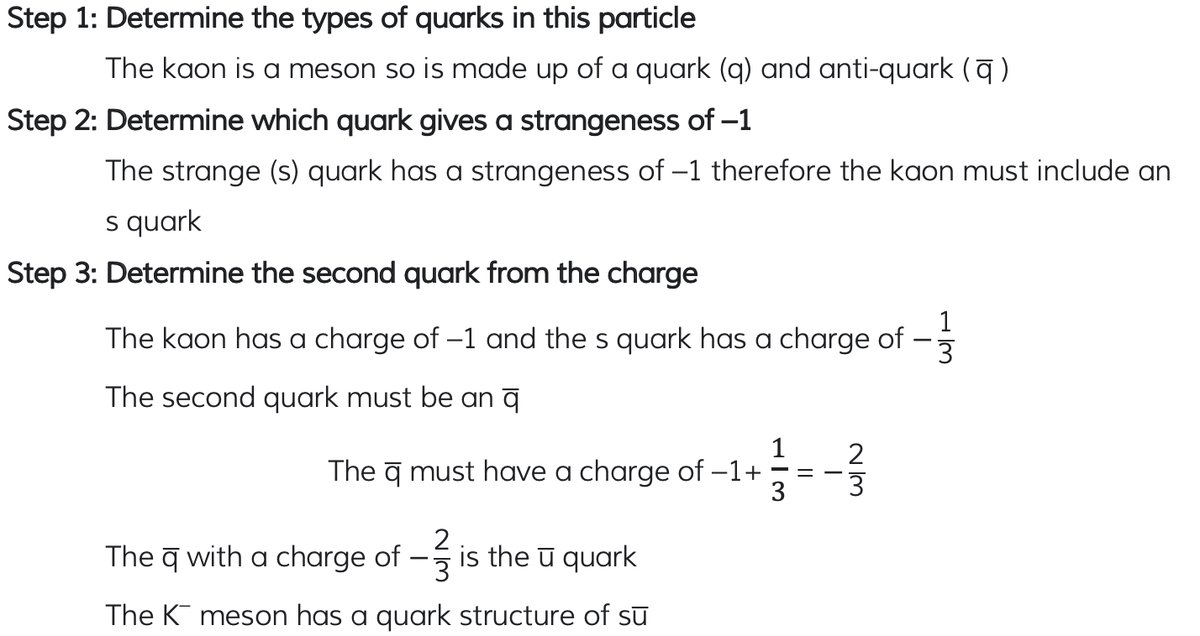
A K- particle has a strangeness of –1. Determine the quark structure of this particle.
Exam Tip
You will not be expected to remember the charge of each quark as this information is provided on the datasheet. So, instead of memorising the charges of anti-quarks too, just remember they are identical but with opposite signs.
Quark Combinations
Baryons
- Protons and neutrons are not fundamental particles
- They are each made up of three quarks
- Protons are made up of two up quarks and a down quark
- Neutrons are made up of two down quarks and an up quark
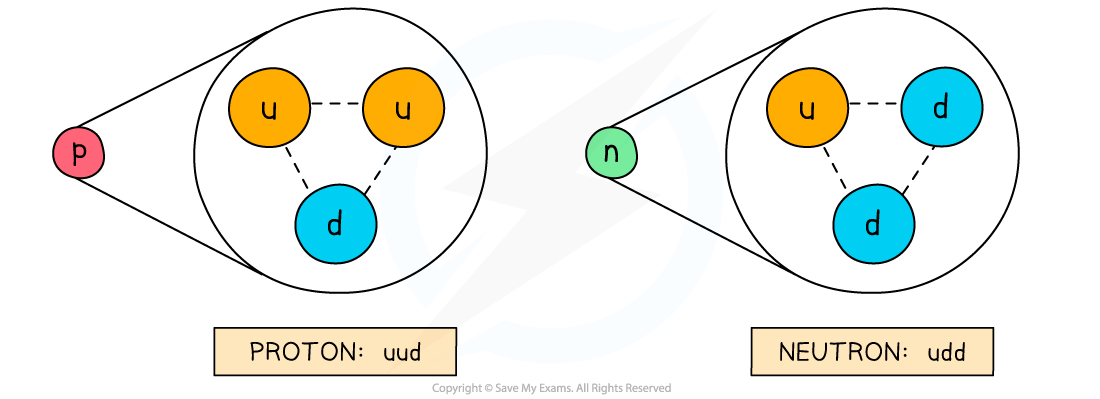
Protons and neutrons are made up of three quarks
Mesons
- Pions and kaons are made up of a quark and anti-quark pair
- Pions are either:
- π+ made up of an up quark and an anti-down quark
- π– made up on an anti-up quark and a down quark
- π0 made up of an up quark and anti-up quark or down quark and anti-down quark
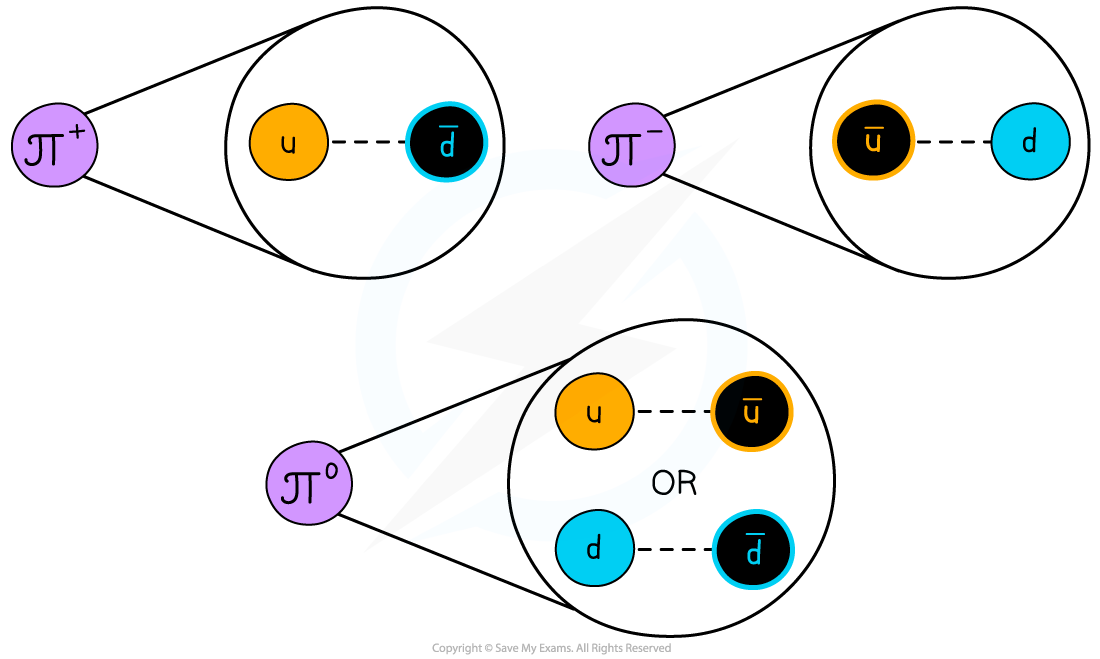
Pions consist of up and down quarks, and their respective antiparticles, depending on their sign
- Kaons are either:
- K+ made up of an up quark and an anti-strange quark
- K– made up on an anti-up quark and a strange quark
- K0 made up of an down quark and anti-strange quark or anti-down quark and strange quark
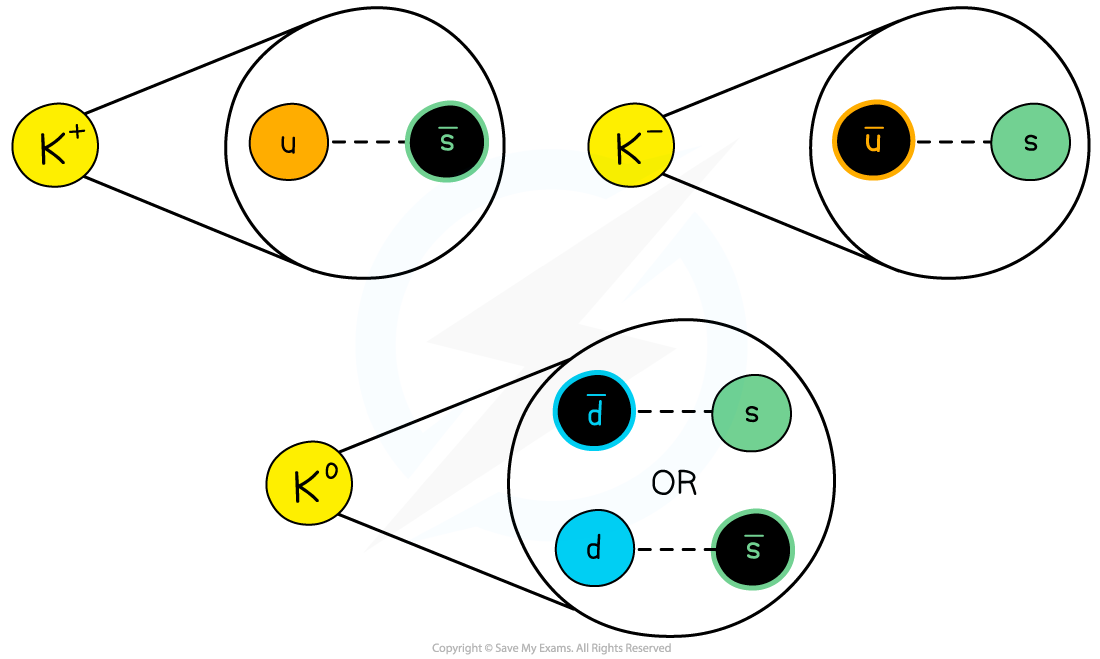
Kaons consist of up, down and strange quarks, and their respective antiparticles, depending on their sign
Worked Example

Step 1: Calculate the number of protons
The number of protons is from the proton number = 26 protons
Step 2: Calculate the number of neutrons
Number of neutrons = nucleon number – proton number
Number of neutrons = 56 - 26 = 30 neutrons
Step 3: Up quarks in a proton
Protons are made up of uud quarks = 2 up quarks
Step 4: Up quarks in a neutron
Neutrons are made up of udd quarks = 1 up quark
Step 5: Total number of up quarks
26 protons × 2 up quarks = 52 up quarks
30 neutrons × 1 up quark = 30 up quarks
Total number of up quarks = 52 + 30 = 82 up quarks
Exam Tip
The quark combinations for protons, neutrons, pions and kaons will be expected to be memorised for the exam.
转载自savemyexams
以上就是关于【AQA A Level Physics复习笔记2.2.5 Quarks & Antiquarks】的解答,如需了解学校/赛事/课程动态,可至翰林教育官网获取更多信息。
往期文章阅读推荐:
翰林独家 | 经济学竞赛核心精讲,一册打通NEC/IEO/USAEBO!
2026 ALEVEL 夏考A率出炉!爱德思vs牛津AQA,哪些科目真的“好出分”?


翰林AMC8视频课重磅上线!

国际竞赛真题资源免费领取






