AQA A Level Physics复习笔记2.2.4 Leptons

Leptons & Antileptons
- Leptons are a group of fundamental (elementary) particles
- This means they are not made up of any other particles (no quarks)
- Leptons interact with other particles via the weak, gravitational or electromagnetic interactions
- They do not interact via the strong nuclear force
- The most common leptons are:
- The electron, e–
- The electron neutrino, ve
- The muon, μ–
- The muon neutrino, vμ
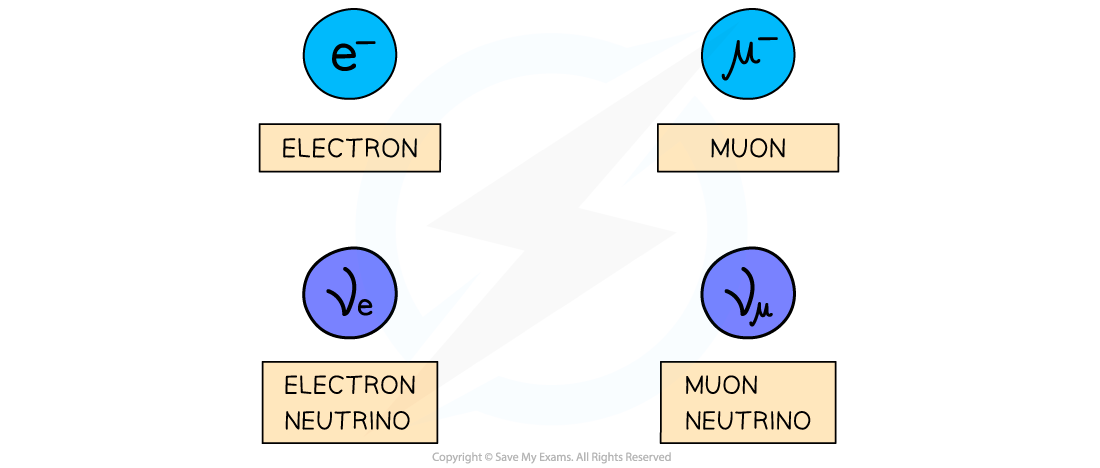
The most common leptons are the electron, muon and their respective neutrinos
- The muon is similar to the electron but is slightly heavier
- Electrons and muons both have a charge of -1e and a mass of 0.0005u
- Neutrinos are the most abundant leptons in the universe and have no charge and negligible mass (almost 0)
- Although quarks are fundamental particles too, they are not classed as leptons
- Leptons do not interact with the strong force, whilst quarks do
Worked Example
Circle all the anti-leptons in the following decay equation.
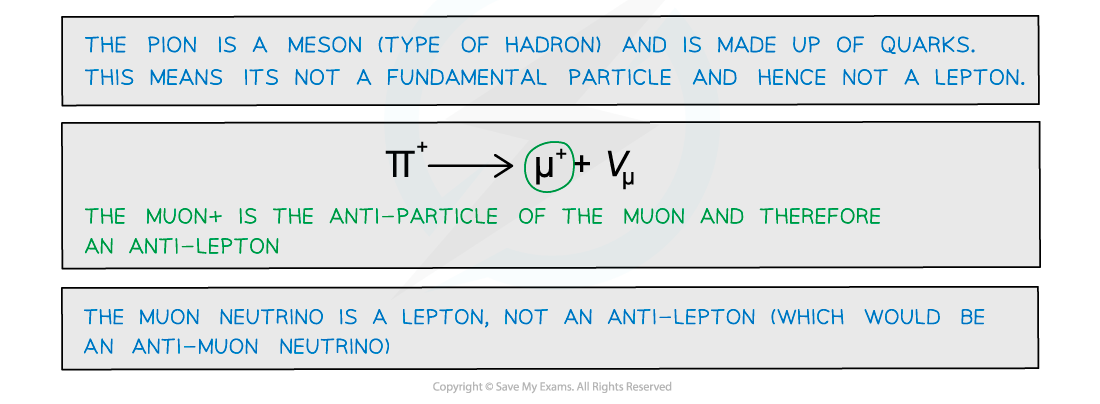
Lepton Number
- Similar to baryon number, the lepton number, L is the number of leptons in an interaction
- L depends on whether the particle is a lepton, anti-lepton or neither
- Leptons have a lepton number L = +1
- Anti-leptons have a lepton number L = –1
- Particles that are not leptons have a lepton number L = 0
- Lepton number is a quantum number and is conserved in all interactions
- This is helpful for knowing whether an interaction is able to happen
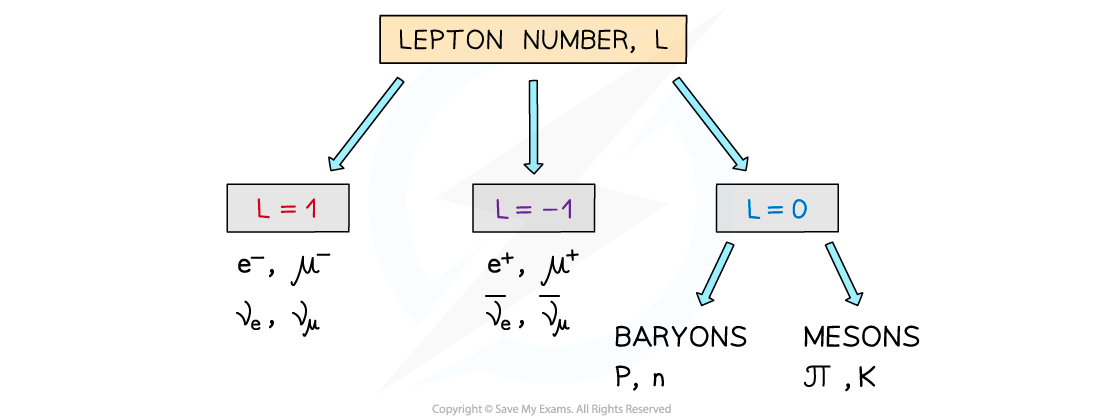
The lepton number depends if the particle is a lepton, anti-lepton or neither
Worked Example
If the lepton number is conserved in the following decay, identify whether particle X should be a neutrino or anti-neutrino
Step 1: Determine the lepton number of all the particles on both sides of the equation
0 + (–1) = 0 + X
Step 2: Identify the lepton number of X
If the lepton number must be conserved, X must also have a lepton number of –1
Step 3: State the particle X
Particle X is an anti-neutrino
Exam Tip
No need to fret about memorising all the different lepton numbers - the lepton number of each lepton and anti–lepton is provided on the datasheet.Remember that although quarks are fundamental particles, they have a lepton number of 0 and are classed as baryons.
Muon Decay
- Muons are leptons that are slightly heavier than the electron
- Muons (μ–) typically decay into an electron
- Anti-muons (μ+) typically decay into positrons
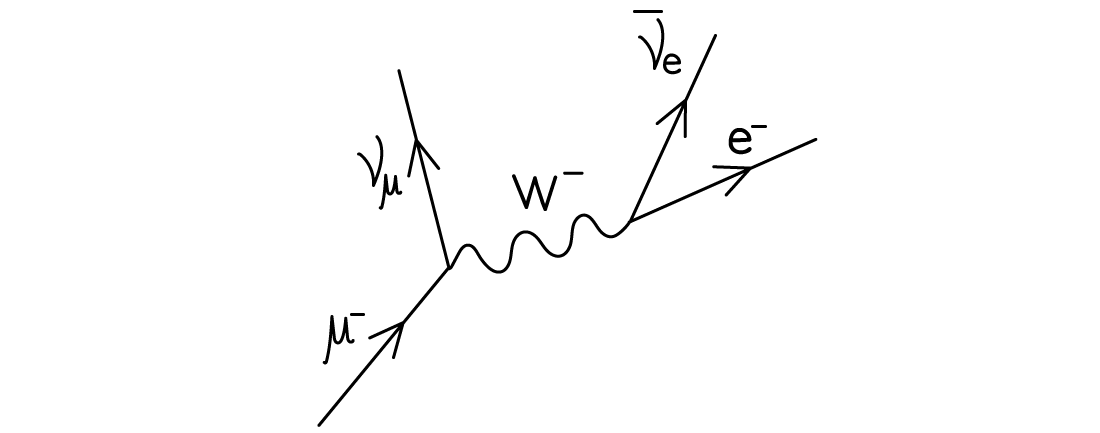
The Feynman diagram for muon decay
- Muon decay occurs through the weak interaction
- This can be recognised by the exchange of the W– boson on a Feynman diagram
Worked Example
Show that muon decay satisfies all the conservation laws.
Step 1: Write out the equation for muon decay
μ– → e– + ṽe + νμ
Step 2: List the quantities which must be conserved in this interaction
-
- Charge, q
- q = –1 for electrons and muons, q = 0 for neutrinos
- Electron lepton number, Le
- Le = +1 for electrons, Le = –1 for anti-electron neutrinos, Le = 0 for muons and muon neutrinos
- Muon lepton number, Lμ
- Lμ = +1 for muons and muon neutrinos, Lμ = 0 for electrons and electron neutrinos
- Charge, q
Step 3: Determine if each quantity balances on each side of the equation
-
- Charge, q:
- μ– → e– + ṽe + νμ
- –1 = –1 + 0 + 0 ✓ conserved
- Electron lepton number, Le:
- μ– → e– + ṽe + νμ
- 0 = +1 – 1 + 0 ✓ conserved
- Muon lepton number, Lμ:
- μ– → e– + ṽe + νμ
- +1 = 0 + 0 + 1 ✓ conserved
- Charge, q:
Step 4: Write a conclusion
-
- The numbers on each side of the equation are equal for charge, electron lepton number and muon lepton number, therefore, muon decay satisfies these conservation laws
转载自savemyexams
以上就是关于【AQA A Level Physics复习笔记2.2.4 Leptons】的解答,如需了解学校/赛事/课程动态,可至翰林教育官网获取更多信息。
往期文章阅读推荐:
翰林独家 | 经济学竞赛核心精讲,一册打通NEC/IEO/USAEBO!
2026 ALEVEL 夏考A率出炉!爱德思vs牛津AQA,哪些科目真的“好出分”?


翰林AMC8视频课重磅上线!

国际竞赛真题资源免费领取






