CIE IGCSE Biology: 复习笔记:14.1.6 The Eye

CIE IGCSE Biology: 复习笔记:14.1.6 The Eye
Structure & Function of the Eye
- The eye is a sense organ containing receptor cells that are sensitive to light (rod cells) and colour (cone cells)
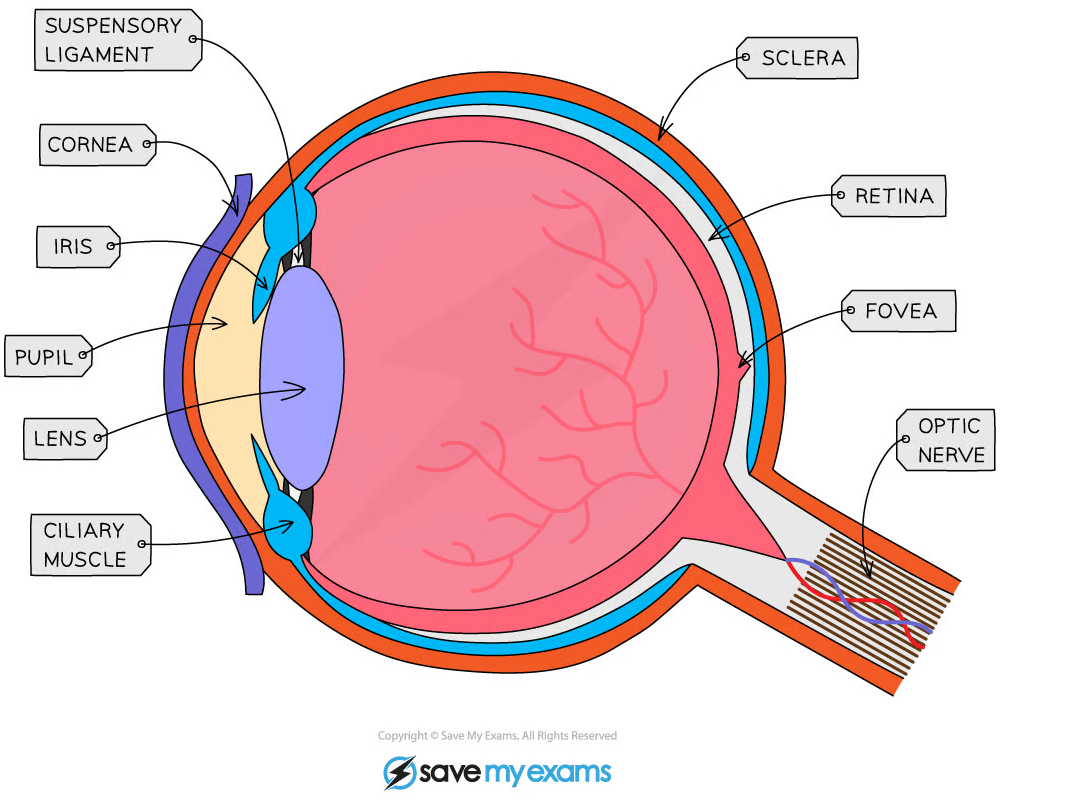 The eye
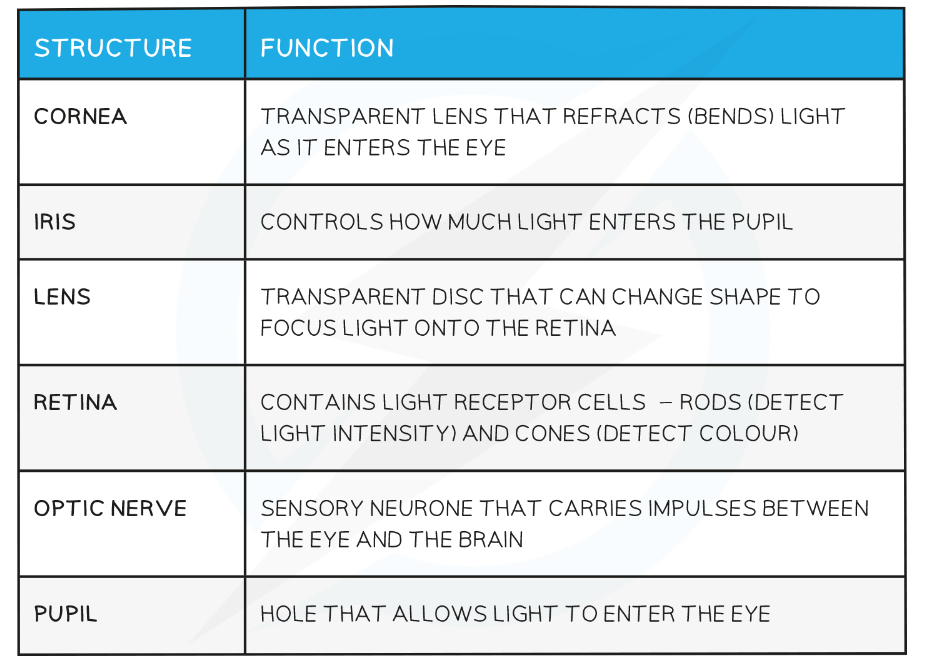
Function of the parts of the eye:
The Blind Spot
- At the point where the optic nerve joins the retina, there are no light-sensitive rod and cone cells on that part of the retina
- Light falling onto that part of the retina will not result in an image being detected
- the brain 'fills in' from surrounding light so we don't see a black hole where no light has fallen
- This causes a blind spot, where we cannot detect an object in our peripheral vision even if it is there
The Pupil Reflex
- This is a reflex action carried out to protect the retina from damage in bright light and protect us from not seeing objects in dim light
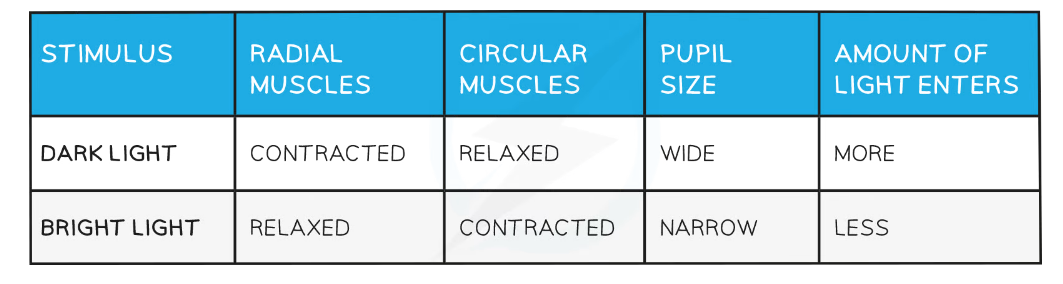
- In dim light the pupil dilates (widens) in order to allow as much light into the eye as possible
- In bright light the pupil constricts (narrows) in order to prevent too much light entering the eye and damaging the retina
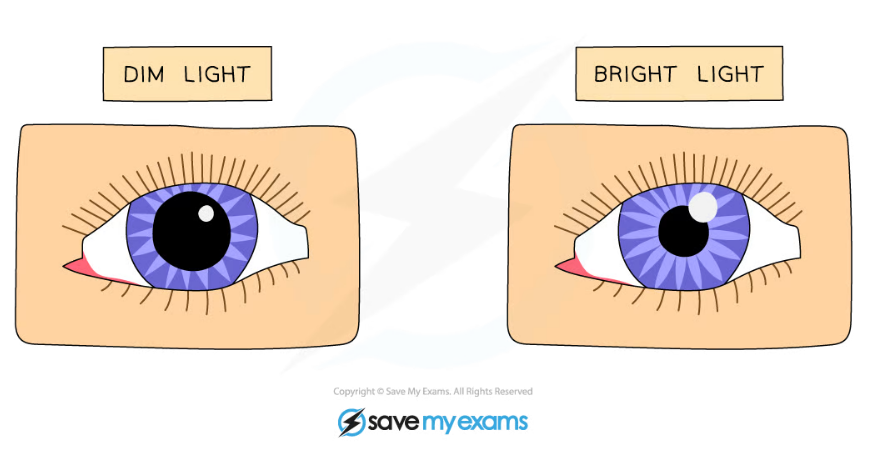 The pupil reflex
- In dim light, the pupil dilates (becomes larger) to allow more light to enter the eye to improve vision.
- In bright light, the pupil constricts (gets smaller) to allow less light to enter the eye to protect the retina from damage.
The Pupil Reflex - Antagonistic Muscle Action: Extended
- The pupil reflex is an example of a pair of antagonistic muscle groups acting together
- They work together to regulate the amount of light entering the eye
- The muscles that work antagonistically are the radial muscles and the circular muscles of the eye
- When one set of muscles contracts, the other relaxes
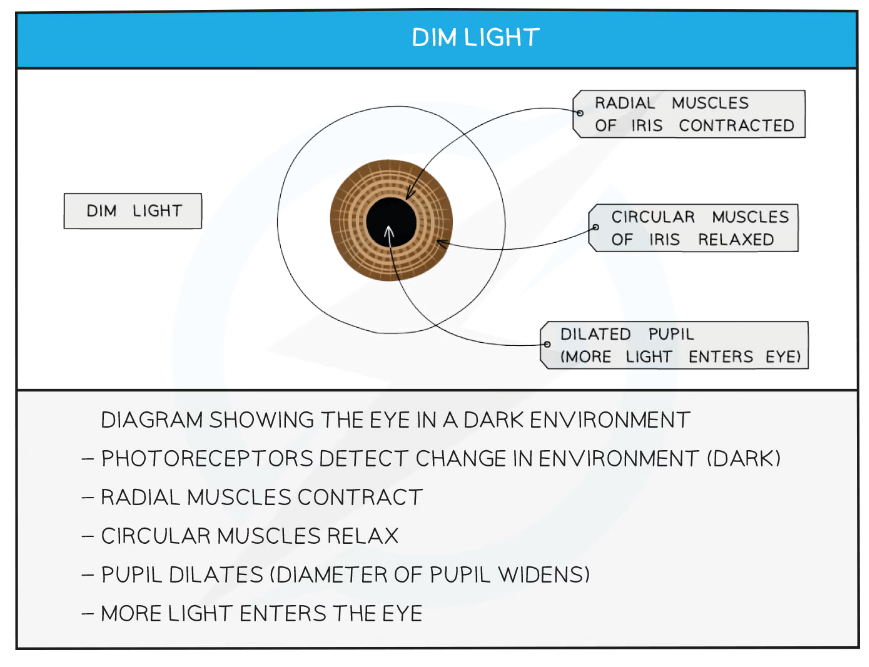
The pupil reflex in dim light
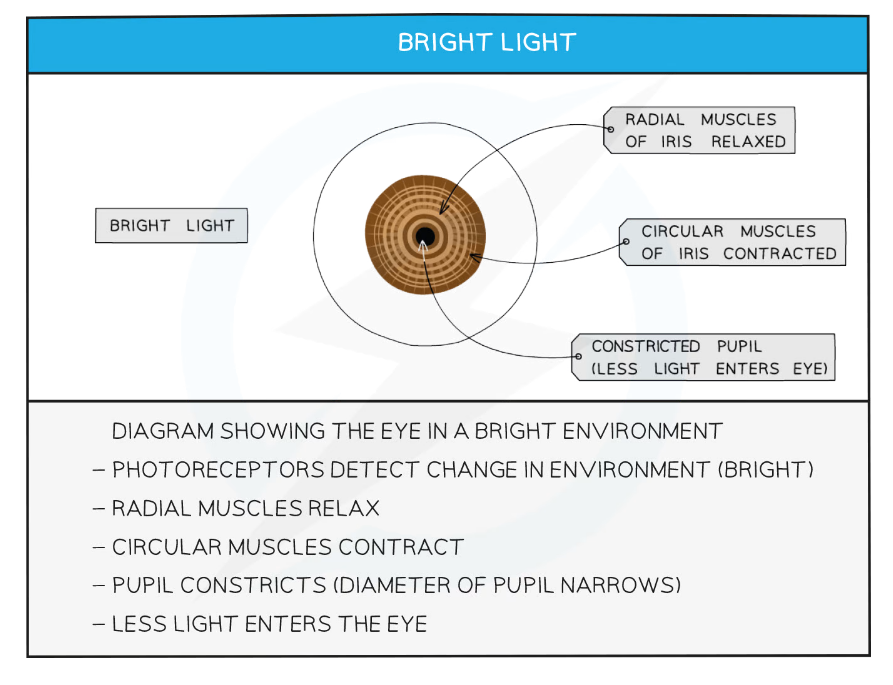
The pupil reflex in bright light
Responding to Changes in Light Intensity Table
Accommodation: Extended
Accommodation: The function of the eye in focusing on near and distant objects
- The way the lens brings about fine focusing is called accommodation
- The lens is elastic and its shape can be changed when the suspensory ligaments attached to it become tight or loose
- The changes are brought about by the contraction or relaxation of the ciliary muscles
- When an object is close up:
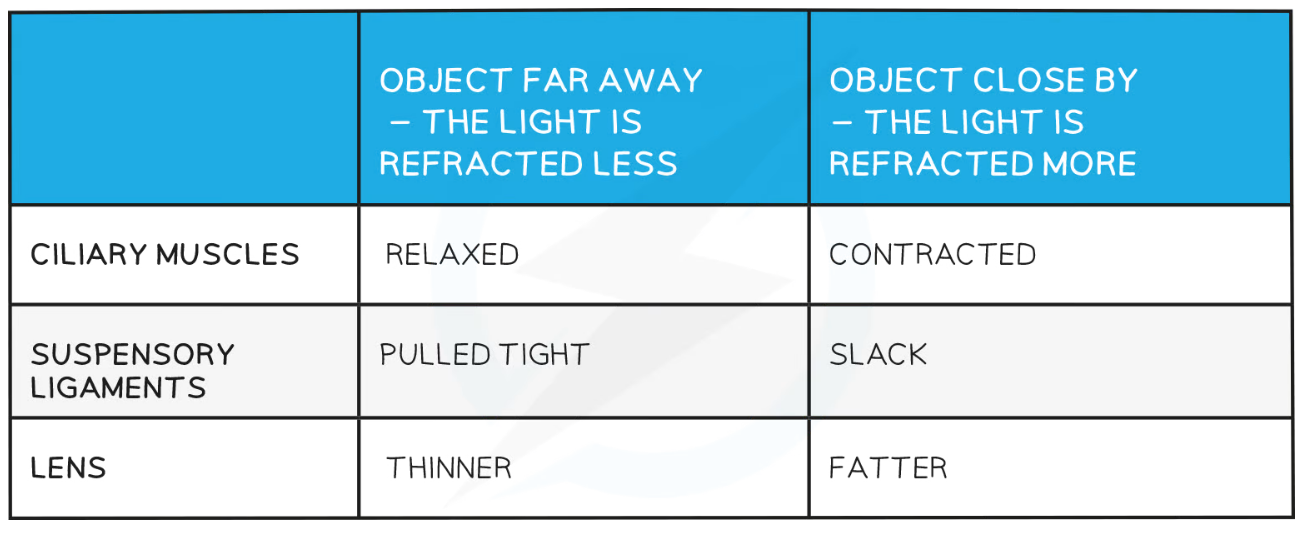
- The ciliary muscles contract (the ring of muscle decreases in diameter)
- This causes the suspensory ligaments to loosen
- This stops the suspensory ligaments from pulling on the lens, which allows the lens to become fatter
- Light is refracted more
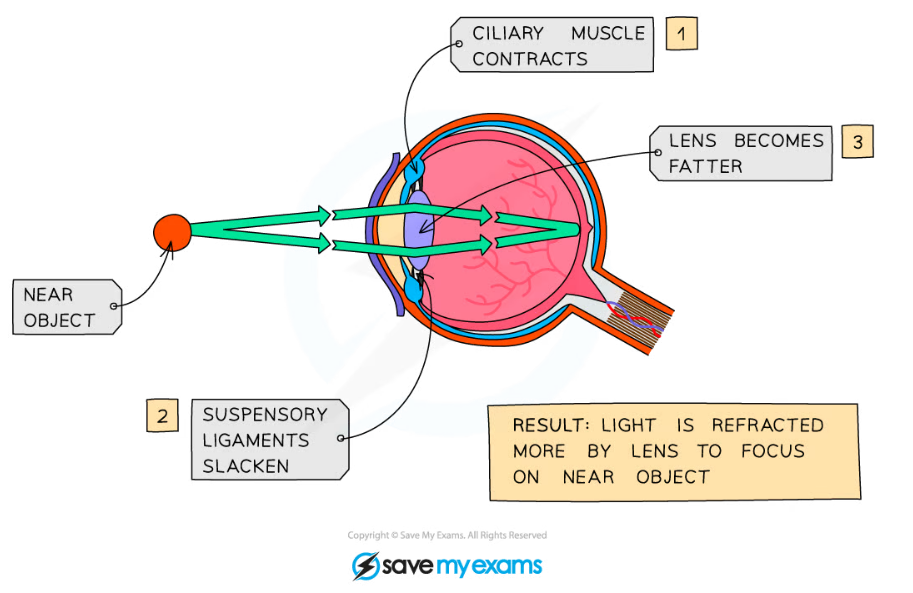
Diagram showing the eye when an object is close up
- When an object is far away:
- The ciliary muscles relax (the ring of muscle increases in diameter)
- This causes the suspensory ligaments to tighten
- The suspensory ligaments pull on the lens, causing it to become thinner
- Light is refracted less
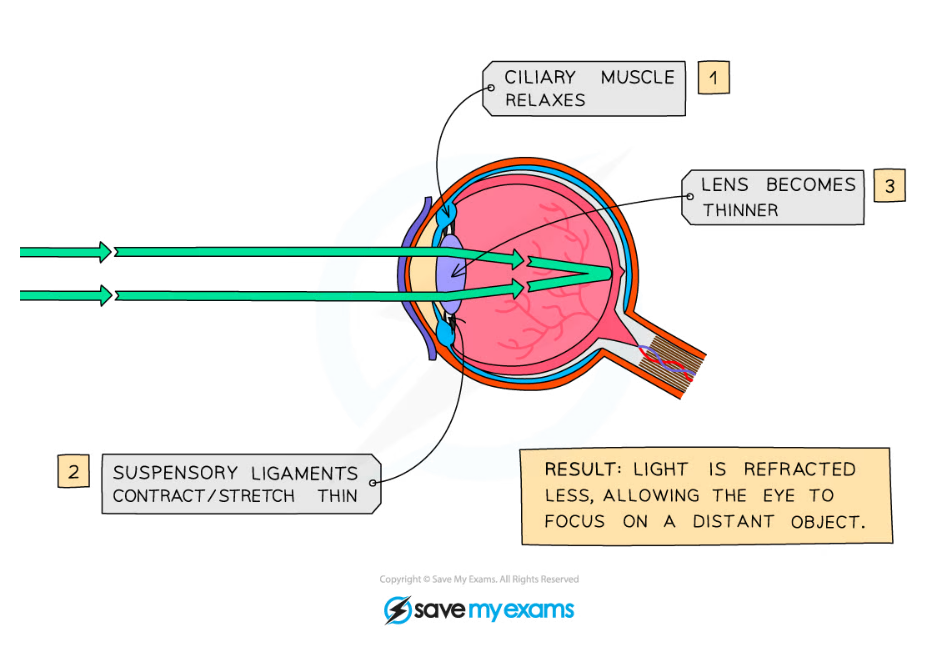
Diagram showing the eye when an object is far away
Focussing on Distant and Near Objects Table
Exam Tip
The focusing of the eye on distant and near objects is complex and it can be hard to remember what is happening. This is something you can work out in an exam if you have forgotten – staring at your hand right in front of your eye will make your eyes feel tight and tired after a few seconds. This is because the ciliary muscles are contracted. Staring at an object far away feels relaxing and comfortable because the ciliary muscles are relaxed.
Rod & Cone Cells: Extended
- There are two types of receptor cells in the retina:
- Rods, which are sensitive to dim light
- Cones, which distinguish between different colours in bright light
- There are 3 types of cone cells which are sensitive to different colours of light (red, blue and green)
- The fovea is an area on the retina where almost all of the cone cells are found
- Rod cells are found all over the retina, other than the area where the optic nerve attaches to the retina - there are no light-sensitive cells at all in this area, and so it is known as the blind spot
Exam Tip
Do you ever wonder why your night vision is black and white? It's because the low light intensity isn't enough to stimulate cone cells, so only rod cells are stimulated. Remember, only the cone cells can detect colour.
Also, if you look directly at a dim star at night, it disappears, but reappears if you look slightly to one side of it. This is because, when looking straight at the star, the light falls on the fovea, which has more cones so fewer rods, so the low light intensity won't be enough to stimulate the rods. Looking to the side allows the light to fall away from the fovea, onto more rod cells, so the start reappears!
转载自savemyexams
以上就是关于【CIE IGCSE Biology: 复习笔记:14.1.6 The Eye】的解答,如需了解学校/赛事/课程动态,可至翰林教育官网获取更多信息。
往期文章阅读推荐:
翰林独家 | 经济学竞赛核心精讲,一册打通NEC/IEO/USAEBO!
IGCSE全A*,A-Level阶段却崩了?别忽视IGCSE选课的重要性!


翰林AMC8视频课重磅上线!

国际竞赛真题资源免费领取






