Edexcel A (SNAB) A Level Biology:复习笔记6.2.4 Antigens & Antibodies

The Role of Antigens & Antibodies
Antigens
- Every cell in the human body has markers on its cell surface membrane that identify it
- Microorganisms such as bacteria and viruses also have their own unique markers
- These markers are called antigens and they allow cell-to-cell recognition
- Antigens are found on cell surface membranes, bacterial cell walls, or the surfaces of viruses
- Some glycolipids and glycoproteins on the outside of cell surface membranes act as antigens
- Antigens can be either self antigens or non-self antigens
- Antigens produced by the organism's own body cells are known as self antigens
- Self antigens do not stimulate an immune response
- Antigens not produced by the organism’s own body cells are known as non-self antigens
- Non-self antigens stimulate an immune response
- E.g. the antigens found on pathogenic bacteria and viruses, or on the surface of a transplanted organ
- Antigens produced by the organism's own body cells are known as self antigens
- After pathogens are engulfed by phagocytosis, phagocytes transfer the antigens of the digested pathogen to their cell surface membrane, becoming antigen presenting cells
- Antigen presenting cells such as macrophages activate the specific immune response
- This occurs when the white blood cells of the specific immune response, known as lymphocytes, bind to the presented antigens with specific receptors on their cell surface membranes
- Note that macrophages are a type of phagocytic white blood cell
- Antigen presenting cells such as macrophages activate the specific immune response
Antibody structure
- Antibodies are Y-shaped molecules sometimes known as immunoglobulins
- Antibodies consist of four polypeptide chains; two ‘heavy’ chains attached by disulfide bonds to two ‘light’ chains
- 'Heavy' chains are long while 'light' chains are short
- Each polypeptide chain has a constant region and variable region
- The constant regions do not vary within a class of antibody
- There are 5 classes of mammalian antibodies, each with different roles
- The amino acid sequences in the variable region are different for each antibody
- The variable region is where the antibody binds to an antigen to form an antigen-antibody complex
- At the end of the variable region is a site called the antigen binding site
- The antigen binding sites vary greatly, giving the antibody its specificity for binding to antigens
- The constant regions do not vary within a class of antibody
- The ‘hinge’ region, where the disulfide bonds join the heavy chains, gives flexibility to the antibody molecule, allowing the antigen binding site to be placed at different angles when binding to antigens
- This region is not present in all classes of antibodies
- Antibodies can be either membrane-bound or secreted directly into the blood
- Membrane-bound antibodies are attached to the surface of lymphocytes
- The membrane-bound antibodies have an extra section of polypeptide chain within their heavy chains which forms the attachment to lymphocytes
- This extra section of polypeptide is not required in antibodies that are not bound to lymphocytes
- The gene which codes for the antibody heavy chains can undergo a process called alternative splicing to remove this extra section in non-bound antibodies
- Splicing removes non-coding sections of mRNA called introns, while alternative splicing removes coding sections called exons; in this case the exons that code for the the extra section of the heavy chains are removed
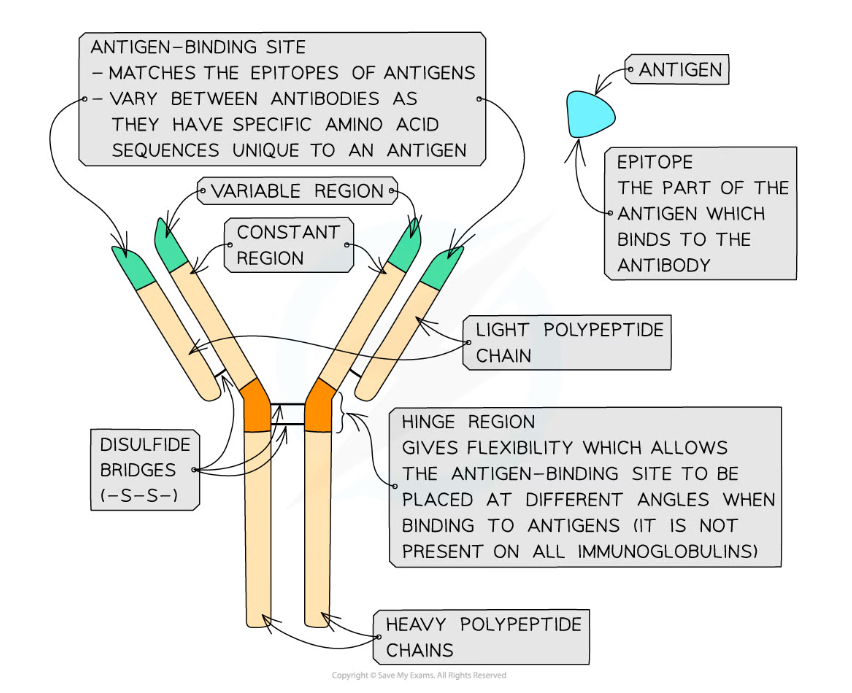
Antibodies are Y-shaped molecules consisting of four polypeptide chains. Note that the term epitope here refers to the part of the antigen that is recognised by the immune system; the variable regions of the antibody are complementary to the epitope of the antigen, allowing them to bind.
Antibody function
- Antibodies bind to specific antigens that trigger the specific immune response
- Antibodies function to disable pathogens in several ways
- Pathogens enter host cells by binding to them using receptors on their surface; antibodies can bind to these receptors, preventing pathogens from infecting host cells
- Antibodies can act as anti-toxins by binding to toxins produced by pathogens, e.g. the bacteria that cause diphtheria and tetanus; this neutralises the toxins
- Antibodies cause pathogens to clump together, a process known as agglutination; this reduces the chance that the pathogens will spread through the body and makes it possible for phagocytes to engulf a number of pathogens at one time
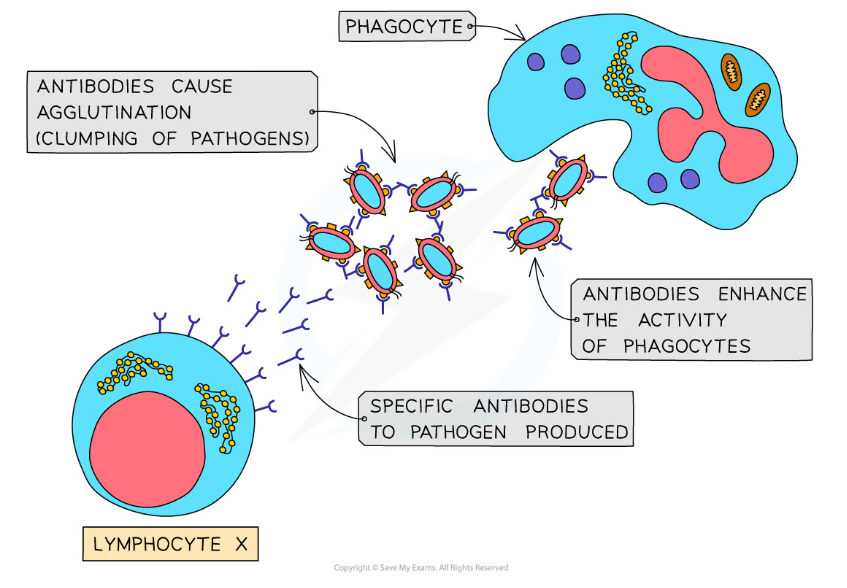
Antibodies cause agglutination, which makes it difficult for the pathogens to infect host cells. This also makes it easier for the phagocytes to engulf the trapped pathogens
转载自savemyexams
以上就是关于【Edexcel A (SNAB) A Level Biology:复习笔记6.2.4 Antigens & Antibodies】的解答,如需了解学校/赛事/课程动态,可至翰林教育官网获取更多信息。
往期文章阅读推荐:
翰林独家 | 经济学竞赛核心精讲,一册打通NEC/IEO/USAEBO!
2026 ALEVEL 夏考A率出炉!爱德思vs牛津AQA,哪些科目真的“好出分”?


翰林AMC8视频课重磅上线!

国际竞赛真题资源免费领取






