Edexcel A (SNAB) A Level Biology:复习笔记3.1.6 Magnification Calculations

Magnification & Measuring Size
- Magnification is how many times bigger the image of a specimen observed is in comparison to the actual, real-life size of the specimen
- A light microscope has two types of lens:
- An eyepiece lens, which often has a magnification of x10
- A series of (usually 3) objective lenses, each with a different magnification
- To calculate the total magnification, the magnification of the eyepiece lens and the objective lens are multiplied together:
total magnification = eyepiece lens magnification x objective lens magnification
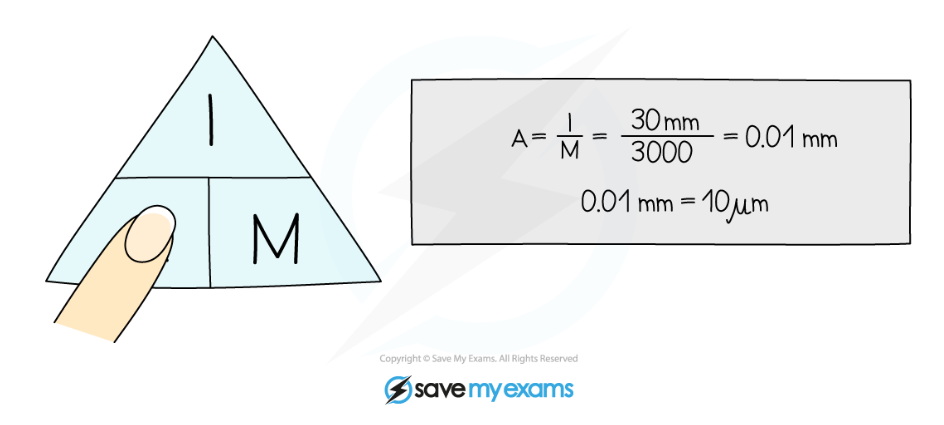
- The magnification (M) of an object can also be calculated if both the size of the image (I), and the actual size of the specimen (A), is known
magnification = image size ÷ actual size
-
- Remember to ensure that the image size (I) and the actual size (A) of the specimen have the same units before doing the calculation

The equation for calculating magnification can be rearranged to calculate either actual size, image size, or magnification.
Worked Example
An image of an animal cell is 30 mm in diameter and it has been magnified by a factor of x3000.
What is the actual diameter of the cell?
Using an eyepiece graticule & stage micrometer
- A graticule is a small disc that has an engraved ruler
- It can be placed into the eyepiece of a microscope to act as a ruler in the field of view, so is sometimes known as an eyepiece graticule
- As an eyepiece graticule has no fixed units it must be calibrated for the objective lens that is in use
- The graticule in the eyepiece remains the same size when the magnification of the microscope is altered, so recalibration is needed at each viewing magnification
- Calibration of the eyepiece graticule is done a microscope slide with an engraved scale known as a stage micrometer
- By using the eyepiece graticule and the stage micrometer together, the size of each graticule unit can be calculated
- After this is known the graticule can be used as a ruler to measure objects in the field of view
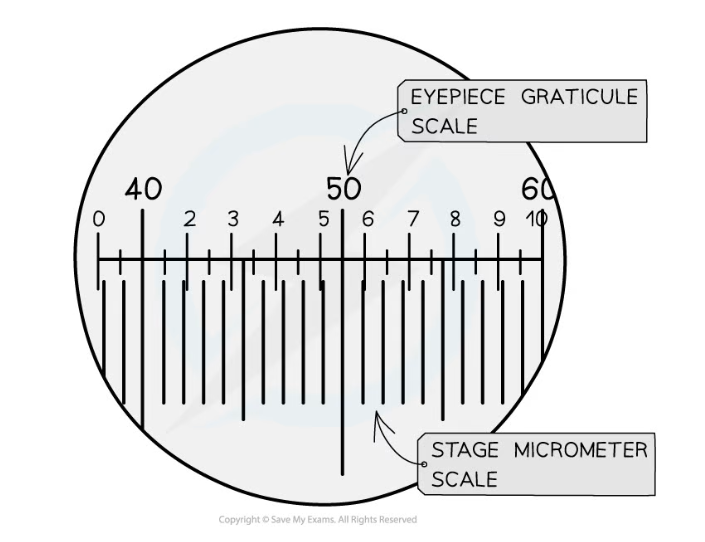
The stage micrometer scale is used to find out how many micrometers each graticule unit represents
Worked Example
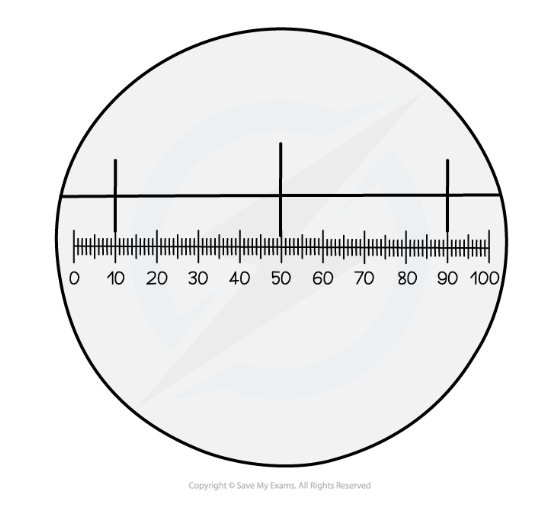
Calculate the size of the units of the eyepiece graticule in the image below.
Note that the large divisions in the top half of the image show the stage micrometer and that each stage micrometer division is 1 mm across.
Step 1: Observe the number of eyepiece unit divisions per micrometer unit
In the image, the stage micrometer has three lines
Each micrometer division has 40 eyepiece graticule divisions within it
Step 2: Calculate the size of each eyepiece graticule unit
40 graticule divisions = 1 mm (1000 µm)
1 graticule unit = 1000 ÷ 40 = 25 µm
- An object that spanned five eyepiece graticule units could therefore be measured as follows
5 x 25 µm = 125 µm
Exam Tip
The biggest pitfall with these kinds of calculations is forgetting to convert the units so that they match before embarking on a calculation. E.g. if image size is measured in mm but the actual size of an object is given in µm then both need to be converted into µm before using the equation triangle above.
To convert a measurement from mm into µm the measurement must be multiplied by 1000 (there are 1000 µm in 1 mm).
转载自savemyexams
以上就是关于【Edexcel A (SNAB) A Level Biology:复习笔记3.1.6 Magnification Calculations】的解答,如需了解学校/赛事/课程动态,可至翰林教育官网获取更多信息。
往期文章阅读推荐:
翰林独家 | 经济学竞赛核心精讲,一册打通NEC/IEO/USAEBO!
2026 ALEVEL 夏考A率出炉!爱德思vs牛津AQA,哪些科目真的“好出分”?


翰林AMC8视频课重磅上线!

国际竞赛真题资源免费领取






