Edexcel A Level Physics:复习笔记6.5 Elastic & Inelastic Collisions

Elastic & Inelastic Collisions
- In both collisions and explosions, momentum is always conserved
- However, kinetic energy might not always be
- A collision (or explosion) is either:
- Elastic – if the kinetic energy is conserved
- Inelastic – if the kinetic energy is not conserved
- Collisions happen when objects strike against each other
- Elastic collisions are commonly those where objects colliding do not stick together; instead, they strike each other then move away in opposite directions
- Inelastic collisions are commonly those where objects collide and stick together after the collision
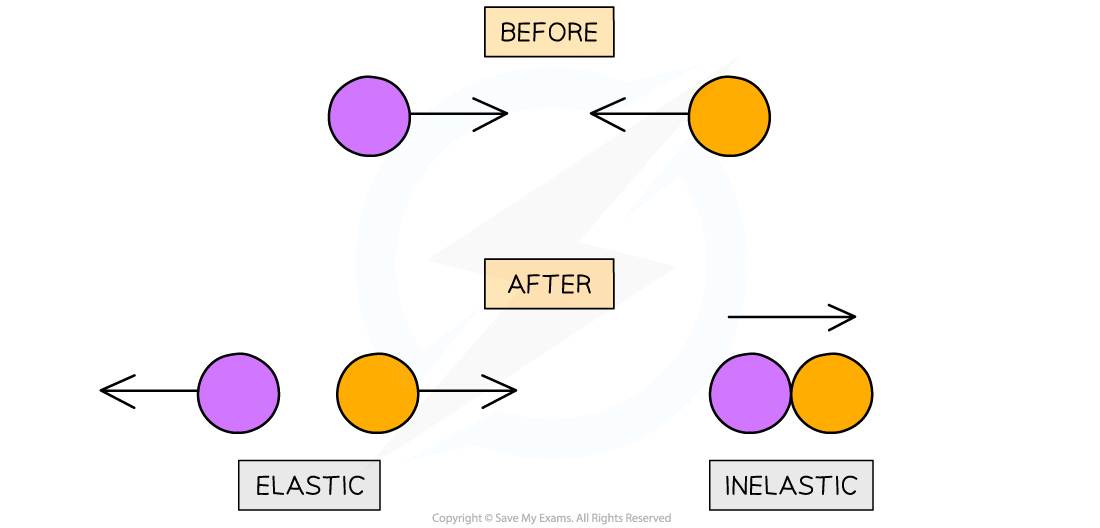
Elastic collisions are those following which objects move away in opposite directions. Inelastic collisions are where two objects stick together
- An explosion is commonly to do with recoil
- For example, a gun recoiling after shooting a bullet or an unstable nucleus emitting an alpha particle and a daughter nucleus
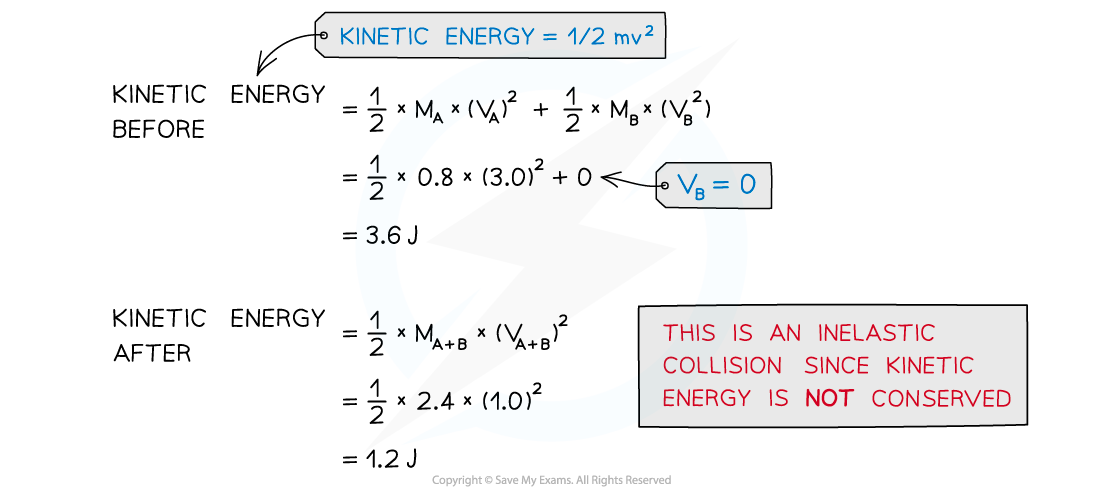
- To find out whether a collision is elastic or inelastic, compare the kinetic energy before and after the collision
- The equation for kinetic energy is:

Worked Example
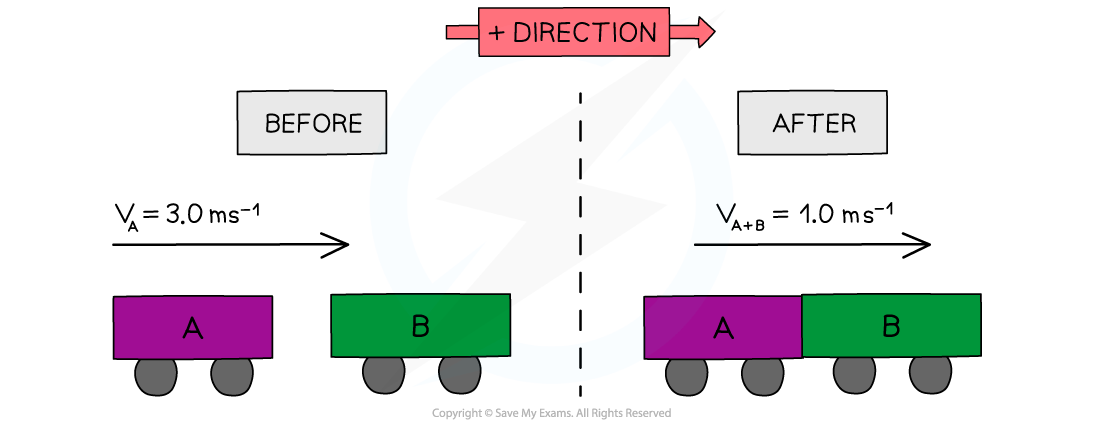
Trolley A of mass 0.80 kg collides head-on with stationary trolley B at speed 3.0 m s–1. Trolley B has twice the mass of trolley A.
The trolleys stick together and travel at a velocity of 1.0 m s–1. Determine whether this is an elastic or inelastic collision.
Worked Example
Discuss whether a head-on collision between two cars is likely to be an elastic or inelastic collision.
Step 1: Define an elastic and inelastic collision
-
- An elastic collision is one in which kinetic energy is conserved
- An inelastic collision is one in which kinetic energy is not conserved, but is transferred to other forms, e.g. heat and sound
Step 2: Describe the effects of head-on car collisions
-
- When cars collide, a large amount of kinetic energy is transferred due to work by internal forces
- This is mainly due to crumpling where the collision of the car causes plastic defamation of the car's bodywork
- Other energy transfers will include kinetic energy into heat and sound
Step 3: Link the effects to energy transfers
-
- Since the cars are brought to rest by the collision, the total KE before the collision does not equal the total KE after
- Therefore, the collision is inelastic
Exam Tip
If an object is stationary or at rest, its velocity equals 0, therefore, the momentum and kinetic energy are also equal to 0.
When a collision occurs in which two objects stick together, treat the final object as a single object with a mass equal to the sum of the two individual objects.
转载自savemyexams
以上就是关于【Edexcel A Level Physics:复习笔记6.5 Elastic & Inelastic Collisions】的解答,如需了解学校/赛事/课程动态,可至翰林教育官网获取更多信息。
往期文章阅读推荐:
翰林独家 | 经济学竞赛核心精讲,一册打通NEC/IEO/USAEBO!
2026 ALEVEL 夏考A率出炉!爱德思vs牛津AQA,哪些科目真的“好出分”?


翰林AMC8视频课重磅上线!

国际竞赛真题资源免费领取






