Edexcel A Level Economics A:复习笔记1.2.6 Price Determination

Price Determination & Equilibrium
Price Determination
- In a free market economy, prices are determined by the interaction of demand and supply in a market
- A market is any place that brings buyers and sellers together
- Markets can be physical (e.g. Waterstones) or virtual (e.g. eBay)
- Buyers and sellers meet to trade at an agreed price
- Buyers agree the price by purchasing the good/service
- If they do not agree on the price then they do not purchase the good/service and are exercising their consumer sovereignty
- Based on this interaction with buyers, sellers will gradually adjust their prices until there is an equilibrium price and quantity that works for both parties
- At the equilibrium price, sellers will be satisfied with the rate/quantity of sales
- At the equilibrium price, the utility/price combination is maximised for the buyers
Equilibrium
- Equilibrium in a market occurs when demand = supply
- At this point the price is called the market clearing price
- This is the price at which sellers are clearing their stock at an acceptable rate
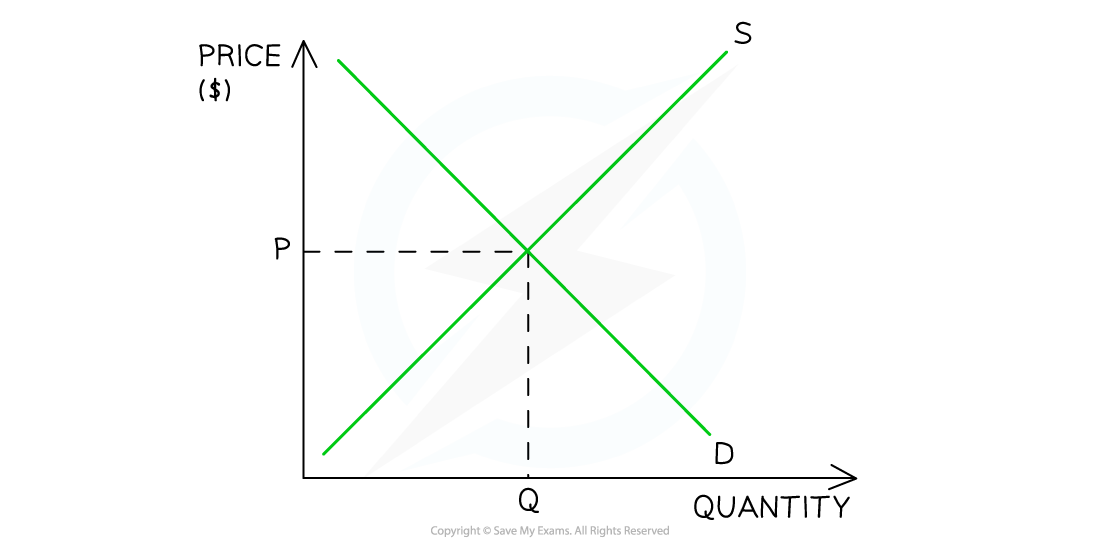
A graph showing a market in equilibrium with a market clearing price at P and quantity at Q
- Any price above or below P creates disequilibrium in this market
- Disequilibrium occurs whenever there is excess demand or supply in a market
Market Disequilibrium
Disequilibrium - Excess Demand
- Excess demand occurs when the demand is greater than the supply
- It can occur when prices are too low or when demand is so high that supply cannot keep up with it
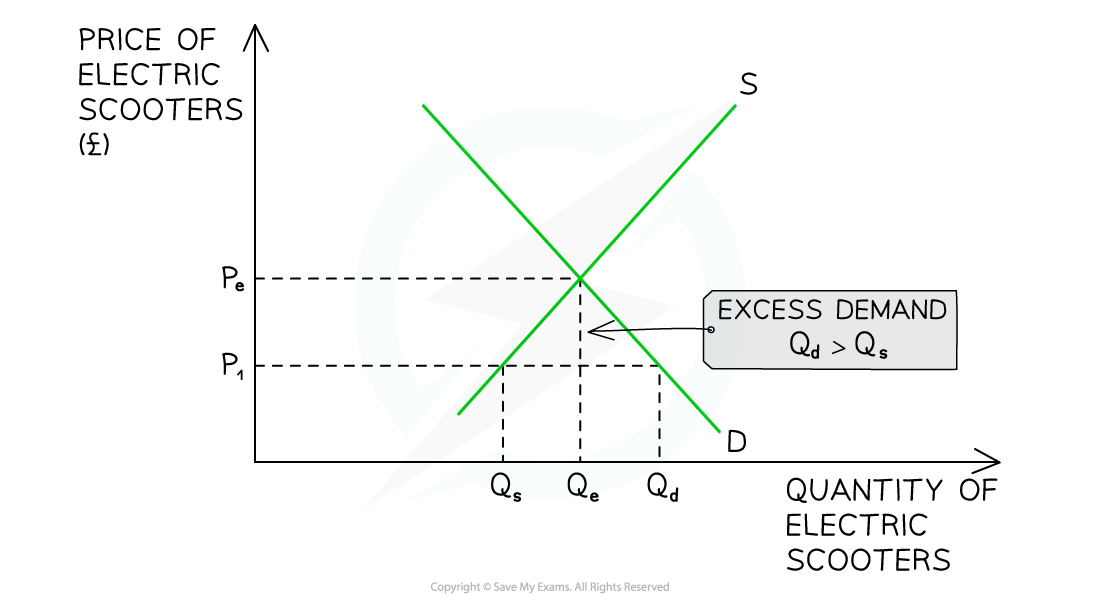
A graph that depicts the condition of excess demand in the market for electric scooters
Diagram Analysis
- At a price of P1, the quantity demanded of electric scooters (Qd) is greater than the quantity supplied (Qs)
- There is a shortage in the market equivalent to QsQd
Market response
- This market is in disequilibrium
- Sellers are frustrated that products are selling so quickly at a price that is obviously too low
- Some buyers are frustrated as they will not be able to purchase the product
- Sellers realise they can increase prices and generate more revenue and profits
- Sellers gradually raise prices
- This causes a contraction in QD as some buyers no longer desire the good/service at a higher price
- This causes an extension in QS as sellers are more incentivised to supply at higher prices
- In time, the market will have cleared the excess demand and arrive at a position of equilibrium (PeQe)
- Different markets take different lengths of time to resolve disequilibrium. For example, retail clothing can do so in a few days. Whereas the housing market may take several months
Disequilibrium - Excess Supply
- Excess supply occurs when the supply is greater than the demand
- It can occur when prices are too high or when demand falls unexpectedly
- During the later stages of the pandemic the market for face masks was in disequilibrium
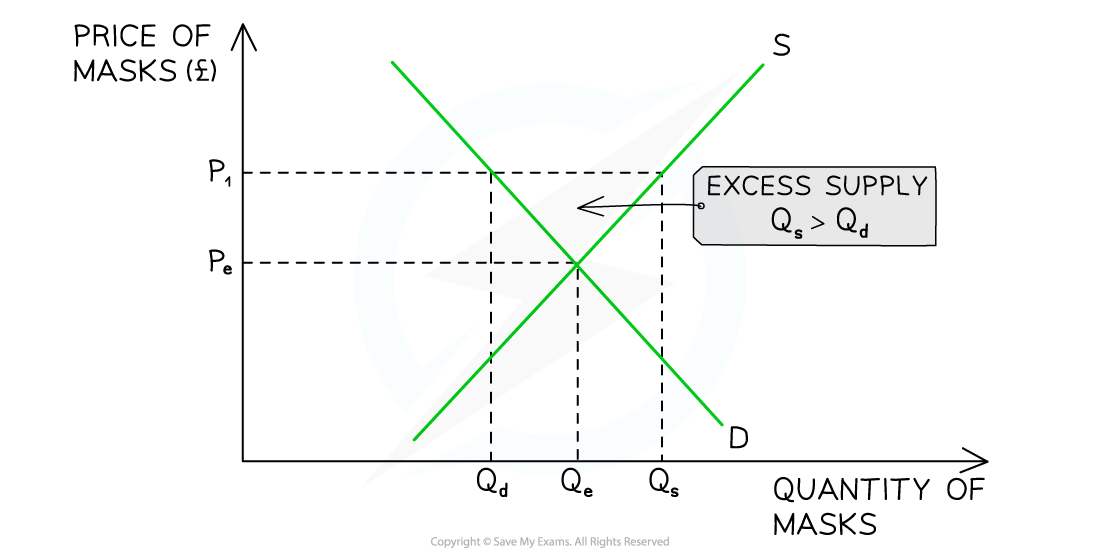
A graph that depicts the condition of excess supply in the market for Covid-19 face masks during the later stages of the pandemic
Diagram Analysis
- At a price of P1, the quantity supplied of face masks (Qs) is greater than the quantity demanded (Qd)
- There is a surplus in the market equivalent to QdQs
Market Response
- This market is in disequilibrium
- Sellers are frustrated that the masks are not selling and that the price is obviously too high
- Some buyers are frustrated as they want to purchase the masks but are not willing to pay the high price
- Sellers will gradually lower prices in order to generate more revenue
- This causes a contraction in QS as some sellers no longer desire to supply masks
- This causes an extension in QD as buyers are more willing to purchase masks at lower prices
- In time, the market will have cleared the excess supply and arrive at a position of equilibrium (PeQe)
Use of Diagrams to Show Market Changes
- Real world markets are constantly changing and are referred to as dynamic markets
- Market equilibrium can change every few minutes in some markets (e.g. stocks and shares), or every few weeks or months in others (e.g clothing)
- Any change to a condition of demand or supply will temporarily create disequilibrium and market forces will then seek to clear the excess demand or supply
Real World Example: Changes to Demand That Increase Price
- During lock downs associated with the Covid-19 pandemic, furniture retailers experienced unexpectedly high demand for their products (especially desks and sofas)
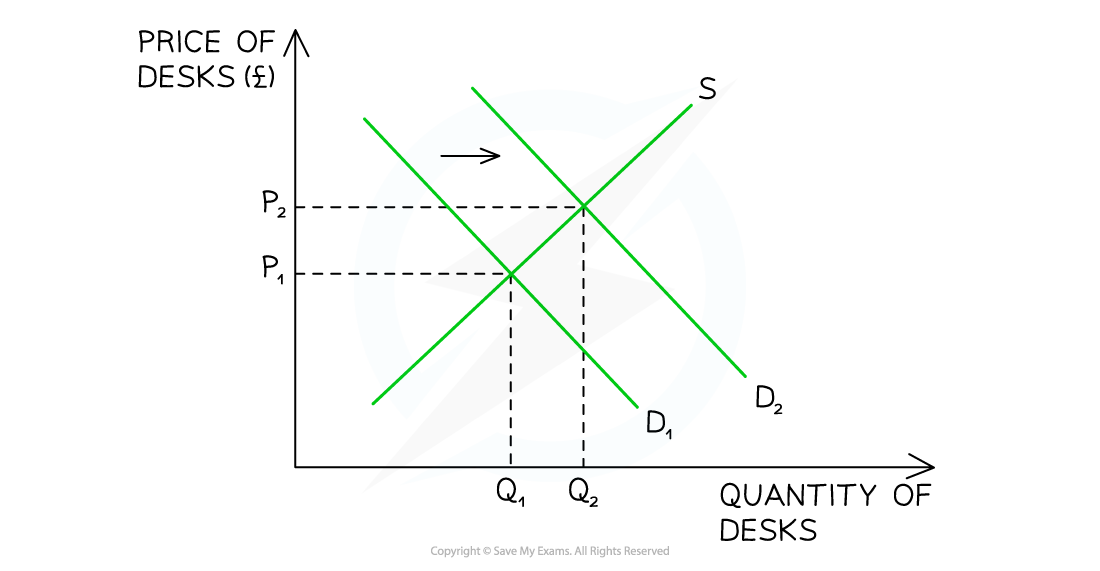
Diagram showing an increase in demand for desks due to a temporary change in tastes/fashions
Diagram Analysis
- Due to the Covid mandated change of working from home, consumers experienced a temporary change in taste as they sought to set up comfortable home offices
- This led to an increase in demand for desks from D1→D2
- At the original market clearing price of P1, a condition of excess demand now exists
- The demand for desks is greater than the supply
- In response, suppliers raise prices
- This causes a contraction of demand and an extension of supply leading to a new market equilibrium at P2Q2
- Both the equilibrium price (P2) and the equilibrium quantity (Q2) are higher than before
- The excess demand in the market has been cleared
Real World Example: Changes to Supply That Increase Price
- Ukraine is one of the world's largest producers of wheat. During the Russian-Ukrainian war, exports of wheat have been halted
- India imported 13% of the nation's wheat requirements from the Ukraine
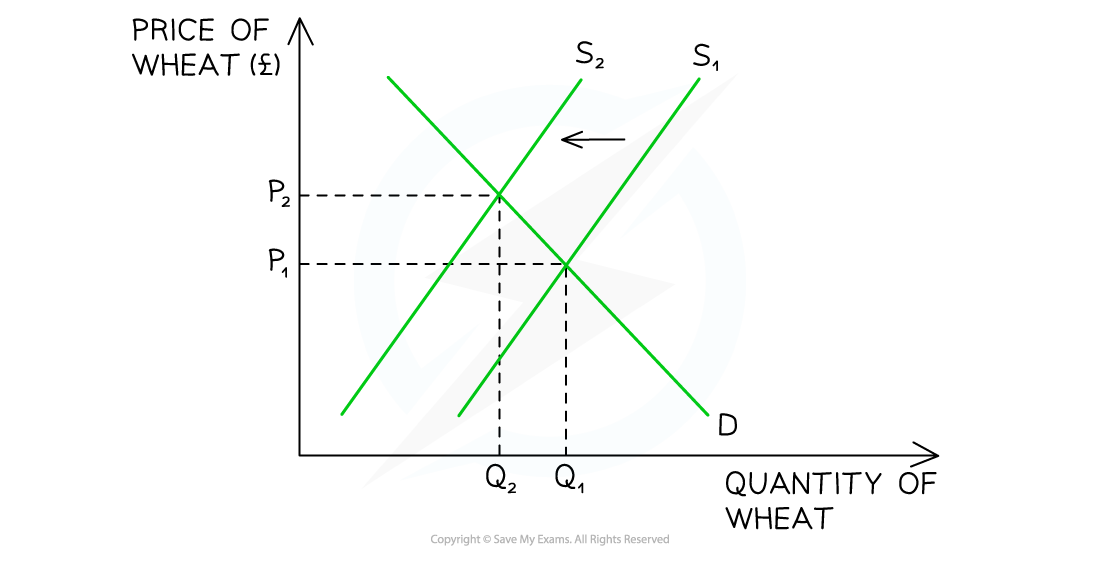
Diagram showing an decrease in supply of wheat in India due to a supply shock caused by the war in Ukraine
Diagram Analysis
- Due to the war in the Ukraine, India is experiencing a supply shock in its wheat market
- This causes a decrease in supply of S1→S2
- At the original market clearing price of P1, a condition of excess demand now exists (shortage)
- The demand for wheat is greater than the supply
- In response, sellers in India raise prices
- This causes a contraction of demand and an extension of supply leading to a new market equilibrium at P2Q2
- The equilibrium price (P2) is higher and the equilibrium quantity (Q2) is lower than before
- The excess demand in the market has been cleared
Real World Example: Changes to Demand That Decrease Price
- Demand for lobsters in Maine, USA has been falling steadily in recent months
- This has resulted in a price fall from $12.35 /pound on the 1st April to $9.35 /pound on the 1st May
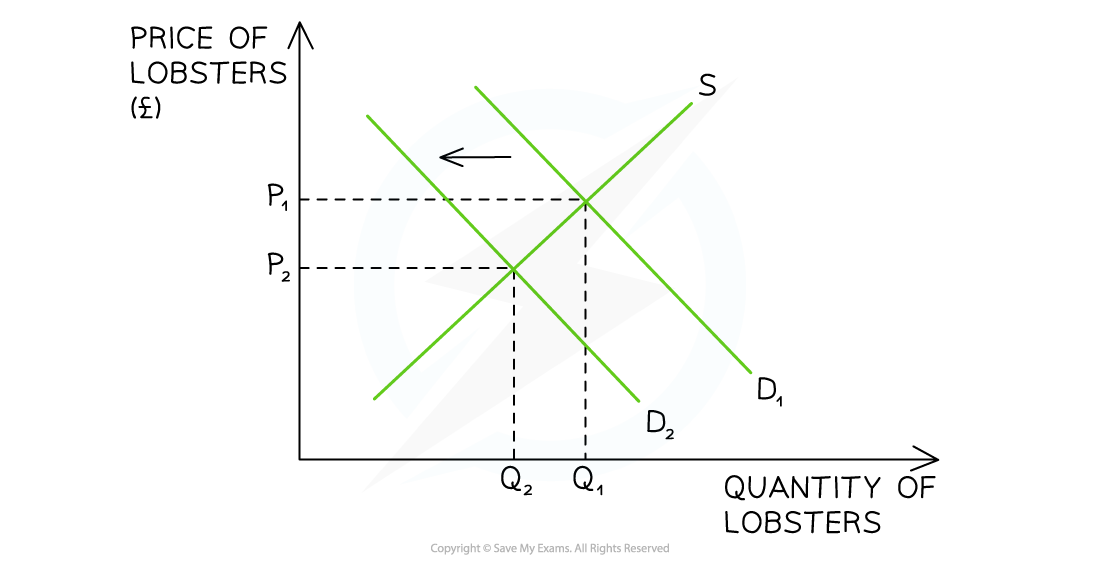
Diagram showing a decrease in demand for lobsters due to a decrease in real income
Diagram Analysis
- In recent months the USA has been experiencing an increasing rate of inflation
- Inflation lowers the purchasing power of money in a consumer's pocket and so effectively reduces their real income
- With reduced real income fewer luxuries are consumed
- This led to a decrease in demand for lobsters from D1→D2
- At the original market clearing price of P1, a condition of excess supply now exists
- The demand for lobsters is less than the supply
- In response, suppliers gradually reduce prices
- This causes a contraction of supply and an extension of demand leading to a new market equilibrium in P2Q2
- Both the equilibrium price (P2) and the equilibrium quantity (Q2) are lower than before
- The excess supply in the market has been cleared
Real World Example: Changes to Supply That Decrease Price
- In order to help meet their climate targets and to lower energy costs for households, the EU is providing subsidies for solar panels

Diagram showing an increase in supply of solar panels in the EU due to a per unit subsidy
Diagram Analysis
- To help meet its climate change targets and lower household energy bills the EU has provided a subsidy to solar panel retailers
- This causes an increase in supply of S1→S2
- At the original market clearing price of P1, a condition of excess supply now exists (surplus)
- The supply of solar panels is greater than the demand
- In response, sellers in the EU lower prices
- This causes an extension of demand and a contraction of supply leading to a new market equilibrium at P2Q2
- The equilibrium price (P2) is lower and the equilibrium quantity (Q2) is higher than before
- The excess supply in the market has been cleared
Exam Tip
MCQ, short answer and essay questions frequently require you to explain dynamic changes in markets. Explaining the steps in the change is often referred to as chains of analysis and students frequently leave out some steps in the chain.
Step 1: From the scenario, identify if the change in condition is on the demand side or supply side.
Step2: State which way the demand or supply curve moves and use notation e.g. S1→S2.
Step 3: State the disequilibrium that now exists at the original market price.
Step 4: State if sellers raise or lower prices to clear the disequilibrium.
Step 5: Explain the relevant contraction and extension that occurs on the demand and supply curves due to the change in price.
Step 6: State the new market equilibrium points e.g. P2Q2.
Step 7: Explain the market outcome (is the new price/quantity higher/lower than the original?)
转载自savemyexams
以上就是关于【Edexcel A Level Economics A:复习笔记1.2.6 Price Determination】的解答,如需了解学校/赛事/课程动态,可至翰林教育官网获取更多信息。
往期文章阅读推荐:
翰林独家 | 经济学竞赛核心精讲,一册打通NEC/IEO/USAEBO!
2026 ALEVEL 夏考A率出炉!爱德思vs牛津AQA,哪些科目真的“好出分”?


翰林AMC8视频课重磅上线!

国际竞赛真题资源免费领取






