CIE A Level Physics复习笔记24.1.4 Intensity Reflection Coefficient

Intensity Reflection Coefficient
- The intensity reflection coefficient α is defined as:
The ratio of the intensity of the reflected wave relative to the incident (transmitted) wave
- This can be calculated using the fraction:

- Where:
- α = intensity reflection coefficient
- IR = intensity of the reflected wave (W m-2)
- I0 = intensity of the incident wave (W m-2)
- Z1 = acoustic impedance of one material (kg m-2 s-1)
- Z2 = acoustic impedance of a second material (kg m-2 s-1)
- This equation will be provided on the datasheet for your exam
- This ratio shows:
- If there is a large difference between the impedance of the two materials, then most of the energy will be reflected
- If the impedance is the same, then there will be no reflection
Coupling Medium
- When ultrasound is used in medical imaging, a coupler is needed between the transducer and the body
- The soft tissues of the body are much denser than air
- If air is present between the transducer and the body, then almost all the ultrasound energy will be reflected
- The coupling gel is placed between the transducer and the body, as skin and the coupling gel have a similar density, so little ultrasound is reflected
- This is an example of impedance matching
Worked Example
A beam of ultrasound is incident at right-angles to a boundary between two materials as shown in the diagram.
The materials have acoustic impedances of Z1 and Z2. The intensity of the transmitted ultrasound beam is IT, and the reflected intensity is IR.
a) What is the relationship between I, IT and IR?
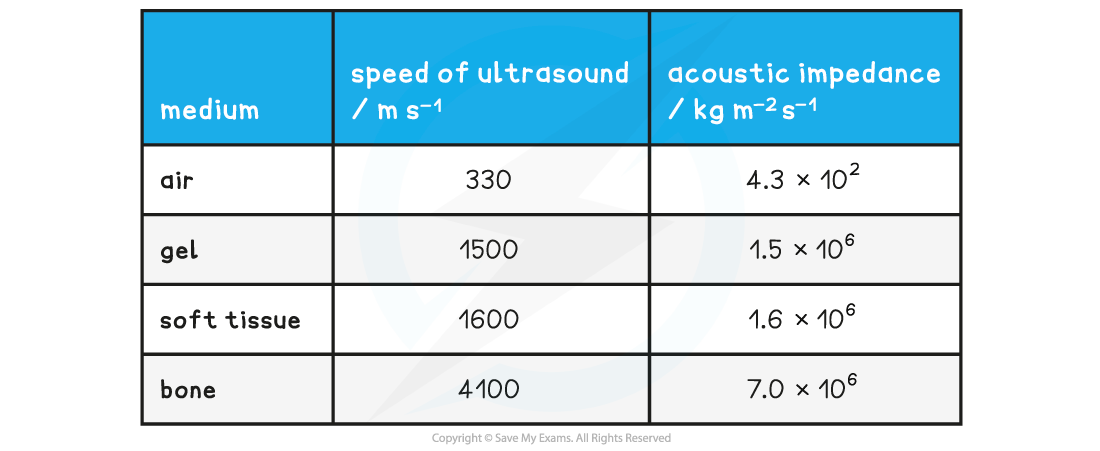
b) Use the data from the table to determine the reflection coefficient α for a boundary between
(i) gel and soft tissue
(ii) air and soft tissue
c) Explain why gel is usually put on the skin during medical diagnosis using ultrasound.
Part (a)
Incident intensity = Transmitted intensity + Reflected intensity
I = IT + IR
Part (b)(i)
Step 1: Write down the equation for intensity reflection coefficient α

Step 2: Write down the acoustic impedances for gel and soft tissue
Gel, Z1 = 1.5 × 10⁶ kg m-2 s-1
Soft tissue, Z2 = 1.6 × 10⁶ kg m-2 s-1
Step 3: Calculate the intensity reflection coefficient

This result means that only 0.1% of the incident intensity will be reflected, with the remaining being transmitted
Part (b)(ii)
Step 1: Write down the acoustic impedances for air and soft tissue
Air, Z1 = 4.3 × 10² kg m-2 s-1
Soft tissue, Z2 = 1.6 × 10⁶ kg m-2 s-1
Step 2: Calculate the intensity reflection coefficient

This result means that 100% of the incident intensity will be reflected, with none being transmitted
Part (c)
-
- At the air-soft tissue boundary, the intensity reflection coefficient is α ≈ 1
- Therefore, without gel, there is almost complete reflection - no ultrasound is transmitted through the skin
- At the gel-soft tissue boundary, the intensity reflection coefficient is α = 0.001
- Therefore, the gel enables almost complete transmission of the ultrasound through the skin, with very little reflection
- At the air-soft tissue boundary, the intensity reflection coefficient is α ≈ 1
转载自savemyexams
以上就是关于【CIE A Level Physics复习笔记24.1.4 Intensity Reflection Coefficient】的解答,如需了解学校/赛事/课程动态,可至翰林教育官网获取更多信息。
往期文章阅读推荐:
翰林独家 | 经济学竞赛核心精讲,一册打通NEC/IEO/USAEBO!
2026 ALEVEL 夏考A率出炉!爱德思vs牛津AQA,哪些科目真的“好出分”?


翰林AMC8视频课重磅上线!

国际竞赛真题资源免费领取






