CIE A Level Physics复习笔记17.1.6 Energy in SHM

Kinetic & Potential Energies
- During simple harmonic motion, energy is constantly exchanged between two forms: kinetic and potential
- The potential energy could be in the form of:
- Gravitational potential energy (for a pendulum)
- Elastic potential energy (for a horizontal mass on a spring)
- Or both (for a vertical mass on a spring)
- Speed, v, is at a maximum when displacement, x, = 0, so:
The system has maximum kinetic energy when the displacement is zero because the oscillator is at its equilibrium position and so moving at maximum velocity.
- Therefore, the kinetic energy is zero at maximum displacement x = x0, so:
 A simple harmonic system is therefore constantly converting between kinetic and potential energy
- When one increases, the other decreases and vice versa, therefore:
The total energy of a simple harmonic system always remains constant and is equal to the sum of the kinetic and potential energies

The kinetic and potential energy of an oscillator in SHM vary periodically
- The key features of the energy-time graph are:
- Both the kinetic and potential energies are represented by periodic functions (sine or cosine) which are varying in opposite directions to one another
- When the potential energy is 0, the kinetic energy is at its maximum point and vice versa
- The total energy is represented by a horizontal straight line directly above the curves at the maximum value of both the kinetic or potential energy
- Energy is always positive so there are no negative values on the y axis
- Recall that the kinetic energy is defined by the equation

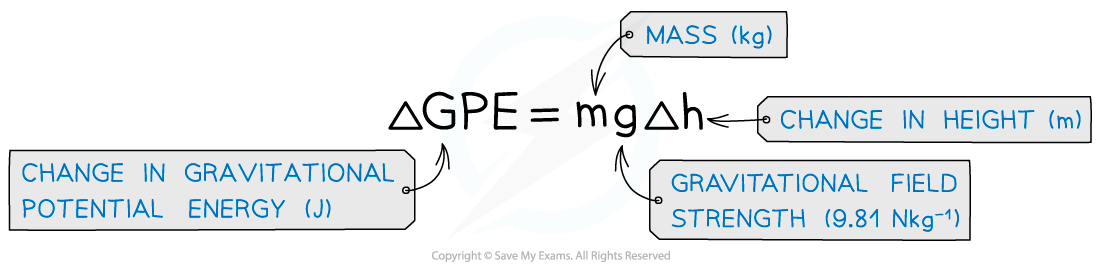
- Gravitational potential energy is defined by the equation
- Note: kinetic and potential energy go through two complete cycles during one period of oscillation
- This is because one complete oscillation reaches the maximum displacement twice (positive and negative)
- The energy-displacement graph for half a cycle looks like:
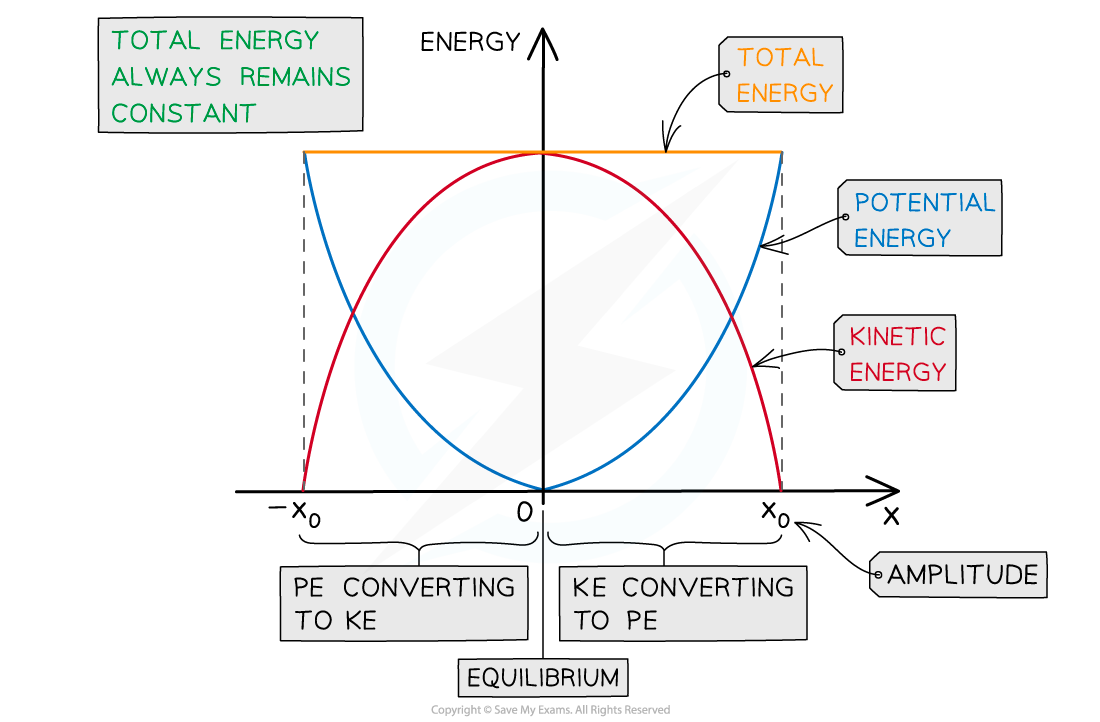
Potential and kinetic energy v displacement in half a period of an SHM oscillation
- The key features of the energy-displacement graph:
- Displacement is a vector, so, the graph has both positive and negative x values
- The potential energy is always at a maximum at the amplitude positions x0 and 0 at the equilibrium position (x = 0)
- This is represented by a ‘U’ shaped curve
- The kinetic energy is the opposite: it is 0 at the amplitude positions x0 and maximum at the equilibrium position x = 0
- This is represented by a ‘n’ shaped curve
- The total energy is represented by a horizontal straight line above the curves
Exam Tip
You may be expected to draw as well as interpret energy graphs against time or displacement in exam questions. Make sure the sketches of the curves are as even as possible and use a ruler to draw straight lines, for example, to represent the total energy.
Calculating Total Energy of a Simple Harmonic System
The total energy of system undergoing simple harmonic motion is defined by:
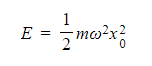
- Where:
- E = total energy of a simple harmonic system (J)
- m = mass of the oscillator (kg)
- ⍵ = angular frequency (rad s-1)
- x0 = amplitude (m)
Worked Example
A ball of mass 23 g is held between two fixed points A and B by two stretch helical springs, as shown in the figure below
The ball oscillates along the line AB with simple harmonic motion of frequency 4.8 Hz and amplitude 1.5 cm.Calculate the total energy of the oscillations.
Step 1: Write down all known quantities
Mass, m = 23 g = 23 × 10–3 kg
Amplitude, x0 = 1.5 cm = 0.015 m
Frequency, f = 4.8 Hz
Step 2: Write down the equation for the total energy of SHM oscillations: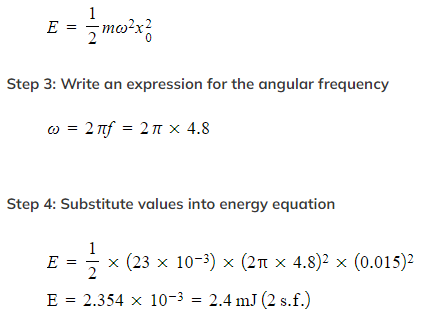
转载自savemyexams
以上就是关于【CIE A Level Physics复习笔记17.1.6 Energy in SHM】的解答,如需了解学校/赛事/课程动态,可至翰林教育官网获取更多信息。
往期文章阅读推荐:
翰林独家 | 经济学竞赛核心精讲,一册打通NEC/IEO/USAEBO!
2026 ALEVEL 夏考A率出炉!爱德思vs牛津AQA,哪些科目真的“好出分”?


翰林AMC8视频课重磅上线!

国际竞赛真题资源免费领取






