CIE A Level Chemistry复习笔记5.5.4 Buffers

Buffers
- A buffer solution is a solution in which the pH does not change a lot when small amounts of acids or alkalis are added
- A buffer solution is used to keep the pH almost constant
- A buffer can consists of weak acid - conjugate base or weak base - conjugate acid
Ethanoic acid & sodium ethanoate as a buffer
- A common buffer solution is an aqueous mixture of ethanoic acid and sodium ethanoate
- Ethanoic acid is a weak acid and partially ionises in solution to form a relatively low concentration of ethanoate ions

- Sodium ethanoate is a salt which fully ionises in solution

- There are reserve supplies of the acid (CH3COOH) and its conjugate base (CH3COO-)
- The buffer solution contains relatively high concentrations of CH3COOH (due to ionisation of ethanoic acid) and CH3COO- (due to ionisation of sodium ethanoate)
- In the buffer solution, the ethanoic acid is in equilibrium with hydrogen and ethanoate ions

- When H+ ions are added:
- The equilibrium position shifts to the left as H+ ions react with CH3COO- ions to form more CH3COOH until equilibrium is re-established
- As there is a large reserve supply of CH3COO- the concentration of CH3COO- in solution doesn’t change much as it reacts with the added H+ ions
- As there is a large reserve supply of CH3COOH the concentration of CH3COOH in solution doesn’t change much as CH3COOH is formed from the reaction of CH3COO- with H+
- As a result, the pH remains reasonable constant

When hydrogen ions are added to the solution the pH of the solution would decrease; However, the ethanoate ions in the buffer solution react with the hydrogen ions to prevent this and keep the pH constant
- When OH- ions are added:
- The OH- reacts with H+ to form water
OH- (aq) + H+ (aq) → H2O (l)
- The H+ concentration decreases
- The equilibrium position shifts to the right and more CH3COOH molecules ionise to form more H+ and CH3COO- until equilibrium is re-established
CH3COOH (aq) → H+ (aq) + CH3COO- (aq)
- As there is a large reserve supply of CH3COOH the concentration of CH3COOH in solution doesn’t change much when CH3COOH dissociates to form more H+ ions
- As there is a large reserve supply of CH3COO- the concentration of CH3COO- in solution doesn’t change much
- As a result, the pH remains reasonable constant
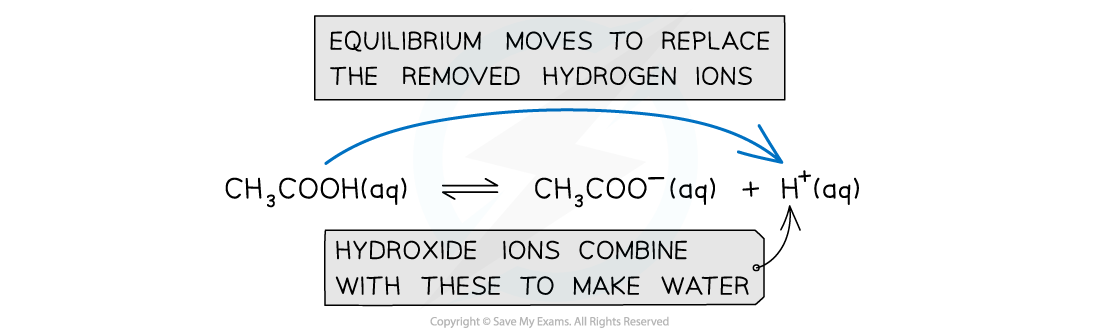
When hydroxide ions are added to the solution, the hydrogen ions react with them to form water; The decrease in hydrogen ions would mean that the pH would increase however the equilibrium moves to the right to replace the removed hydrogen ions and keep the pH constant
Uses of buffer solutions in controlling the pH of blood
- In humans, HCO3- ions act as a buffer to keep the blood pH between 7.35 and 7.45
- Body cells produce CO2 during aerobic respiration
- This CO2 will combine with water in blood to form a solution containing H+ ions
CO2 (g) + H2O (l) ⇌ H+ (aq) + HCO3- (aq)
- This equilibrium between CO2 and HCO3- is extremely important
- If the concentration of H+ ions is not regulated, the blood pH would drop and cause ‘acidosis’
- Acidosis refers to a condition in which there is too much acid in the body fluids such as blood
- This could cause body malfunctioning and eventually lead to coma
- If there is an increase in H+ ions
- The equilibrium position shifts to the left until equilibrium is restored
H+ (aq) + HCO3- (aq) → CO2 (g) + H2O (l)
- This reduces the concentration of H+ and keeps the pH of the blood constant
- If there is a decrease in H+ ions
- The equilibrium position shifts to the right until equilibrium is restored
CO2 (g) + H2O (l) → H+ (aq) + HCO3- (aq)
- This increases the concentration of H+ and keeps the pH of the blood constant
Exam Tip
Remember that buffer solutions cannot cope with excessive addition of acids or alkalis as their pH will change significantly.The pH will only remain relatively constant if small amounts of acids or alkalis are added.
转载自savemyexams
以上就是关于【CIE A Level Chemistry复习笔记5.5.4 Buffers】的解答,如需了解学校/赛事/课程动态,可至翰林教育官网获取更多信息。
往期文章阅读推荐:
翰林独家 | 经济学竞赛核心精讲,一册打通NEC/IEO/USAEBO!
2026 ALEVEL 夏考A率出炉!爱德思vs牛津AQA,哪些科目真的“好出分”?


翰林AMC8视频课重磅上线!

国际竞赛真题资源免费领取






