CIE A Level Chemistry复习笔记1.2.4 Balancing Equations

Balancing Equations
- A symbol equation is a shorthand way of describing a chemical reaction using chemical symbols to show the number and type of each atom in the reactants and products
- A word equation is a longer way of describing a chemical reaction using only words to show the reactants and products
Balancing equations
- During chemical reactions, atoms cannot be created or destroyed
- The number of each atom on each side of the reaction must therefore be the same
- E.g. the reaction needs to be balanced
- When balancing equations remember:
- Not to change any of the formulae
- To put the numbers used to balance the equation in front of the formulae
- To balance firstly the carbon, then the hydrogen and finally the oxygen in combustion reactions of organic compounds
- When balancing equations follow the following the steps:
- Write the formulae of the reactants and products
- Count the numbers of atoms in each reactant and product
- Balance the atoms one at a time until all the atoms are balanced
- Use appropriate state symbols in the equation
- The physical state of reactants and products in a chemical reaction is specified by using state symbols
- (s) solid
- (l) liquid
- (g) gas
- (aq) aqueous
Ionic equations
- In aqueous solutions ionic compounds dissociate into their ions
- Many chemical reactions in aqueous solutions involve ionic compounds, however only some of the ions in solution take part in the reactions
- The ions that do not take part in the reaction are called spectator ions
- An ionic equation shows only the ions or other particles taking part in a reaction, without showing the spectator ions
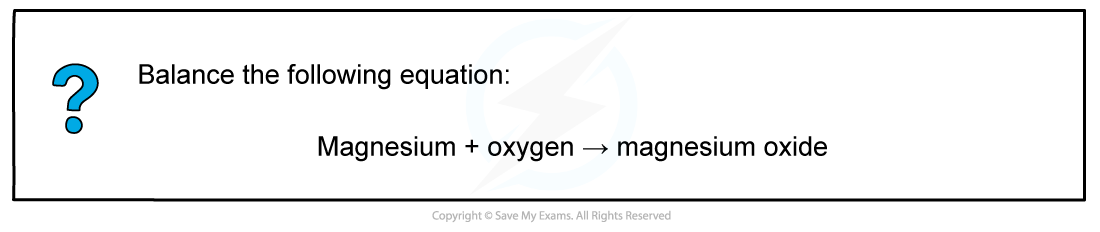
Answer:
Step 1: Write out the symbol equation showing reactants and products
Mg + O2 → MgO
Step 2: Count the numbers of atoms in each reactant and product

Step 3: Balance the atoms one at a time until all the atoms are balanced
2Mg + O2 → 2MgO
This is now showing that 2 moles of magnesium react with 1 mole of oxygen to form 2 moles of magnesium oxide
Step 4: Use appropriate state symbols in the fully balanced equation
2Mg(s) + O2(g) → 2MgO(s)
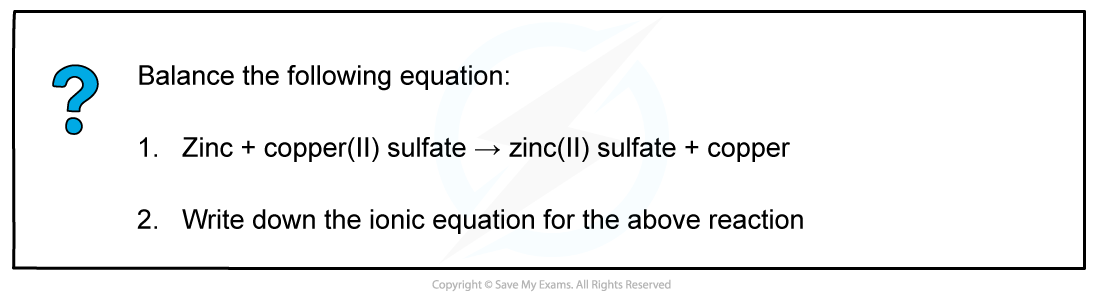
Answer 1:
Step 1: To balance the equation, write out the symbol equation showing reactants and products
Zn + CuSO4 → ZnSO4 + Cu
Step 2: Count the numbers of atoms in each reactant and product. The equation is already balanced
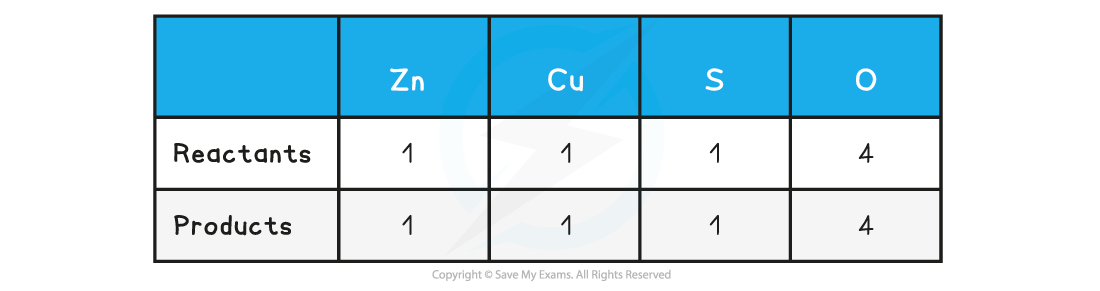
Step 3: Use appropriate state symbols in the equation
Zn (s) + CuSO4 (aq) → ZnSO4 (aq) + Cu (s)
Answer 2:
Step 1: The full chemical equation for the reaction is
Zn (s) + CuSO4 (aq) → ZnSO4 (aq) + Cu (s)
Step 2: Break down reactants into their respective ions
Zn (s) + Cu2+ SO42- (aq) → Zn2+SO42- (aq) + Cu (s)
Step 3: Cancel the spectator ions on both sides to give the ionic equation
Zn (s) + Cu2+SO42- (aq) → Zn2+SO42- (aq) + Cu (s)
Zn (s) + Cu2+(aq) → Zn2+(aq) + Cu (s)
转载自savemyexams
以上就是关于【CIE A Level Chemistry复习笔记1.2.4 Balancing Equations】的解答,如需了解学校/赛事/课程动态,可至翰林教育官网获取更多信息。
往期文章阅读推荐:
翰林独家 | 经济学竞赛核心精讲,一册打通NEC/IEO/USAEBO!
2026 ALEVEL 夏考A率出炉!爱德思vs牛津AQA,哪些科目真的“好出分”?


翰林AMC8视频课重磅上线!

国际竞赛真题资源免费领取






