CIE A Level Biology复习笔记18.2.6 Spearman's Rank Correlation

Spearman's Rank Correlation
- If there is an apparent relationship between two variables but the data does not show a normal distribution, Pearson’s linear correlation coefficient should not be used
- Spearman’s rank correlation determines whether there is correlation between variables that don’t show a normal distribution
- Method:
- Step 1: Create a scatter graph and identify possible linear correlation
- Step 2: State a null hypothesis
- Step 3: Use the following equation to work out Spearman’s rank correlation coefficient r

-
-
- Where:
- rs = spearman’s rank coefficient
- D = difference in rank
- n = number of samples
- Where:
- Step 4: Refer to a table that relates critical values of rs to levels of probability
-
- If the value calculated for Spearman’s rank is greater than the critical value for the number of samples in the data ( n ) at the 0.05 probability level (p), then the null hypothesis can be rejected, meaning there is a correlation between two variables
Worked Example
A student conducted an experiment using quadrats to measure the abundance of different plant species in a neglected allotment. They wanted to see if there was correlation between the abundance of species C and D. When they looked at their data and plotted a scatter graph they saw some correlation.Investigate the possible correlation using Spearman’s rank correlation coefficient.
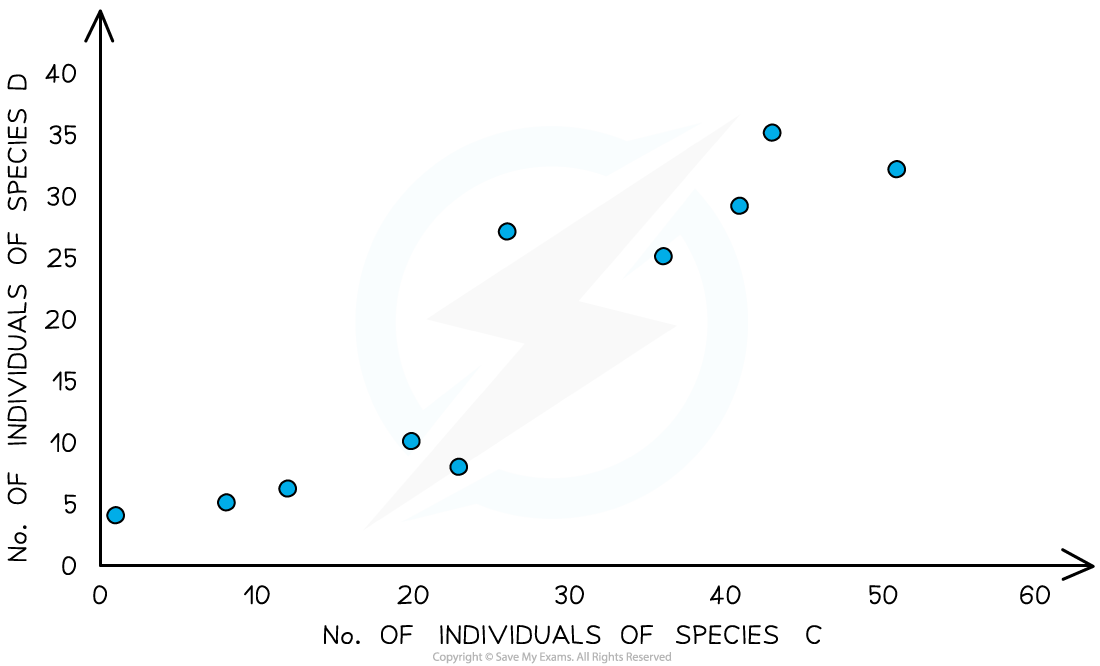
Scatter graph showing the correlation between the abundance of species C and species D
As the data was not normally distributed they decided to use Spearman’s rank correlation coefficient.
Null hypothesis: there is no correlation between the abundance of species A and species B.
-
- n = 10 as there are 10 quadrat samples
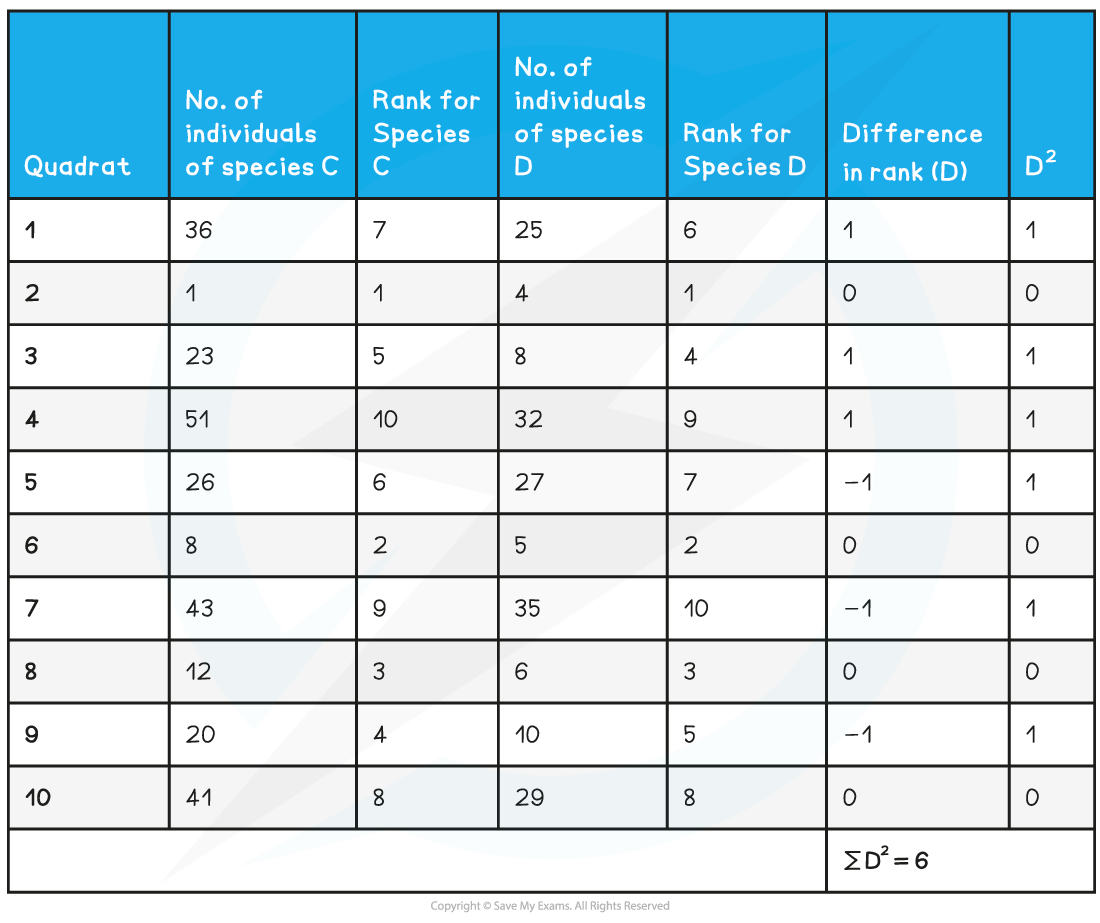
Step 1: Rank each set of data (rank 1 being the smallest data figure)
Step 2: Find the difference in rank between the two species, D
Step 3: Square the difference in rank, D2 (= 6)
Step 4: Substitute the appropriate numbers into the equation (remember n = 10)
Step 5: Refer to a table that relates values of rs to probability. Look for the 0.05 probability level with n = 10

-
- As Rs = 0.964, it is greater than the critical value of 0.65. The null hypothesis can be rejected, there is genuine positive correlation between the abundance of species A and B
Exam Tip
You will be provided with the formula for Spearman’s rank correlation in the exam. You need to be able to carry out the calculation to test for correlation, as you could be asked to do this in the exam. You should understand when it is appropriate to use the different statistical tests that crop up in this topic, and the conditions in which each is valid.Correlation does not always mean causation. Just because there is a correlation between the abundance of species A and species B it does not mean that the presence of species A causes the presence of species B.
转载自savemyexams
以上就是关于【CIE A Level Biology复习笔记18.2.6 Spearman's Rank Correlation】的解答,如需了解学校/赛事/课程动态,可至翰林教育官网获取更多信息。
往期文章阅读推荐:
翰林独家 | 经济学竞赛核心精讲,一册打通NEC/IEO/USAEBO!
2026 ALEVEL 夏考A率出炉!爱德思vs牛津AQA,哪些科目真的“好出分”?


翰林AMC8视频课重磅上线!

国际竞赛真题资源免费领取






