CIE A Level Biology复习笔记18.2.5 Pearson's Linear Correlation

Pearson's Linear Correlation
- When recording the abundance and distribution of species in an area different trends may be observed
- Sometimes correlation between two variables can appear in the data
- Correlation is an association or relationship between variables
- There is a clear distinction between correlation and causation: a correlation does not necessarily imply a causative relationship
- Causation occurs when one variable has an influence or is influenced by, another
- There may be a correlation between species; for example, two species always occurring together
- There may be a correlation between a species and an abiotic factor, for example, a particular plant species and the soil pH
- The apparent correlation between variables can be analysed using scatter graphs and different statistical tests
Correlation between variables
- In order to get a broad overview of the correlation between two variables the data points for both variables can be plotted on a scatter graph
- The correlation coefficient (r) indicates the strength of the relationship between variables
- Perfect correlation occurs when all of the data points lie on a straight line with a correlation coefficient of 1 or -1
- Correlation can be positive or negative
- Positive correlation: as variable A increases, variable B increases
- Negative correlation: as variable A increases, variable B decreases
- If there is no correlation between variables the correlation coefficient will be 0
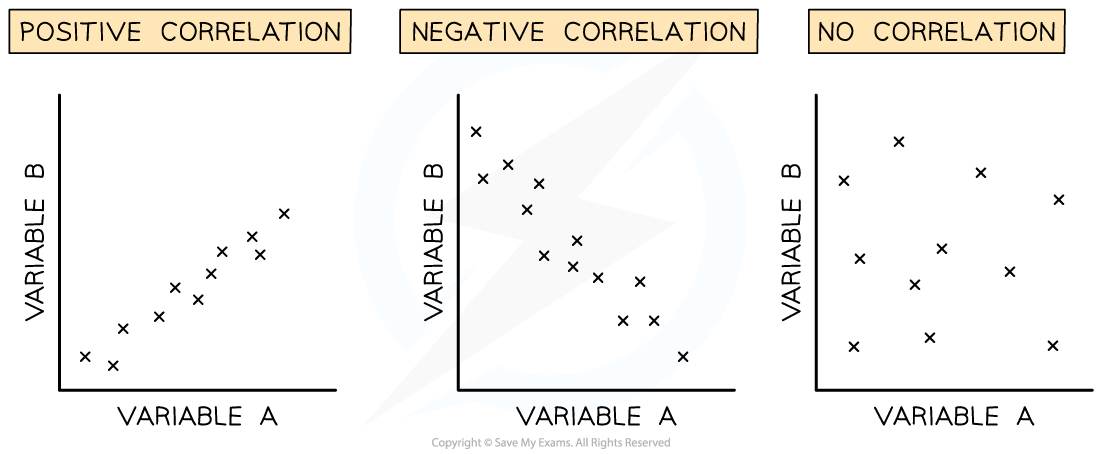
Different types of correlation in scatter graphs
- The correlation coefficient (r) can be calculated to determine whether a linear relationship exists between variables and how strong that relationship is
Pearson linear correlation
- Pearson's linear correlation is a statistical test that determines whether there is linear correlation between two variables
- The data must:
- Be quantitative
- Show normal distribution
- Method:
-
- Step 1: Create a scatter graph of data gathered and identify if a linear correlation exists
- Step 2: State a null hypothesis
- Step 3: Use the following equation to work out Pearson’s correlation coefficient r
-

-
- Where:
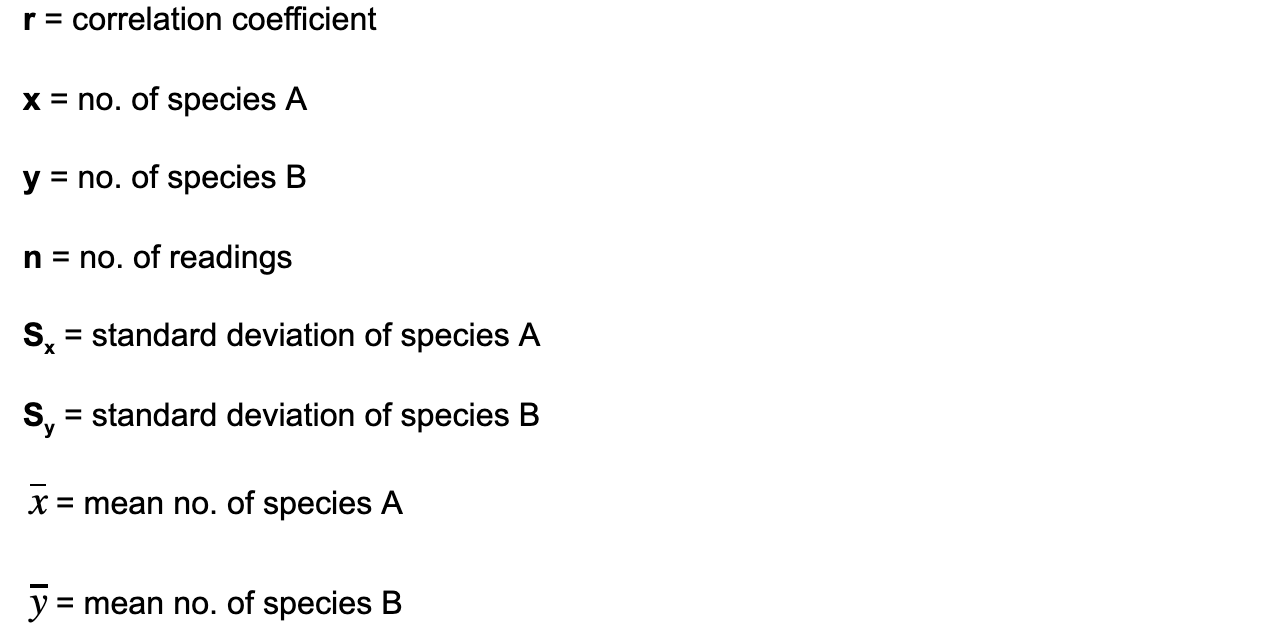
- If the correlation coefficient r is close to 1 or -1 then it can be stated that there is a strong linear correlation between the two variables and the null hypothesis can be rejected
Worked Example
A student used quadrats to measure the abundance of different plant species in their garden. They noticed that two particular species seemed to occur alongside each other. They plotted a scatter graph and the data they collected had no major outliers and showed roughly normal distribution.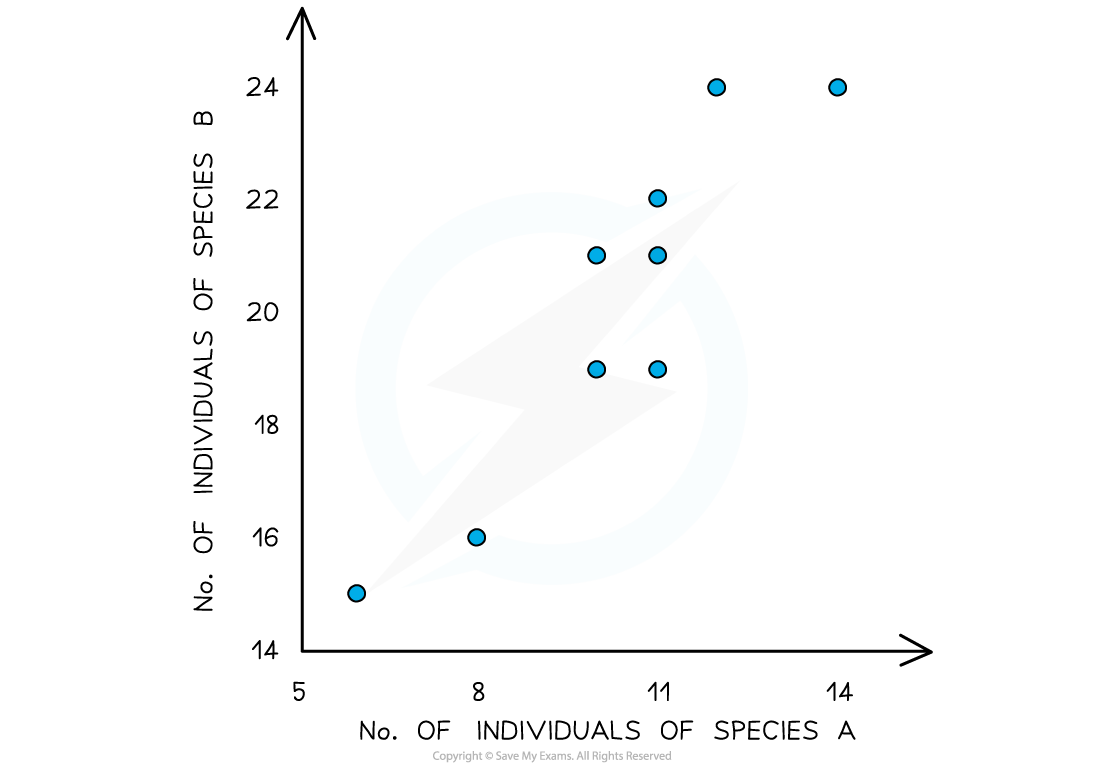
Scatter graph showing the linear correlation between the abundance of species A and B. It shows linear correlation and so is suitable for analysis by Pearson’s correlation coefficient.
Investigate the possible correlation using Pearson’s linear correlation coefficient.
Null hypothesis: There is no correlation between the abundance of species A and species B.
Steps to calculate the correlation coefficient:
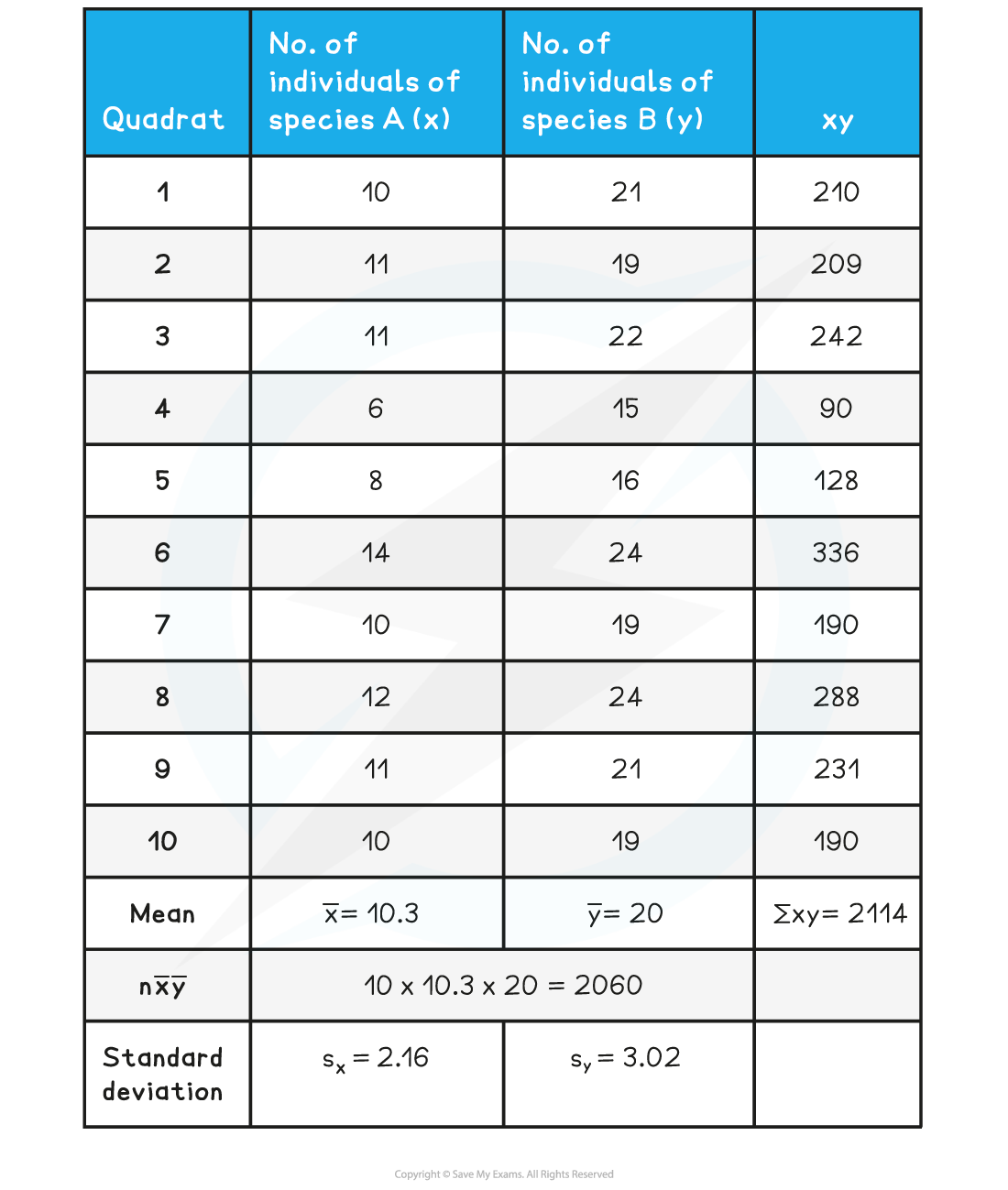
Step 1: Calculate xy
Step 2: Calculate x̅ and y̅ (means of x and y)
Step 3: Calculate nx̅y̅
Step 4: Find ∑xy
Step 5: Calculate standard deviation for each set of data Sx and Sy
Step 6: Substitute the appropriate numbers into the equation
-
- n = 10 as there are 10 quadrat samples.
- The sum of x x y (∑xy) = 2114
- n x mean of x x mean of y = nx̅y̅ = 2060
- Sx = 2.16 and Sy = 3.02
- Substitute values into the equation above:

-
- As the value of r lies close to 1, the null hypothesis can be rejected. There is a positive correlation between the abundance of species A and species B
Exam Tip
You will be provided with the formula for Pearson’s linear correlation in the exam. You need to be able to carry out the calculation to test for correlation, as you could be asked to do this in the exam. You should understand when it is appropriate to use the different statistical tests that crop up in this topic, and the conditions in which each is valid.
转载自savemyexams
以上就是关于【CIE A Level Biology复习笔记18.2.5 Pearson's Linear Correlation】的解答,如需了解学校/赛事/课程动态,可至翰林教育官网获取更多信息。
往期文章阅读推荐:
翰林独家 | 经济学竞赛核心精讲,一册打通NEC/IEO/USAEBO!
2026 ALEVEL 夏考A率出炉!爱德思vs牛津AQA,哪些科目真的“好出分”?


翰林AMC8视频课重磅上线!

国际竞赛真题资源免费领取






