CIE A Level Biology复习笔记2.2.4 The Glycosidic Bond

Forming the Glycosidic Bond
- To make monosaccharides more suitable for transport, storage and to have less influence on a cell’s osmolarity, they are bonded together to form disaccharides and polysaccharides
- Disaccharides and polysaccharides are formed when two hydroxyl (-OH) groups (on different saccharides) interact to form a strong covalent bond called the glycosidic bond (the oxygen link that holds the two molecules together)
- Every glycosidic bond results in one water molecule being removed, thus glycosidic bonds are formed by condensation
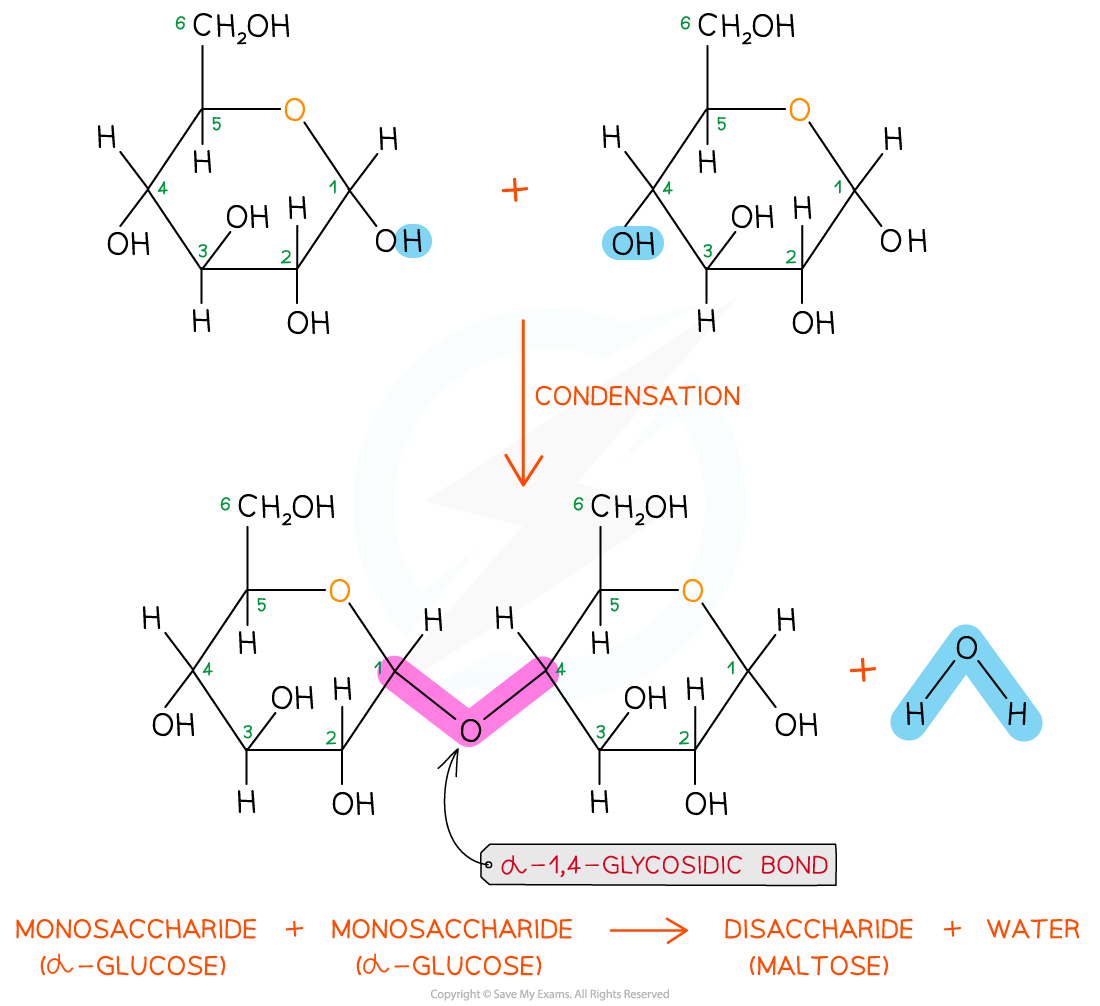
The formation of a glycosidic bond by condensation between two monosaccharides (glucose) to form a disaccharide (maltose)
- Each glycosidic bond is catalysed by enzymes specific to which OH groups are interacting
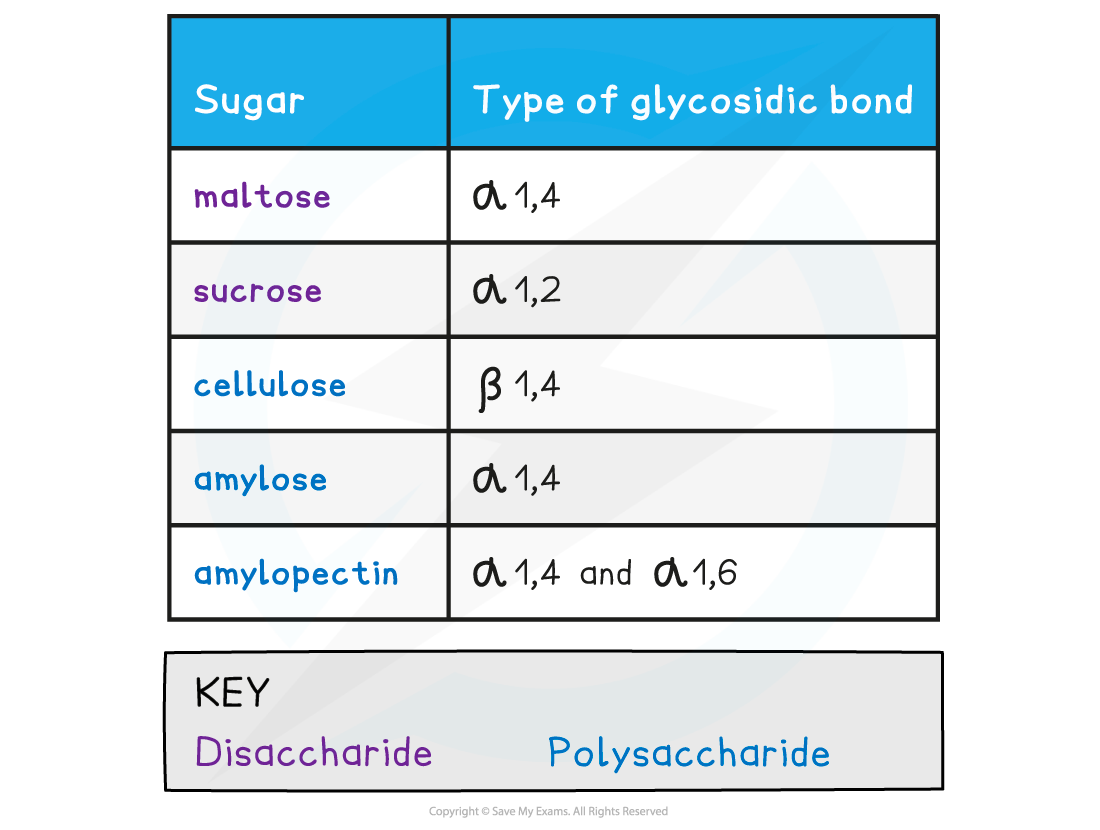
- As there are many different monosaccharides this results in different types of glycosidic bonds forming (e.g maltose has a α-1,4 glycosidic bond and sucrose has a α-1,2 glycosidic bond)
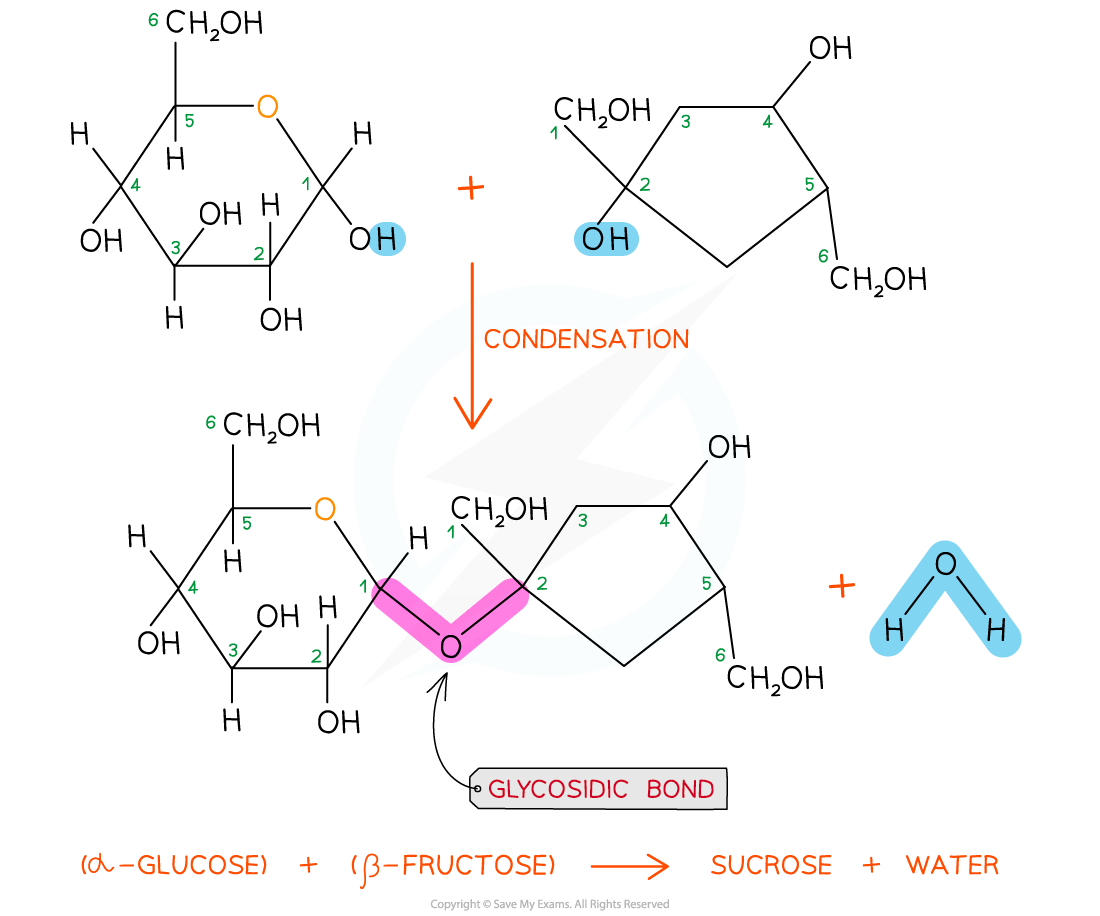
The formation of a glycosidic bond by condensation between α-glucose and β-fructose to form a disaccharide (sucrose)
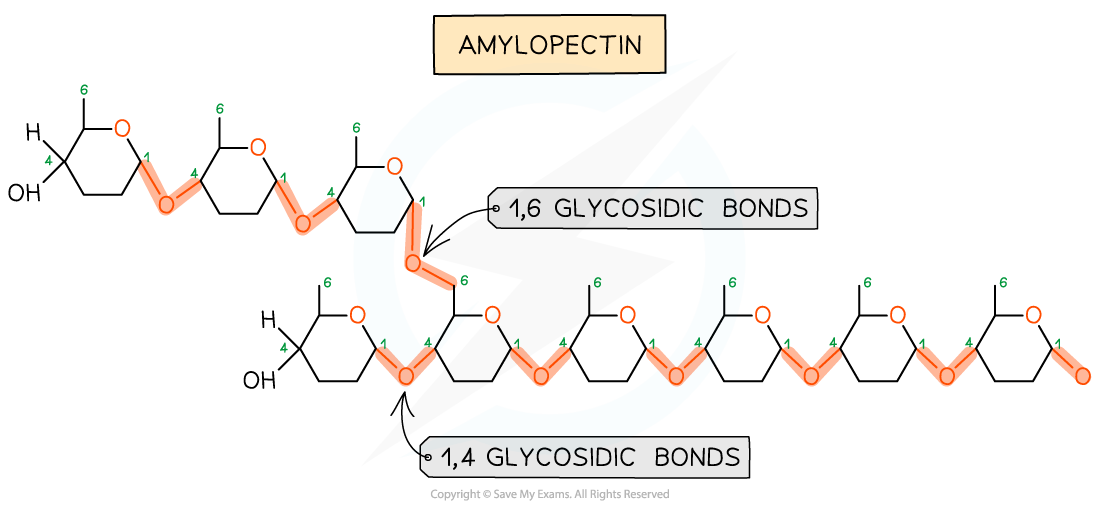
The formation of glycosidic bonds to create a polysaccharide (amylopectin)
Types of Glycosidic Bonds Table
Exam Tip
Make sure you can identify where the glycosidic bond is in a carbohydrate.
Breaking the Glycosidic Bond
- The glycosidic bond is broken when water is added in a hydrolysis (meaning ‘hydro’ - with water and ‘lyse’ - to break) reaction
- Disaccharides and polysaccharides are broken down in hydrolysis reactions
- Hydrolytic reactions are catalysed by enzymes, these are different to those present in condensation reactions
- Examples of hydrolytic reactions include the digestion of food in the alimentary tract and the breakdown of stored carbohydrates in muscle and liver cells for use in cellular respiration
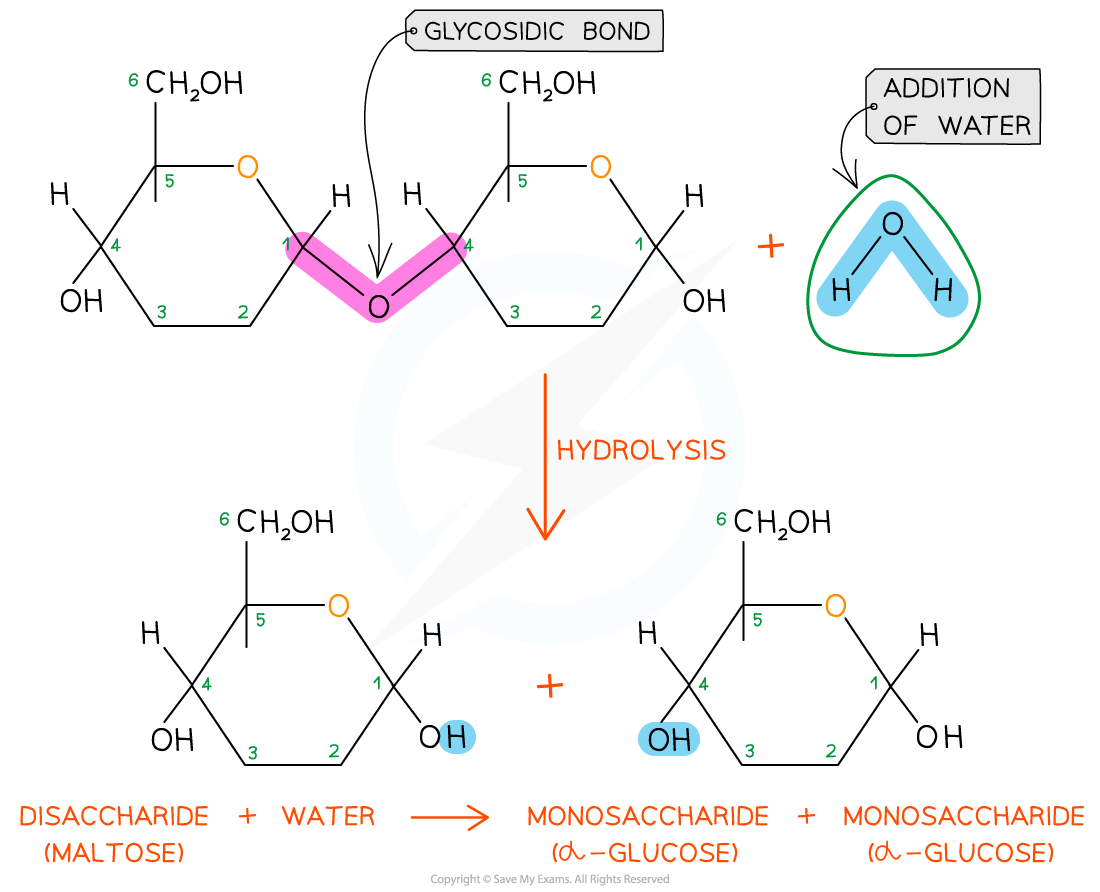
Glycosidic bonds are broken by the addition of water in a hydrolysis reaction
- Sucrose is a non-reducing sugar which gives a negative result in a Benedict’s test. When sucrose is heated with hydrochloric acid this provides the water that hydrolyses the glycosidic bond resulting in two monosaccharides that will produce a positive Benedict's test
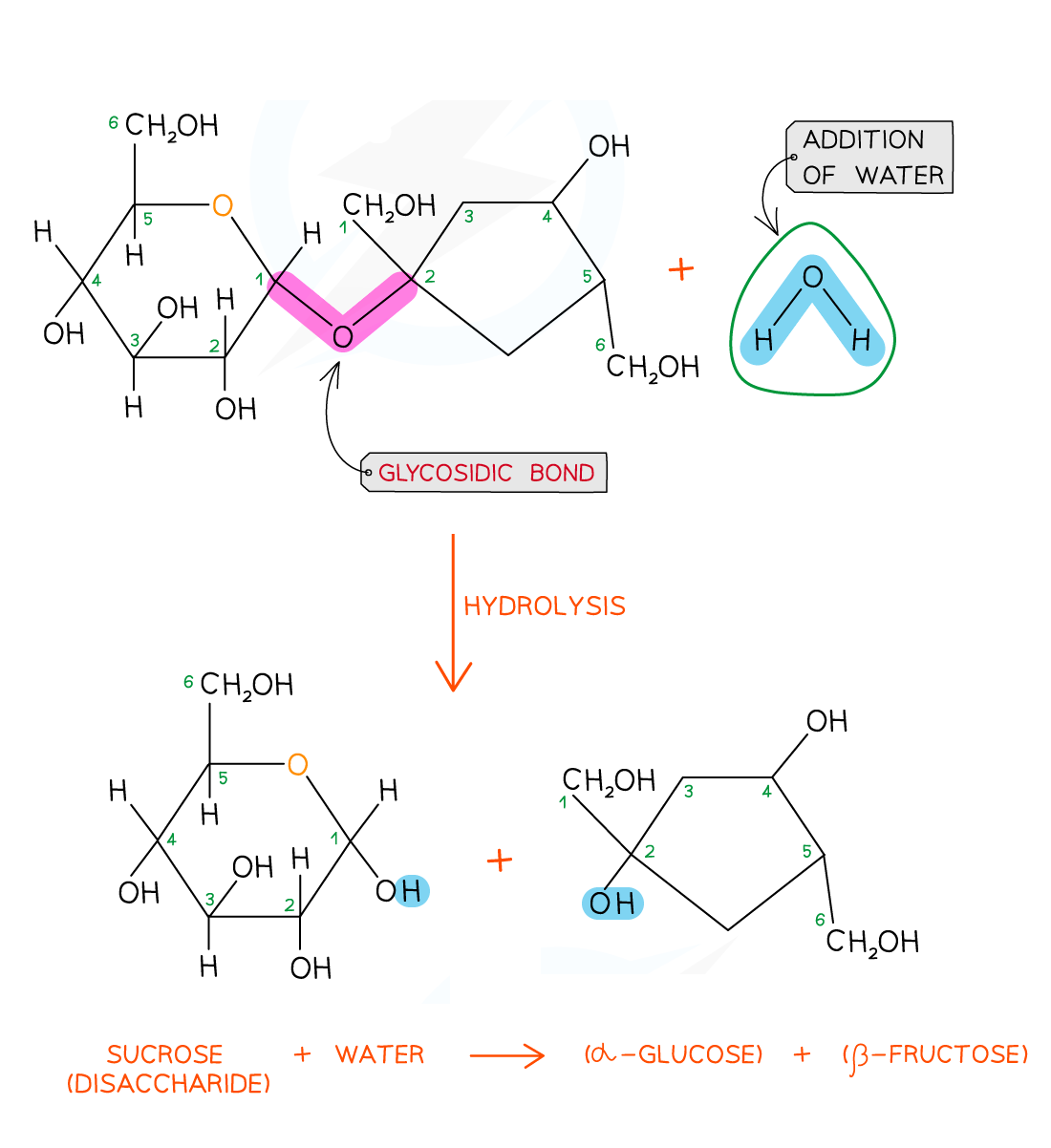
A molecule of glucose and a molecule of fructose are formed when one molecule of sucrose is hydrolysed; the addition of water to the glycosidic bond breaks it
Exam Tip
Remember that disaccharides hydrolyse to two monosaccharides whereas polysaccharides must undergo many hydrolytic reactions until they form monosaccharides.
转载自savemyexams
以上就是关于【CIE A Level Biology复习笔记2.2.4 The Glycosidic Bond】的解答,如需了解学校/赛事/课程动态,可至翰林教育官网获取更多信息。
往期文章阅读推荐:
翰林独家 | 经济学竞赛核心精讲,一册打通NEC/IEO/USAEBO!
2026 ALEVEL 夏考A率出炉!爱德思vs牛津AQA,哪些科目真的“好出分”?


翰林AMC8视频课重磅上线!

国际竞赛真题资源免费领取






