IB DP Physics: HL复习笔记9.1.1 The Defining Equation of SHM

The Defining Equation of SHM
- Simple harmonic motion (SHM) is a fundamental oscillation which appears naturally in various phenomena, including:
- The swing of a pendulum
- A mass on a spring
- Guitar strings
- Vibrations of molecules
- SHM is defined as:
A type of oscillation in which the acceleration on a body is proportional to its displacement, but acts in the opposite direction
- The conditions for an object to oscillate in SHM are that it shows:
- Periodic oscillations
- Acceleration proportional to its displacement
- Acceleration in the opposite direction to its displacement
- SHM is isochronous, meaning that the time period stays constant
- Therefore frequency must also be constant
- The period of simple harmonic oscillations can be calculated using the equation:
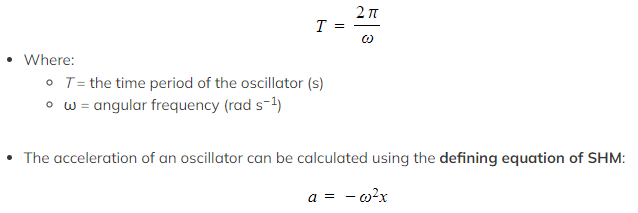
- Where:
- a = acceleration of the oscillator (m s−2)
- x = displacement of the oscillator from its equilibrium position (m)
- The equation shows that:
- The acceleration reaches its maximum value when the displacement is at a maximum i.e. x = x0
- The minus sign shows that when the object is displacement to the right, the direction of the acceleration is to the left
- An object in SHM will have a restoring force acting on it to return it to its equilibrium position
- This restoring force will be directly proportional, but in the opposite direction, to the displacement of the object from the equilibrium position
- Note: the restoring force and acceleration act in the same direction
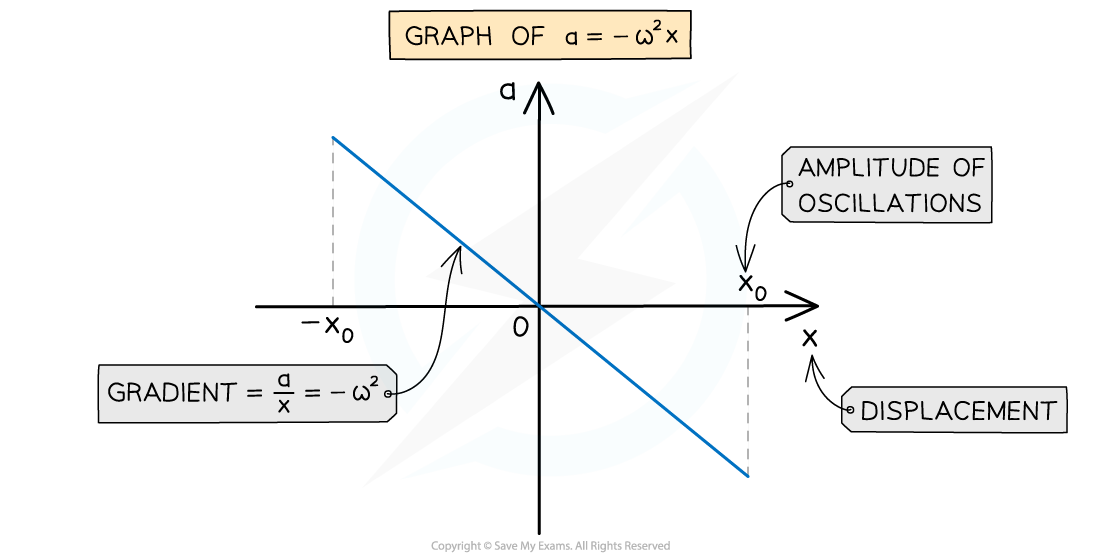
The acceleration of an object in SHM is directly proportional to the negative displacement
Calculating Displacement of an Oscillator
- The graph of acceleration against displacement is a straight line through the origin sloping downwards (similar to y = −x)
- Key features of the graph:
- The gradient is equal to −ω2
- The maximum and minimum displacement x values are the amplitudes −x0 and +x0
- A solution to the SHM acceleration equation is the displacement equation:
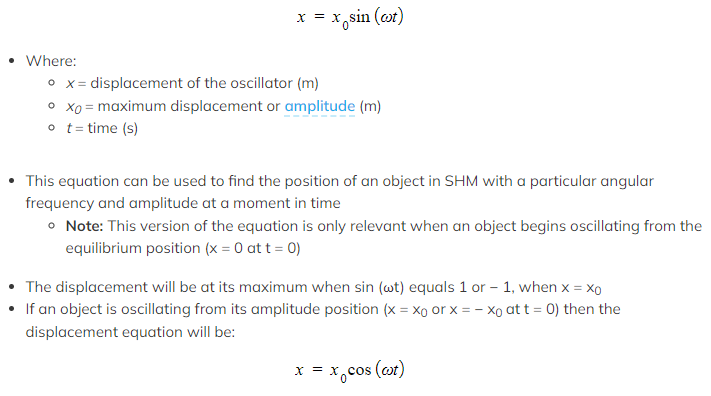
- This is because the cosine graph starts at a maximum, whilst the sine graph starts at 0
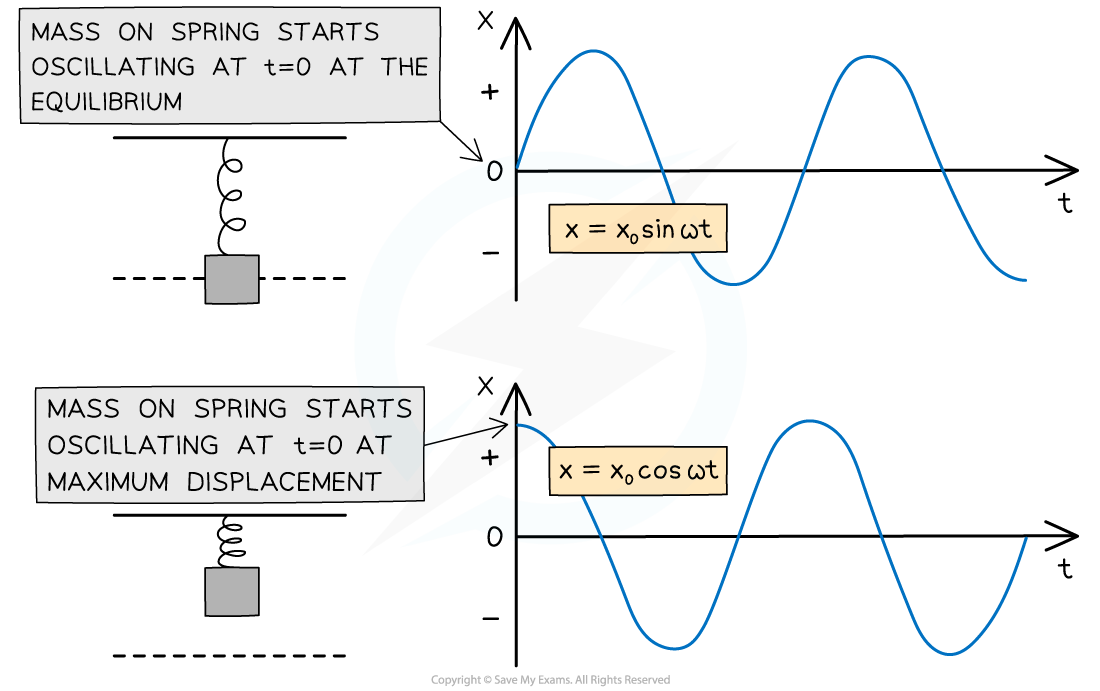
These two graphs represent the same SHM. The difference is the starting position
Equations & Graphs for SHM
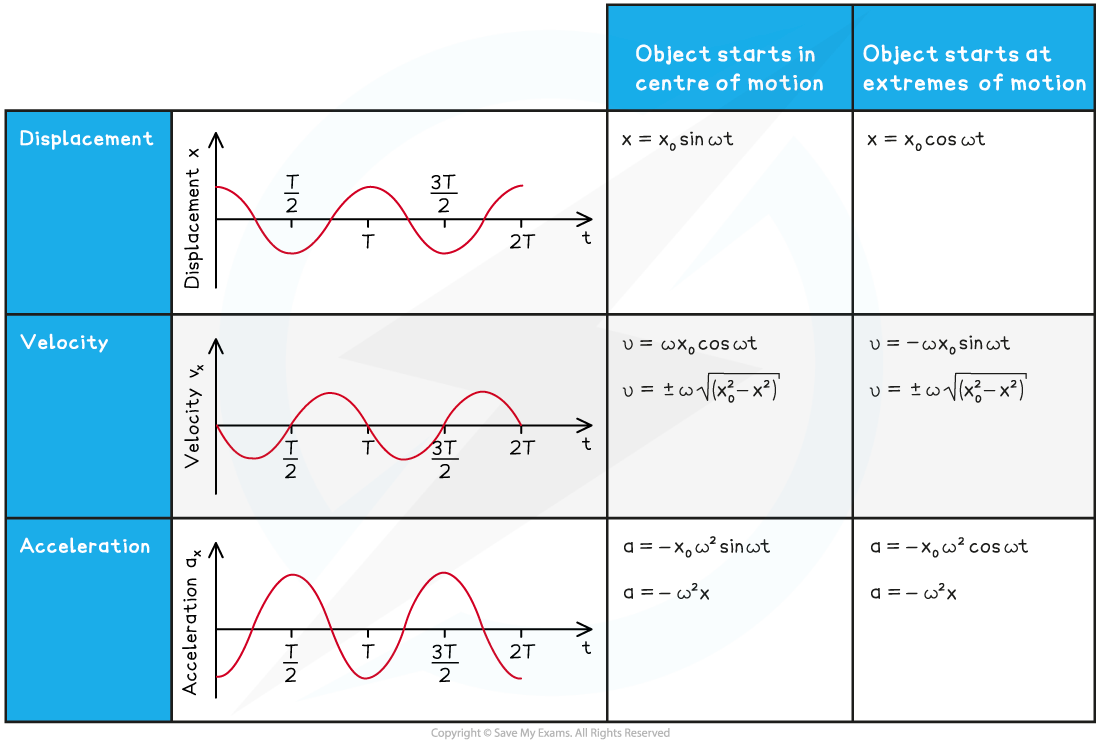
- A summary of the equations and graphs of simple harmonic motion are shown in the table
- Note that the equations differ depending on the starting point of the oscillator
- The derivation of these equations are found lower down the page
Summary table of equations and graphs for displacement, velocity and acceleration
Worked Example
A mass is suspended from a fixed point by means of a spring. The stationary mass is pulled vertically downwards through a distance of 4.3 cm and then released at t = 0. The mass is observed to perform simple harmonic motion with a period of 0.8 s.
Calculate the displacement, x, in cm of the mass at time t = 0.3 s.
Step 1: List the known quantities
-
- Maximum displacement, x0 = 4.3 cm
- Period of oscillation, T = 0.8 s
- Time interval, t = 0.3 s
Step 2: Write down the SHM displacement equation
-
- Since the mass is released at t = 0 at its maximum displacement, the displacement equation will involve the cosine function:
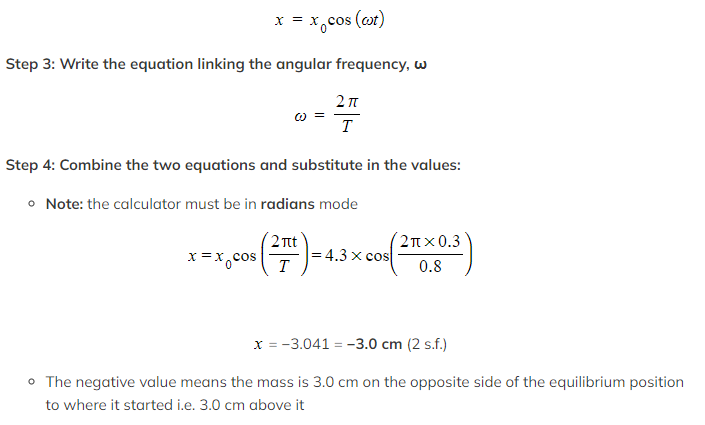
- Since the mass is released at t = 0 at its maximum displacement, the displacement equation will involve the cosine function:
-
- The negative value means the mass is 3.0 cm on the opposite side of the equilibrium position to where it started i.e. 3.0 cm above it
Calculating Velocity of an Oscillator
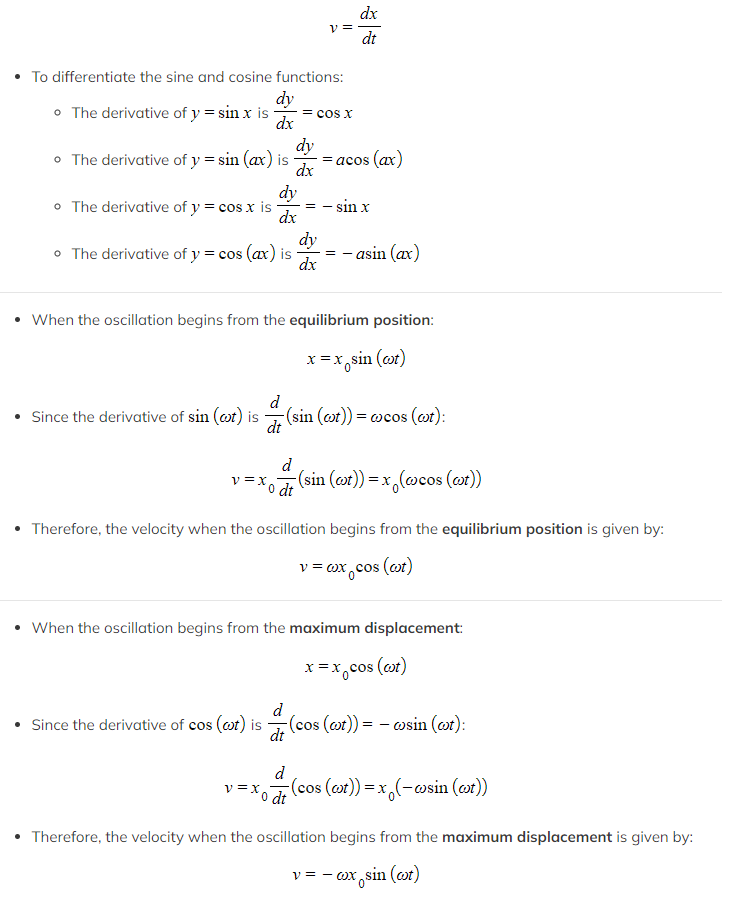
- The velocity, v, of an oscillation can be found by differentiating the displacement with respect to time::

Calculating Acceleration of an Oscillator
- The acceleration, a, of an oscillator can be found by differentiating the displacement with respect to time twice:
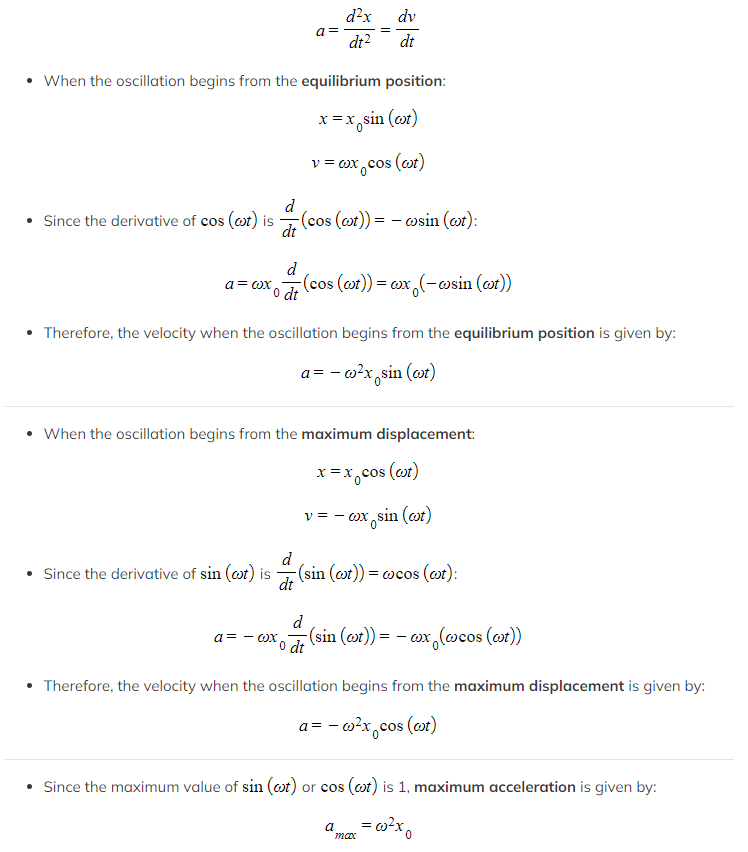
- This is the maximum acceleration of the oscillator regardless of its starting point
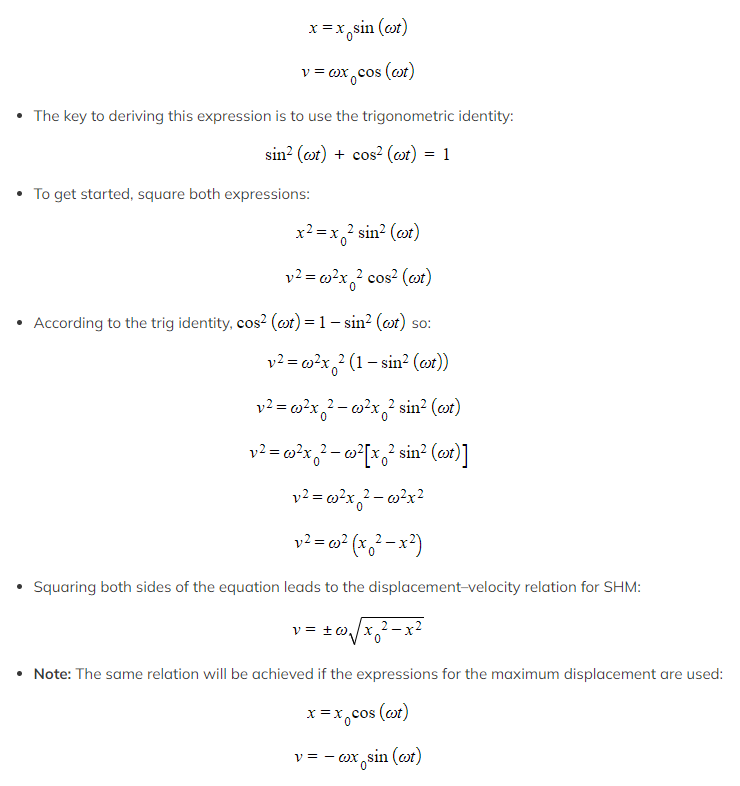
Displacement–Velocity Relation for SHM
- A useful relation between the displacement and velocity of a simple harmonic oscillator can be derived using the expressions from the equilibrium position:
Exam Tip
The defining equation of SHM shows acceleration, as a positive value, and displacement, −x as a negative one. This reminds us that acceleration and displacement are vector quantities and are always in the opposite direction to each other in SHM.
Since displacement is a vector quantity, remember to keep the minus sign in your solutions if they are negative. Getting the marks will depend on keeping your positive and negative numbers distinct from each other! Also remember that your calculator must be in radians mode when using the cosine and sine functions. This is because the angular frequency ⍵ is calculated in rad s-1, not degrees.
转载自savemyexams
以上就是关于【IB DP Physics: HL复习笔记9.1.1 The Defining Equation of SHM】的解答,如需了解学校/赛事/课程动态,可至翰林教育官网获取更多信息。
往期文章阅读推荐:
翰林独家 | 经济学竞赛核心精讲,一册打通NEC/IEO/USAEBO!
2026 AMC10/12美国数学竞赛新赛季!【翰林教育 × 清华大学出版社】独家教材全面发售!


翰林AMC8视频课重磅上线!

国际竞赛真题资源免费领取






