AQA A Level Physics复习笔记8.1.4 Inverse-Square Law of Gamma Radiation

Inverse-Square Law of Gamma Radiation
- As an electromagnetic wave, gamma radiation shares many of the same wave properties as light
- Light sources which are further away appear fainter because the light they emit is spread out over a greater area than a light source which is closer by
- The moment the light leaves the source, it begins to spread out uniformly as a sphere, according to an inverse square law
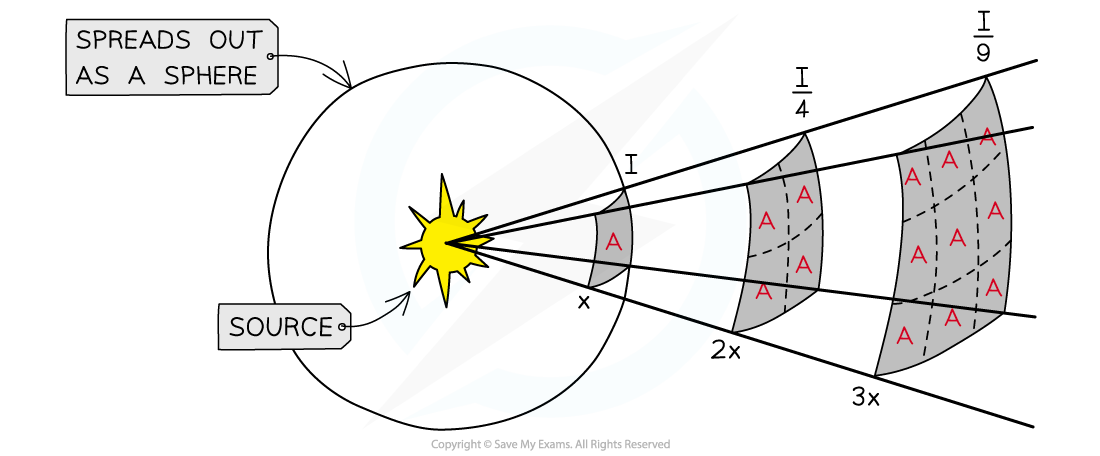
When an EM wave spreads out, the area over which it spreads is proportional to the radius squared
- This applies to gamma radiation too, and can be calculated using the equation:

- Where:
- I = intensity of the gamma radiation (W m–2)
- k = constant of proportionality
- x = the distance from the source (m)
- Since k is a constant, this equation can be written for radiation at two different points as follows:

- Where:
- I1 = intensity of the gamma radiation at x1 (W m–2)
- I2 = intensity of the gamma radiation at x2 (W m–2)
- x1 = the initial distance from the source (m)
- x2 = the subsequent distance from the source (m)
Worked Example
A source of gamma radiation is placed at a distance of 0.2 m away from a small radiation detector.The detector records a corrected count rate of 200 Bq from the gamma source.Calculate the count rate that would be recorded when the detector is moved a distance of 0.5 m away from the source.
Step 1: List the known quantities
Initial count rate, I1 = 200 Bq
Initial distance, x1 = 0.2 m
Final count rate = I2
Final distance, x2 = 0.5 m
Step 2: Write down the inverse square law equation
 Step 3: Rearrange and calculate the count rate at 0.5 m

Exam Tip
As you can see from the worked example, the inverse square law applies to other quantities such as the activity, or count rate, of the gamma radiation as well as the intensity. However, you must remember that the inverse square law only applies to gamma radiation and not alpha or beta radiation.This is because gamma radiation is not absorbed by matter easily, whereas alpha and beta are absorbed quickly before they can spread out.
转载自savemyexams
以上就是关于【AQA A Level Physics复习笔记8.1.4 Inverse-Square Law of Gamma Radiation】的解答,如需了解学校/赛事/课程动态,可至翰林教育官网获取更多信息。
往期文章阅读推荐:
翰林独家 | 经济学竞赛核心精讲,一册打通NEC/IEO/USAEBO!
2026 ALEVEL 夏考A率出炉!爱德思vs牛津AQA,哪些科目真的“好出分”?


翰林AMC8视频课重磅上线!

国际竞赛真题资源免费领取






