Edexcel IGCSE Biology 复习笔记 5.1.6 Fish Farming

Edexcel IGCSE Biology 复习笔记 5.1.6 Fish Farming
Fish Farming
Benefits of fish farming
- Most fish are still caught in the wild (i.e. in the open ocean or in freshwater rivers and lakes)
- However, overfishing has lead to dramatic declines in many fish populations
- Fish farms are ways of raising large numbers of fish in a small space to provide food (protein) for humans
- This has several advantages over wild-caught fish, including:
- The ability to selectively breed fish to ensure high quality, fast-growing fish
- The ability to protect against predators
- The ability to control water quality (many wild-caught fish have significant levels of pollutants such as mercury in their flesh)
- The ability to control feeding to ensure rapid growth
Methods used in fish farms to ensure high yield
- Within fish farms, large numbers of fish are kept in freshwater or seawater enclosures and are carefully monitored and controlled in many different ways
- This helps to ensure high yields (fast growth of healthy fish)
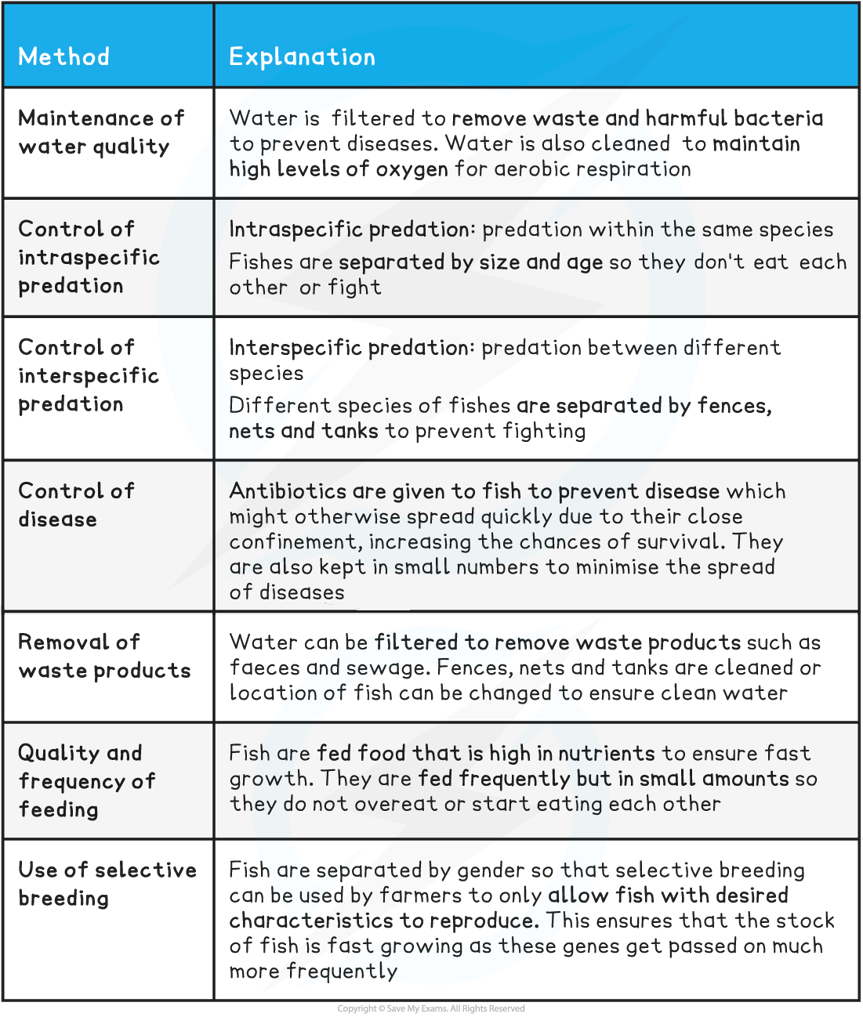
- The methods used include:
- The control (and maintenance) of water quality
- The control of intraspecific predation
- The control of interspecific predation
- The control of disease
- The control (and removal) of waste products
- The control of the quality and frequency of feeding
- The use of selective breeding
Fish Farming Methods Table
转载自savemyexam
以上就是关于【Edexcel IGCSE Biology 复习笔记 5.1.6 Fish Farming】的解答,如需了解学校/赛事/课程动态,可至翰林教育官网获取更多信息。
往期文章阅读推荐:
翰林独家 | 经济学竞赛核心精讲,一册打通NEC/IEO/USAEBO!
IGCSE全A*,A-Level阶段却崩了?别忽视IGCSE选课的重要性!


翰林AMC8视频课重磅上线!

国际竞赛真题资源免费领取






