Edexcel IGCSE Physics: Double Science 复习笔记:2.1.1 Charge & Current

Edexcel IGCSE Physics: Double Science 复习笔记:2.1.1 Charge & Current
Current
- Electric current is defined as the rate of flow charge
- In other words, the size of an electric current is the amount of charge passing through a component per second
- Current flows from the positive terminal to the negative terminal of a cell
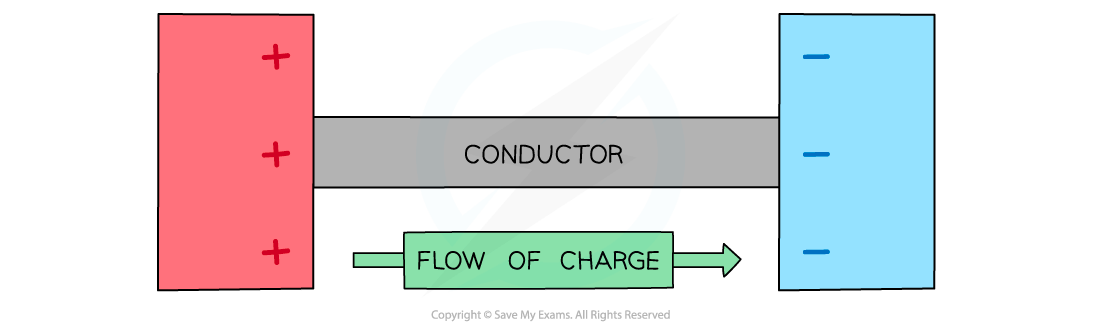
Charge flows from the positive terminal to the negative terminal
Charge
- The wires in an electric circuit are made of metal, because metal is a good conductor of electric current
- In the wires, the current is a flow of negatively charged electrons
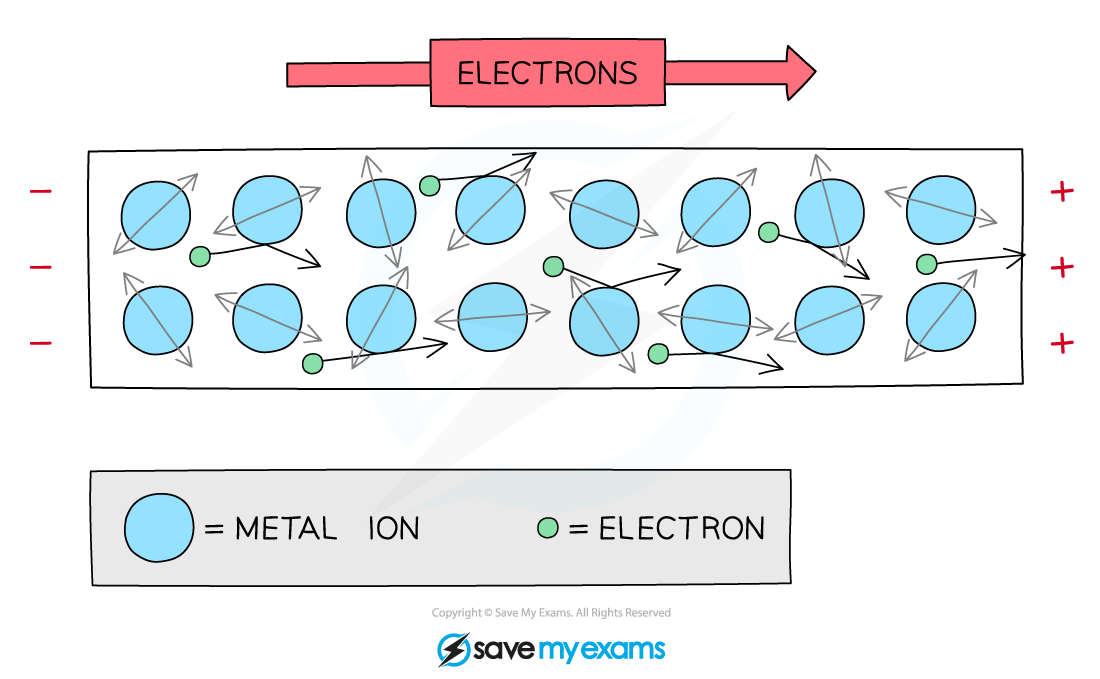
In metal wires, the current is a flow of negatively charged electrons. This image shows the electrons flowing through a lattice of metal ions
Calculating Electric Charge
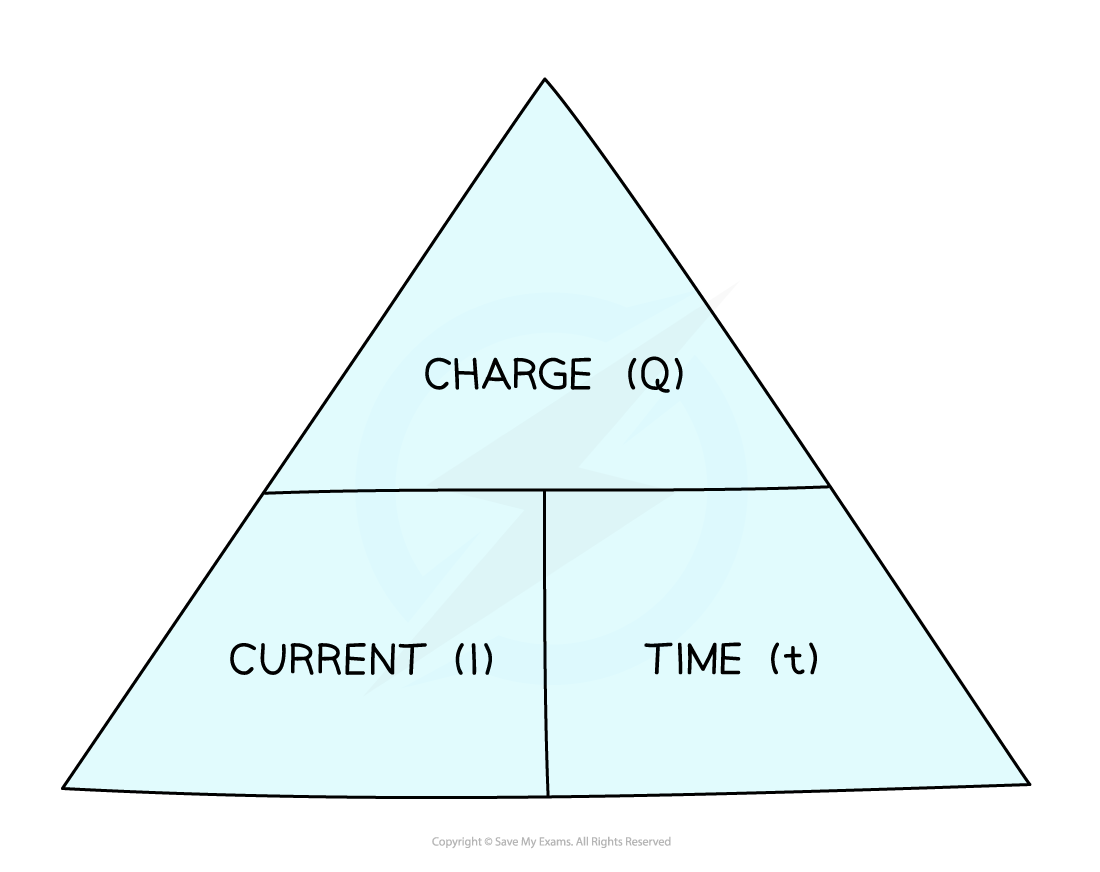
- The charge, current and time are related by the equation:

- Where:
- Q = charge measured in Coulombs (C)
- I = current measure in amps (A)
- t = time measured in seconds (s)
- This equation can be rearranged with the help of the following formula triangle:
Worked Example
When will 8 mA of current pass through an electrical circuit?
A When 1 J of energy is used by 1 C of charge
B When a charge of 4 C passes in 500 sC When a charge of 8 C passes in 100 s
D When a charge of 1 C passes in 8 s
ANSWER: B
Step 1: Write out the equation relating current, charge and time
Q = It
-
- This can be rearranged to make current I the subject of the equation:

Step 2: Rule out any obviously incorrect options
-
- Option A does not mention time, so can be ruled out
Step 3: Try the rest of the options by applying the equation to determine the correct answer
-
- Consider option B:
I = 4 / 500 = 8 × 10–3 = 8 mA
-
- Consider option C:
I = 8 / 100 = 80 × 10–3 = 80 mA
-
- Consider option D:
I = 1 / 8 = 125 × 10–3 = 125 mA
-
- Therefore, the correct answer is B
Exam Tip
Electric currents in everyday circuits tend to be quite small, so it's really common for examiners to throw in a unit prefix like 'm' next to quantities of current, e.g. 10 mA (10 milliamperes).Make sure that you are on the lookout for these prefixes and that you can convert them into standard units, so 10 mA = 10 × 10-3 A
转载自savemyexams
以上就是关于【Edexcel IGCSE Physics: Double Science 复习笔记:2.1.1 Charge & Current】的解答,如需了解学校/赛事/课程动态,可至翰林教育官网获取更多信息。
往期文章阅读推荐:
翰林独家 | 经济学竞赛核心精讲,一册打通NEC/IEO/USAEBO!
IGCSE全A*,A-Level阶段却崩了?别忽视IGCSE选课的重要性!


翰林AMC8视频课重磅上线!

国际竞赛真题资源免费领取






