CIE A Level Biology复习笔记16.2.3 Predicting Inheritance: Dihybrid Crosses

Predicting Inheritance: Dihybrid Crosses
- Monohybrid crosses look at how the alleles of one gene transfer across generations
- Dihybrid crosses look at how the alleles of two genes transfer across generations
- The genetic diagrams for both types of crosses are very similar
- There are several more genotypes and phenotypes involved
- When writing the different genotypes write the two alleles for one gene, followed immediately by the two alleles for the other gene. Do not mix up the alleles from the different genes
- If there was a gene with alleles Y and y and another gene with alleles G and g an example genotype for an individual would be YYGg
Worked example: Dihybrid genetic diagram
- Horses have a single gene for coat colour that has two alleles:
- B, a dominant allele produces a black coat
- b, a recessive allele produces a chestnut coat
- Horses also have single gene for eye colour
- E, a dominant allele produces brown eyes
- e, a recessive allele produces blue eyes
- In this example a horse which is heterozygous for both genes has been crossed with a horse that is homozygous for one gene and heterozygous for the other
Parental phenotypes: black coat, brown eyes x chestnut coat, brown eyes
Parental genotypes: BbEe bbEe
Parental gametes: BE or Be or bE or be bE or be
Dihybrid cross punnett square table
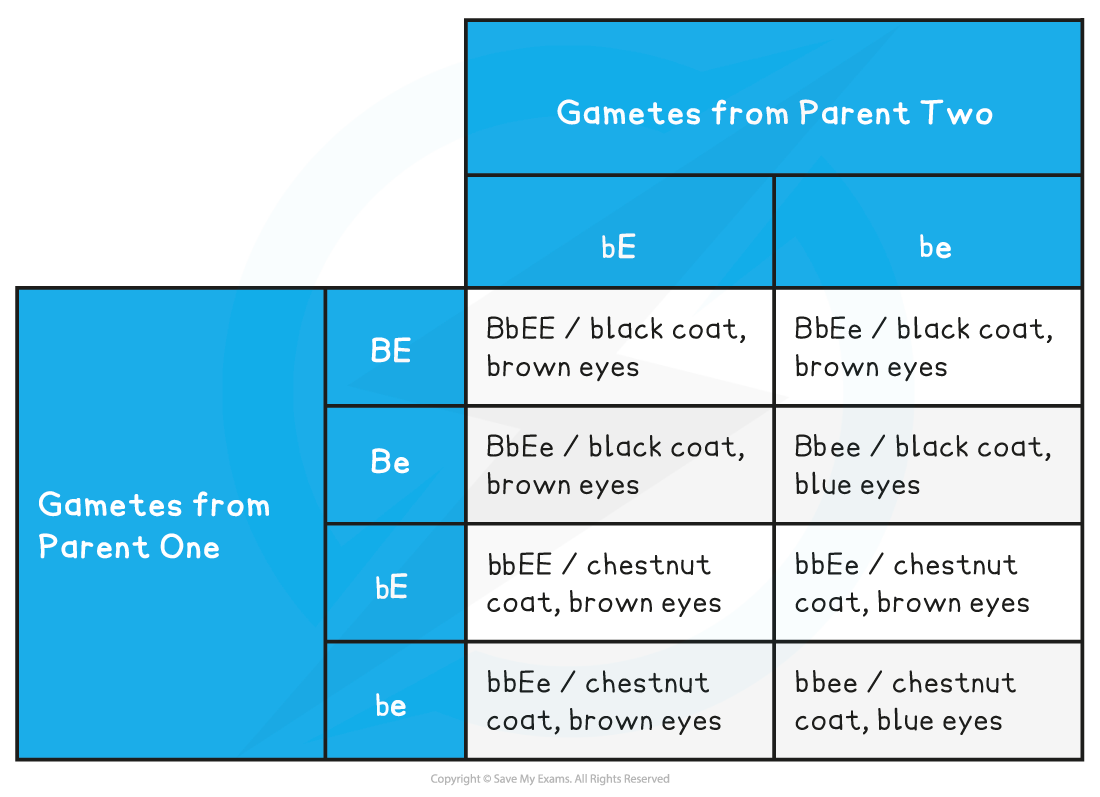
Predicted ratio of phenotypes in offspring – 3 black coat, brown eyes : 3 chestnut coat, brown eyes : 1 black coat, blue eyes : 1 chestnut coat, blue eyes
Autosomal linkage
- Dihybrid crosses and their predictions rely on the assumption that the genes being investigated behave independently of one another during meiosis
- Not all genes assort independently during meiosis
- Some genes which are located on the same chromosome display autosomal linkage and stay together in the original parental combination
- Linkage between genes affects how parental alleles are passed onto offspring through the gametes
- When writing linked genotypes it can be easier to keep the linked alleles within a bracket
- For example an individual has the genotype FFGG however if there is linkage between the two genes then it would be written as (FG)(FG)
Worked example: Explaining autosomal linkage
- The genes for tail length and scale colour in a species of newt have displayed autosomal linkage
- The gene for tail length has two alleles :
- Dominant allele T produces a normal length tail
- Recessive allele t produces a shorter length tail
- The gene for scale colour has two alleles:
- Dominant allele G produces green scales
- Recessive allele g produces white scales
- A newt heterozygous for a normal tail and green scales is crossed with a newt that has a shorter tail and white scales
Parental phenotypes: normal tail, green scales x short tail, white scales
Parental genotypes: (TG)(tg) (tg)(tg)
Parental gametes: (TG) or (tg) (tg)
Dihybrid cross with linkage punnett square table
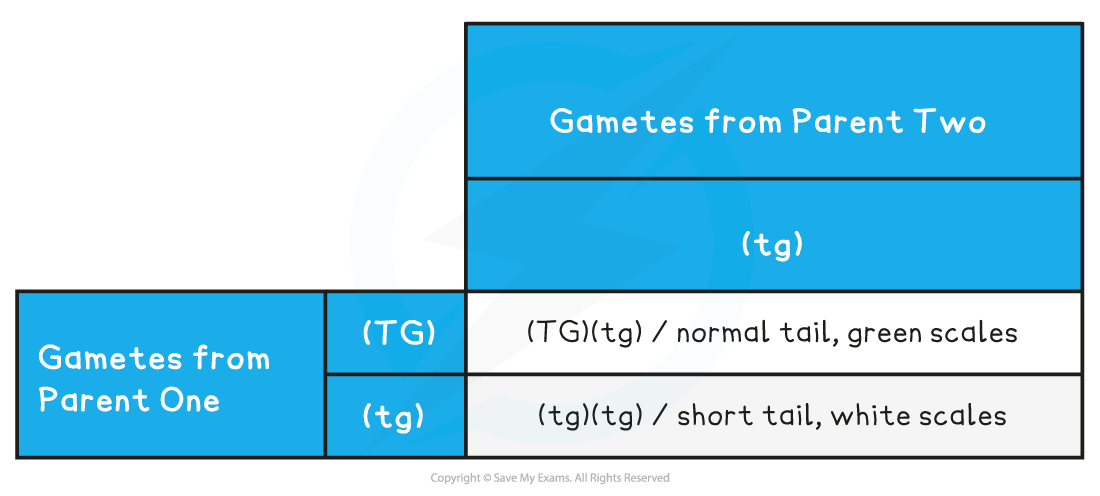
Predicted ratio of phenotypes in offspring – 1 normal tail, green scales : 1 short tail, white scales
Predicted ratio of genotypes in offspring – 1 (TG)(tg) : 1 (tg)(tg)
Epistasis
- In some cases one gene can affect the expression of another gene
- Epistasis: when two genes on different chromosomes affect the same feature
- If epistasis is present it needs to be taken into account when determining the phenotypes of individuals
- The whole combination of alleles from the different genes dictates the phenotype
Worked example: Explaining epistasis
- There is a gene that dictates the feather colour of pigeons
- The gene has two alleles (R / r) :
- Allele R codes for a pigment that produces grey feathers
- Allele r doesn’t produce a pigment, resulting in white feathers
- Another gene has also been found to have an effect on feather colour
- This gene has two alleles (F / f) :
- The dominant allele F stops grey feathers being produced even if the allele R is present
- These are the possible phenotypes:
- RRFF white feathers
- RrFF white feathers
- rrFF white feathers
- RRFf white feathers
- RrFf white feathers
- rrFf white feathers
- rrff white feathers
- RRff grey feathers
- Rrff grey feathers
Exam Tip
When you are working through different genetics questions you may notice that test crosses involving autosomal linkage predict solely parental type offspring (offspring that have the same combination of characteristics as their parents).However in reality recombinant offspring (offspring that have a different combination of characteristics to their parents) are often produced. This is due to the crossing over that occurs during meiosis. The crossing over and exchanging of genetic material breaks the linkage between the genes and recombines the characteristics of the parents.So if a question comes along that asks you why recombinant offspring are present you now know why!
转载自savemyexams
以上就是关于【CIE A Level Biology复习笔记16.2.3 Predicting Inheritance: Dihybrid Crosses】的解答,如需了解学校/赛事/课程动态,可至翰林教育官网获取更多信息。
往期文章阅读推荐:
翰林独家 | 经济学竞赛核心精讲,一册打通NEC/IEO/USAEBO!
2026 ALEVEL 夏考A率出炉!爱德思vs牛津AQA,哪些科目真的“好出分”?


翰林AMC8视频课重磅上线!

国际竞赛真题资源免费领取






