CIE A Level Biology复习笔记13.1.7 Photophosphorylation

Types of Photophosphorylation
- The thylakoid membrane is the site of the light-dependent stage of photosynthesis
- During the light-dependent stage of photosynthesis:
- Light energy is used to breakdown water (photolysis) to produce hydrogen ions, electrons and oxygen in the thylakoid lumen
- A proton gradient is formed due to the photolysis of water resulting in a high concentration of hydrogen ions in the thylakoid lumen
- Electrons travel through an electron transport chain of proteins within the membrane
- Reduced NADP (NADPH) is produced when hydrogen ions in the stroma and electrons from the electron transport chain combine with the carrier molecule NADP
- ATP is produced during a process known as photophosphorylation (ADP + Pi → ATP) using the proton gradient between the thylakoid lumen and stroma to drive the enzyme ATP synthase
- The photophosphorylation of ADP to ATP can be cyclic or non-cyclic, depending on the pattern of electron flow in photosystem I or photosystem II or both
- In cyclic photophosphorylation, only photosystem I is involved
- In non-cyclic photophosphorylation, both photosystem I and photosystem II are involved
- Photosystems are collections of photosynthetic pigments that absorb light energy and transfer the energy onto electrons, each photosystem contains a primary pigment
- Photosystem II has a primary pigment that absorbs light at a wavelength of 680nm and is therefore called P680
- Photosystem II is at the beginning of the electron transport chain and is where the photolysis of water takes place
- Photosystem I has a primary pigment that absorbs light at a wavelength of 700nm and is therefore called P700
- Photosystem I is in the middle of the electron transport chain
- The energy carried by the ATP is then used during the light-independent reactions of photosynthesis
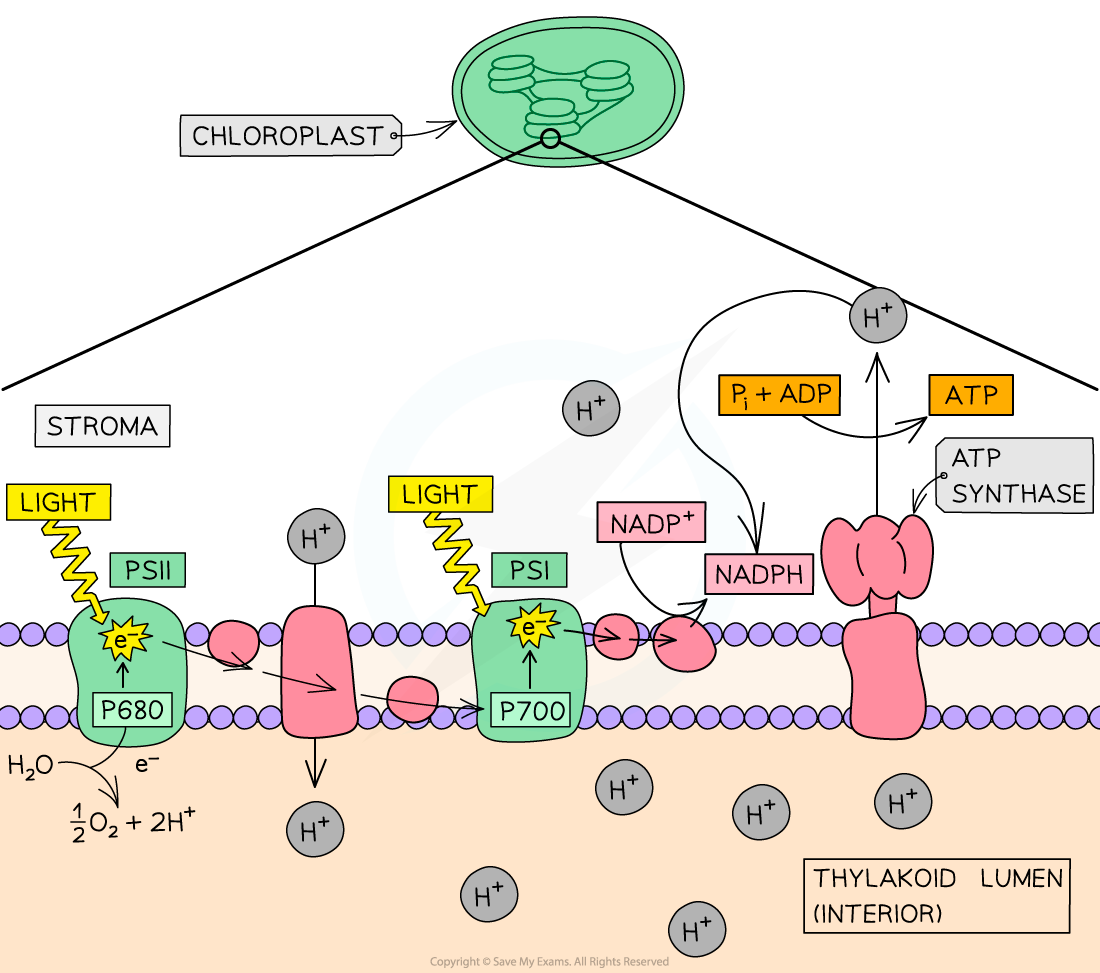
The light-dependent stage of photosynthesis takes place in the thylakoid membrane and thylakoid lumen
Cyclic Photophosphorylation
- Cyclic photophosphorylation involves photosystem I (PSI) only
- Light is absorbed by photosystem I (located in the thylakoid membrane) and passed to the photosystem I primary pigment (P700)
- An electron in the primary pigment molecule (ie. the chlorophyll molecule) is excited to a higher energy level and is emitted from the chlorophyll molecule in a process known as photoactivation
- This excited electron is captured by an electron acceptor, transported via a chain of electron carriers known as an electron transport chain before being passed back to the chlorophyll molecule in photosystem I (hence: cyclic)
- As electrons pass through the electron transport chain they provide energy to transport protons (H+) from the stroma to the thylakoid lumen via a proton pump
- A build-up of protons in the thylakoid lumen can then be used to drive the synthesis of ATP from ADP and an inorganic phosphate group (Pi) by the process of chemiosmosis
- Chemiosmosis is the movement of chemicals (protons) down their concentration gradient, the energy released from this can be used by ATP synthase to synthesise ATP
- The ATP then passes to the light-independent reactions
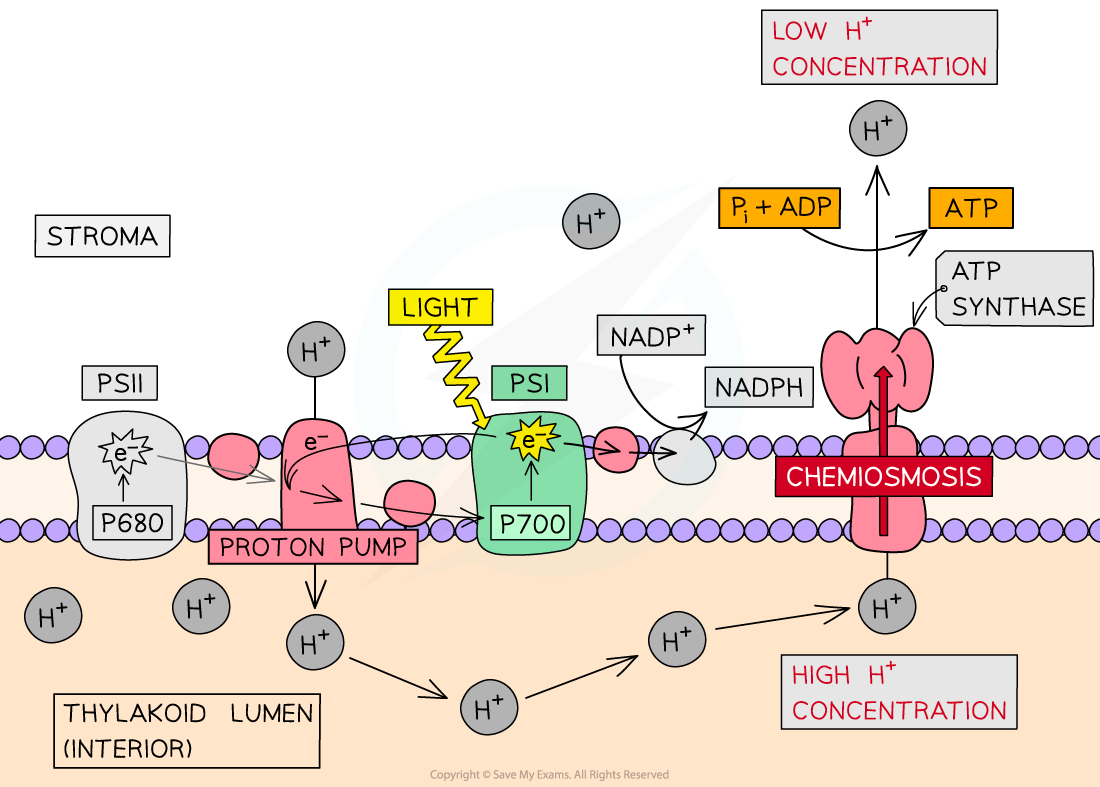
Cyclic photophosphorylation
Exam Tip
Make sure you know the difference between the two forms of photophosphorylation!Cyclic photophosphorylation differs from non-cyclic photophosphorylation in two key ways:
- Cyclic photophosphorylation only involves photosystem I (whereas non-cyclic photophosphorylation involves photosystems I and II)
- Cyclic photophosphorylation does not produce reduced NADP (whereas non-cyclic photophosphorylation does)
Non-Cyclic Photophosphorylation
- Non-cyclic photophosphorylation involves both photosystem I (PSI) and photosystem II (PSII)
Photosystem II
- Light is absorbed by photosystem II (located in the thylakoid membrane) and passed to the photosystem II primary pigment (P680)
- An electron in the primary pigment molecule (ie. the chlorophyll molecule) is excited to a higher energy level and is emitted from the chlorophyll molecule in a process known as photoactivation
- This excited electron is passed down a chain of electron carriers known as an electron transport chain, before being passed on to photosystem I
- During this process to ATP is synthesised from ADP and an inorganic phosphate group (Pi) by the process of chemiosmosis
- The ATP then passes to the light-independent reactions
- Photosystem II contains a water-splitting enzyme called the oxygen-evolving complex which catalyses the breakdown (photolysis) of water by light:
H2O → 2H+ + 2e- + ½O2
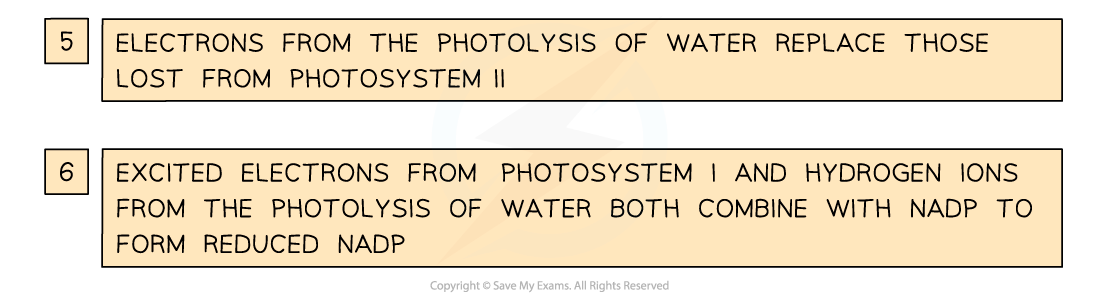
- As the excited electrons leave the primary pigment of photosystem II and are passed on to photosystem I, they are replaced by electrons from the photolysis of water
Photosystem I
- At the same time as photoactivation of electrons in photosystem II, electrons in photosystem I also undergo photoactivation
- The excited electrons from photosystem I also pass along an electron transport chain
- These electrons combine with hydrogen ions (produced by the photolysis of water) and the carrier molecule NADP to give reduced NADP:
2H+ + 2e- + NADP → reduced NADP
- The reduced NADP (NADPH) then passes to the light-independent reactions to be used in the synthesis of carbohydrate
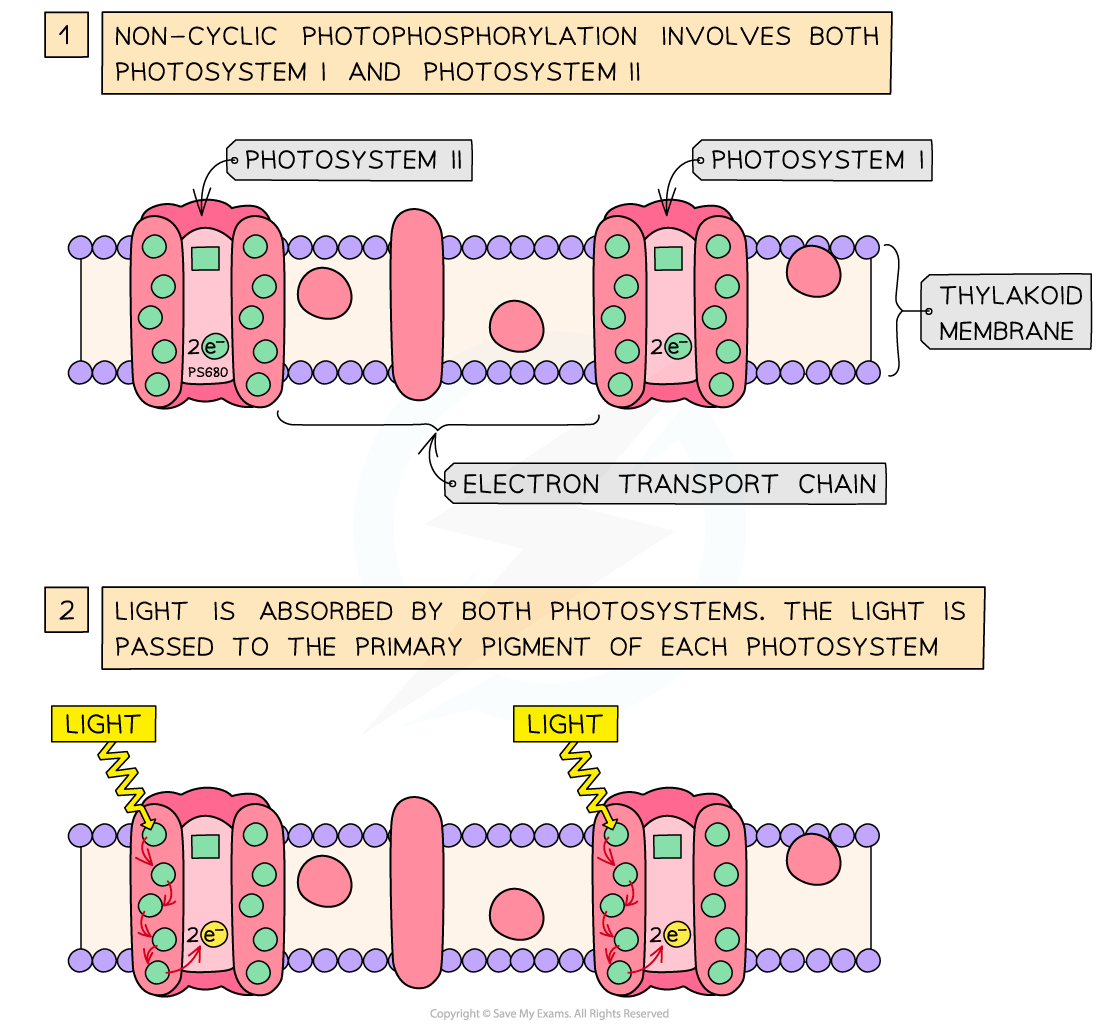
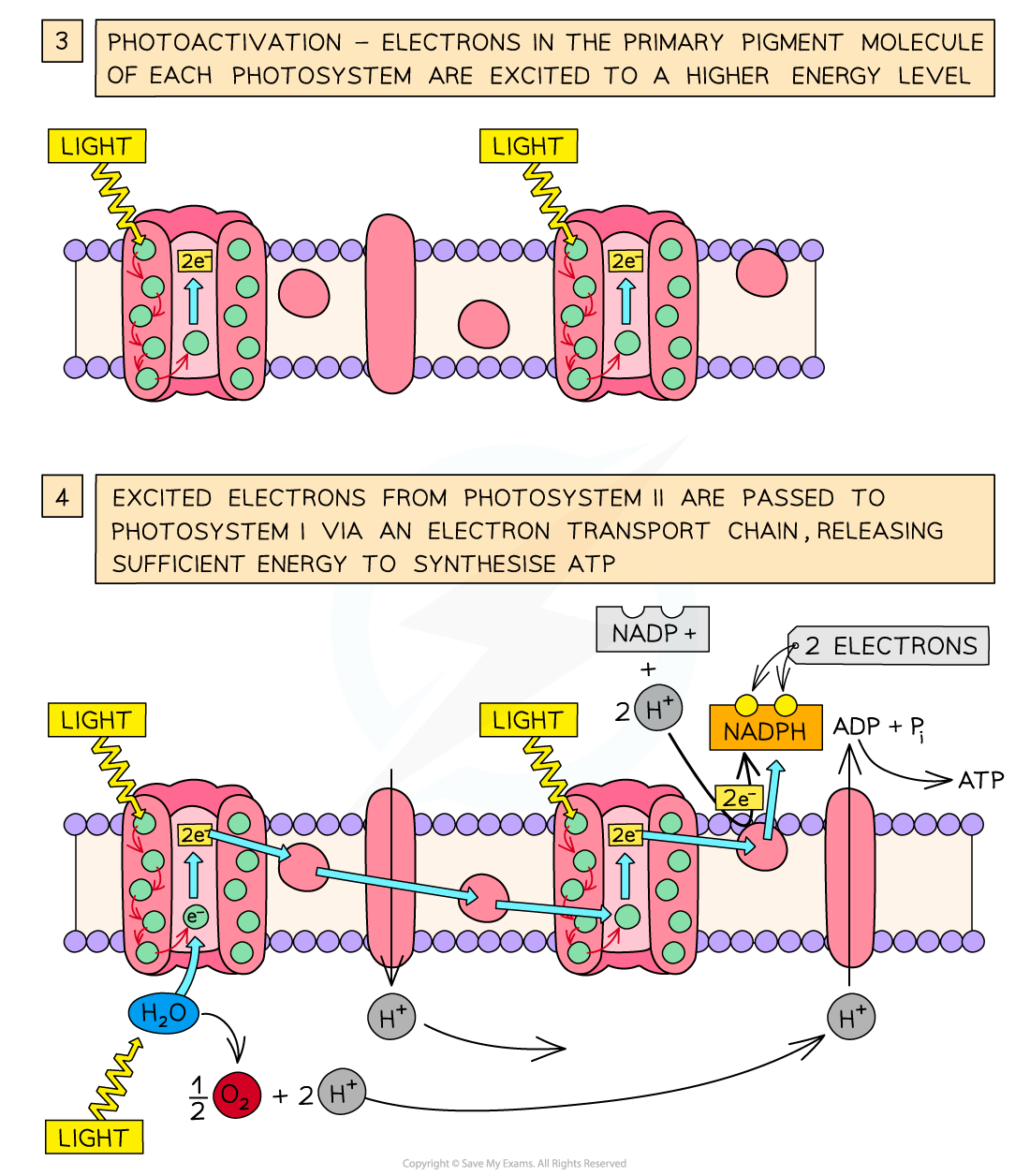
Non-cyclic photophosphorylation
Exam Tip
Remember – the oxygen produced during the photolysis of water is a waste product of this process. The hydrogen ions and electrons produced during the photolysis of water are useful products.The electrons replace those that have been lost from the primary pigment molecule of photosystem II (as photosystem II passes its electrons on to photosystem I). The hydrogen ions combine with the electrons from photosystem I to form reduced NADP (NADPH).
Photophosphorylation & Chemiosmosis
- During photophosphorylation, energetic (excited) electrons are captured by an electron acceptor in a thylakoid membrane
- These excited electrons are then passed along a chain of electron carriers (known as the electron transport chain)
- The electron carriers are alternately reduced (as they gain an electron) and then oxidised (as they lose the electron by passing it to the next carrier)
- The excited electrons gradually release their energy as they pass through the electron transport chain
- The released energy is used to actively transport protons (H+ ions) across the thylakoid membrane, from the stroma (the fluid within chloroplasts) to the thylakoid lumen (the space within thylakoids)
- A ‘proton pump’ transports the protons across the thylakoid membrane, from the stroma to the thylakoid lumen
- This creates a proton gradient, with a high concentration of protons in the thylakoid lumen and a low concentration in the stroma
- Protons then return to the stroma (moving down the proton concentration gradient) by facilitated diffusion through transmembrane ATP synthase enzymes in a process known as chemiosmosis
- This process provides the energy needed to synthesise ATP by adding an inorganic phosphate group (Pi) to ADP (ADP + Pi → ATP)
- The whole process is known as photophosphorylation as light provides the initial energy source for ATP synthesis
- After being passed down the electron transport chain, the de-energised electrons from photosystem II are taken up by photosystem I

The process of photophosphorylation first involves the active transport of protons across the thylakoid membrane. These protons then move back across the thylakoid membrane via a process of facilitated diffusion known as chemiosmosis
Exam Tip
Make sure you understand the direction of movement of protons across the thylakoid membrane during photophosphorylation. Protons are first actively transferred from the stroma to the thylakoid space. These protons then move from the thylakoid space back to the stroma during chemiosmosis.
以上就是关于【CIE A Level Biology复习笔记13.1.7 Photophosphorylation】的解答,如需了解学校/赛事/课程动态,可至翰林教育官网获取更多信息。
往期文章阅读推荐:
翰林独家 | 经济学竞赛核心精讲,一册打通NEC/IEO/USAEBO!
2026 AMC10/12美国数学竞赛新赛季!【翰林教育 × 清华大学出版社】独家教材全面发售!


翰林AMC8视频课重磅上线!

国际竞赛真题资源免费领取






