IB DP Physics: HL复习笔记9.4.2 Rayleigh Criterion Calculations

Rayleigh Criterion Calculations
- The Rayleigh Criterion can be mathematically described by considering angular separation and single-slit diffraction
- Angular separation can be calculated using the equation:

- Where:
- θ = angular separation (rad)
- s = distance between the two sources (m)
- d = distance between the sources and the observer (m)
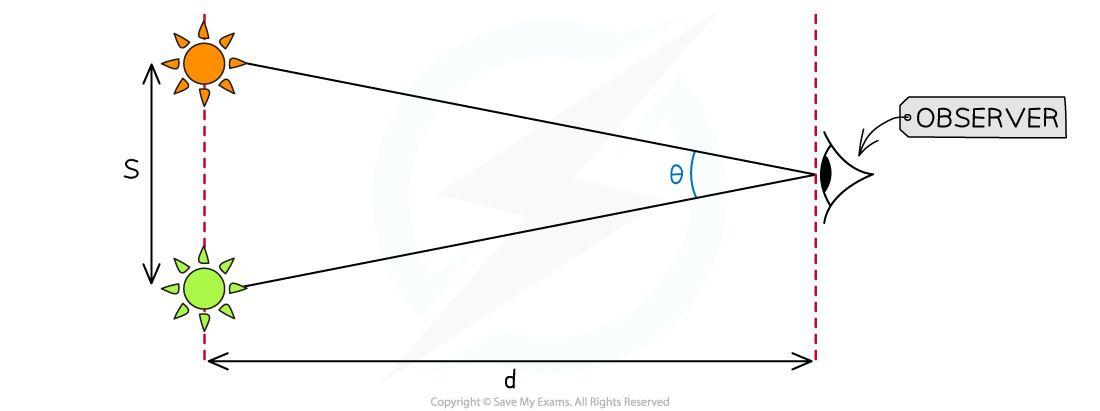
Angular separation, θ, is equal to the separation, s, of two sources divided by the distance, d, between the sources and the observer
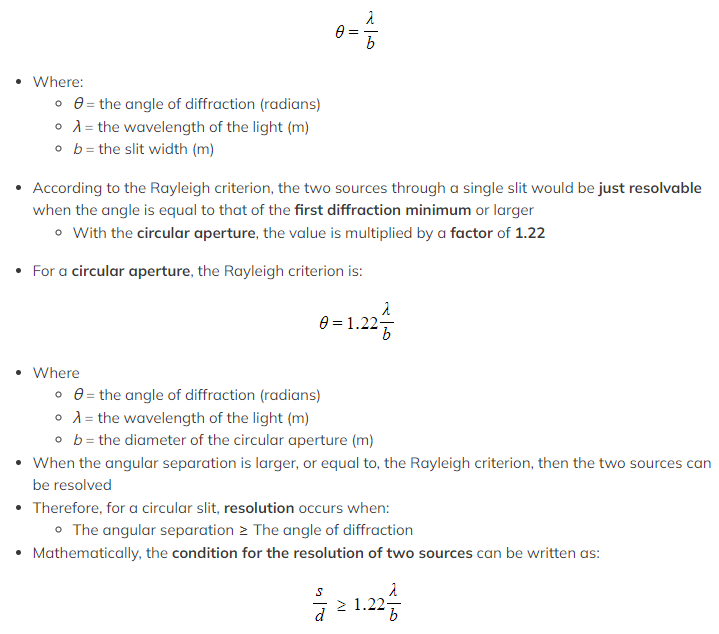
- In single slit diffraction, the first minimum occurs when the angle of diffraction is:
 Worked Example
A student looks at a helicopter in the night sky with one eye closed and can just resolve two lights as individual sources. The wavelength of both sources is 530 nm. The approximate diameter of the student’s pupil is 6.0 mm. The distance from the student to the helicopter is 6.0 km.
Determine the minimum distance between the lights.
-
- Wavelength of light sources, λ = 530 nm = 530 × 10−9 m
- Student pupil diameter, b = 6.0 mm = 6.0 × 10⁻³ m
- Distance from the helicopter light sources to the student's eye, d = 6.0 km = 6 × 10³ m
-
-
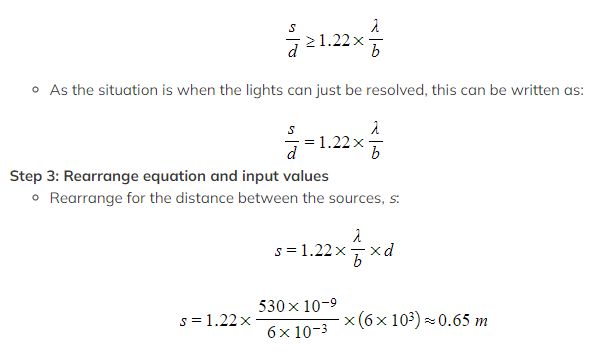
Since the lights can just be resolved, this is Rayleigh's criterion
-
The equation needed is:
-
-
-
The approximate distance between the light sources on the helicopter, s = 65 cm
-
Worked Example
A student views a car in the distance. It has headlights which are 1.5 m apart. The wavelength of light from the car headlights is 500 nm and the pupil diameter of the student is 4.0 mm.
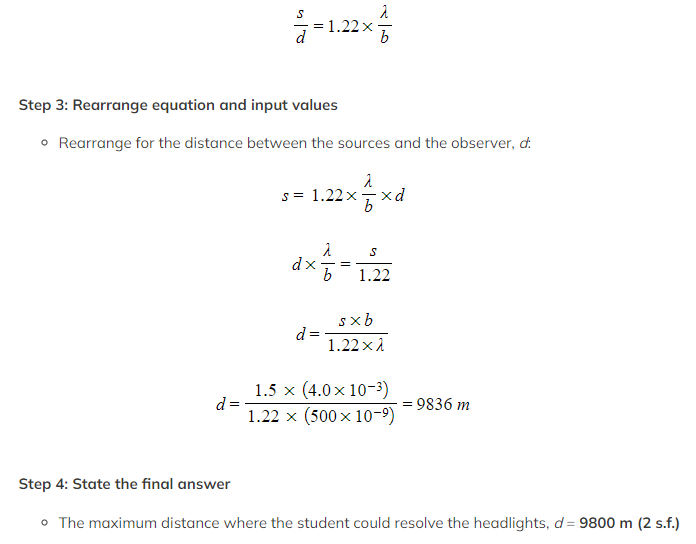
Estimate the maximum distance at which the two headlights could be resolved by the student.
-
-
Wavelength of light sources, λ = 500 nm = 500 × 10-9 m
-
Student pupil diameter, b = 4.0 mm = 4.0 × 10⁻³ m
-
Distance of separation between headlights, s = 1.5 m
-
-
-
Since the answer will occur when Rayleigh’s criterion is met, the equation needed is:
-
 Exam Tip
You might be curious where the factor of 1.22 comes from, however, the derivation of this is beyond the scope of the IB DP Physics course so just make sure you know how to use it in your calculations
转载自savemyexams
以上就是关于【IB DP Physics: HL复习笔记9.4.2 Rayleigh Criterion Calculations】的解答,如需了解学校/赛事/课程动态,可至翰林教育官网获取更多信息。
往期文章阅读推荐:
翰林独家 | 经济学竞赛核心精讲,一册打通NEC/IEO/USAEBO!
2026 AMC10/12美国数学竞赛新赛季!【翰林教育 × 清华大学出版社】独家教材全面发售!


翰林AMC8视频课重磅上线!

国际竞赛真题资源免费领取






