Edexcel IGCSE Physics 复习笔记 1.4.2 The Principle of Moments

Edexcel IGCSE Physics 复习笔记 1.4.2 The Principle of Moments
The Principle of Moments
- The principle of moments states that:
If an object is balanced, the total clockwise moment about a pivot equals the total anticlockwise moment about that pivot
- Remember that the moment = force × distance from a pivot
- The forces should be perpendicular to the distance from the pivot
- For example, on a horizontal beam, the forces which will cause a moment are those directed upwards or downwards
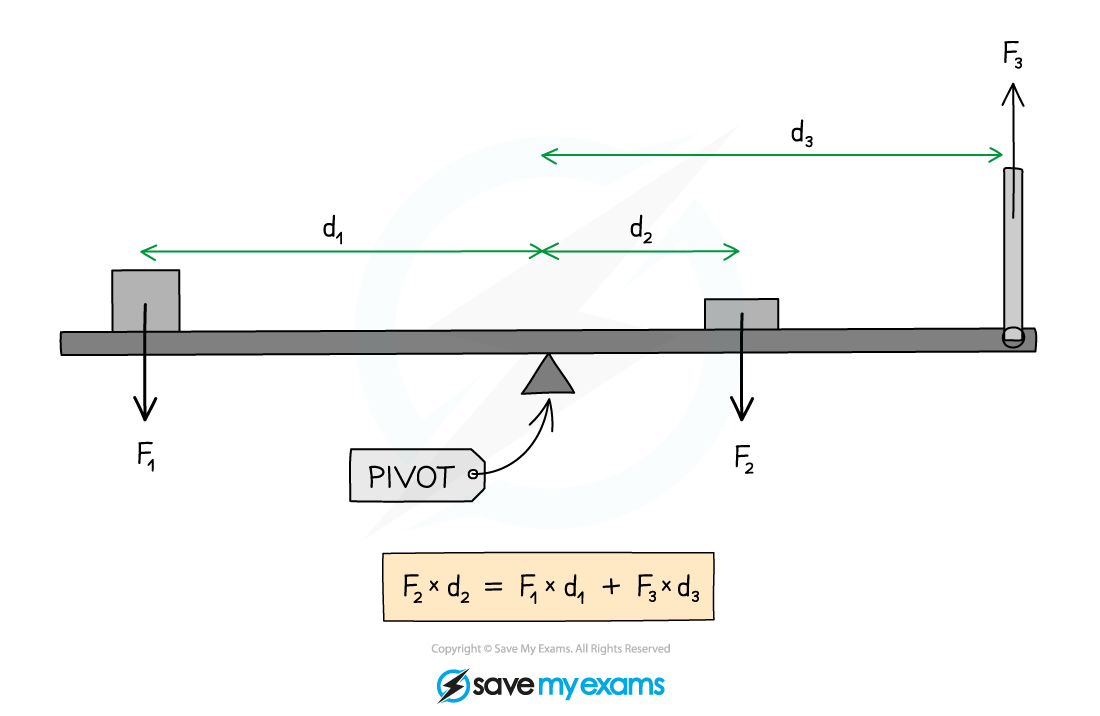
Moments on a balanced beam
- In the above diagram:
- Force F2 is supplying a clockwise moment;
- Forces F1 and F3 are supplying anticlockwise moments
- Due to the principle of moments, if the beam is balanced
Total clockwise moments = Total anticlockwise moments
- Hence:
F2 × d2 = (F1 × d1) + (F3 × d3)
Worked Example
A parent and child are at opposite ends of a playground see-saw. The parent weighs 690 N and the child weighs 140 N. The adult sits 0.3 m from the pivot.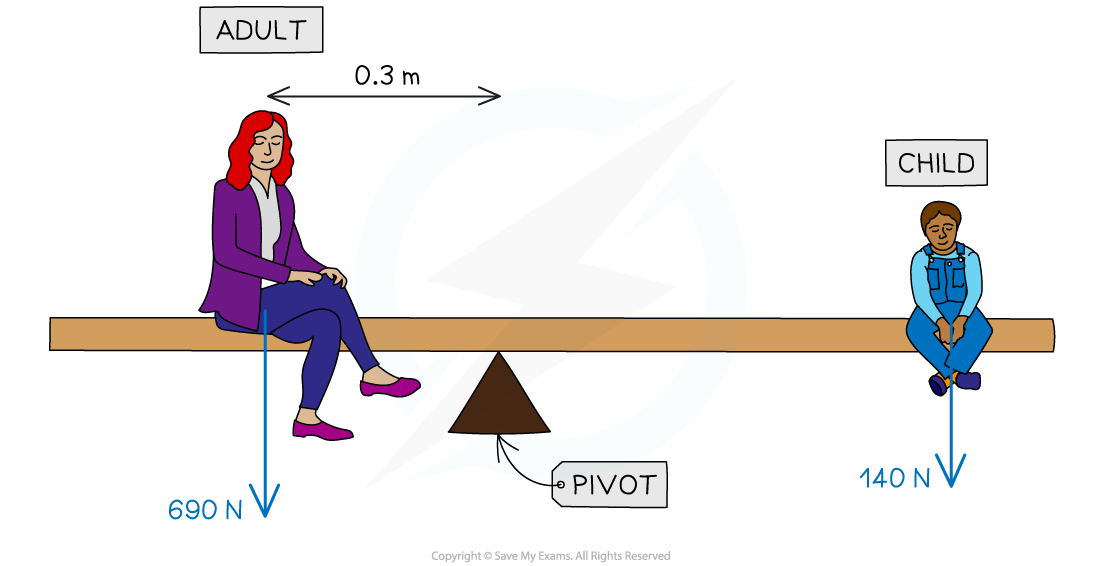 Calculate the distance the child must sit from the pivot for the see-saw to be balanced.
Step 1: List the know quantities
-
- Clockwise force (child), Fchild = 140 N
- Anticlockwise force (adult), Fadult = 690 N
- Distance of adult from the pivot, dadult = 0.3 m
Step 2: Write down the relevant equation
Moment = force × distance from pivot
-
- For the see-saw to balance, the principle of moments states that
Total clockwise moments = Total anticlockwise moments
Step 3: Calculate the total clockwise moments
-
- The clockwise moment is from the child
Momentchild = Fchild × dchild = 140 × dchild
Step 4: Calculate the total anticlockwise moments
-
- The anticlockwise moment is from the adult
Momentadult = Fadult × dadult = 690 × 0.3 = 207 Nm
Step 5: Substitute into the principle of moments equation
140 × dchild = 207
Step 6: Rearrange for the distance of the child from the pivot
dchild = 207 ÷ 140 = 1.48 m
Exam Tip
Make sure that all the distances are in the same units and you’re considering the correct forces as clockwise or anticlockwise, as seen in the diagram below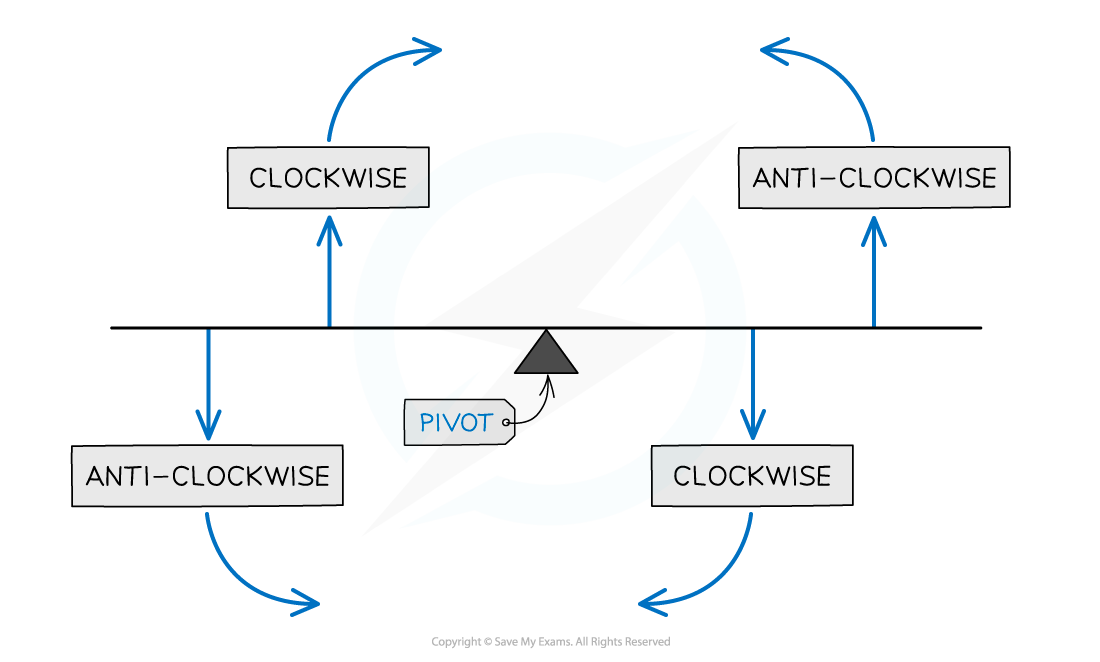 Clockwise is defined as the direction the hands of a clock move (and anticlockwise as the opposite)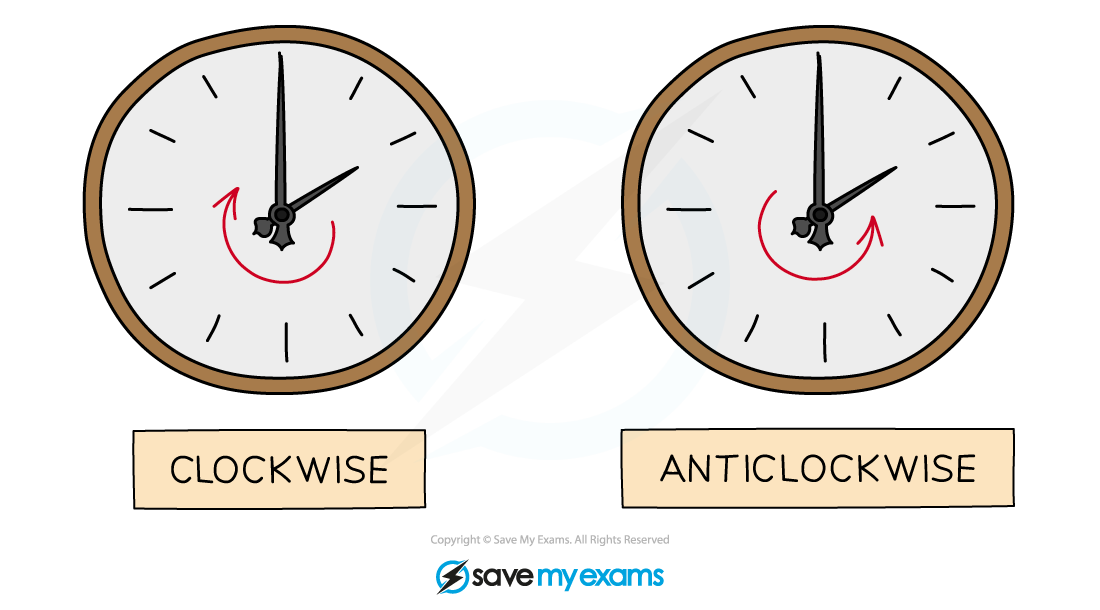
Supporting a Beam
- A light beam is one that can be treated as though it has no mass
- The supports, therefore, must supply upwards forces that balance the weight of any object placed on the beam
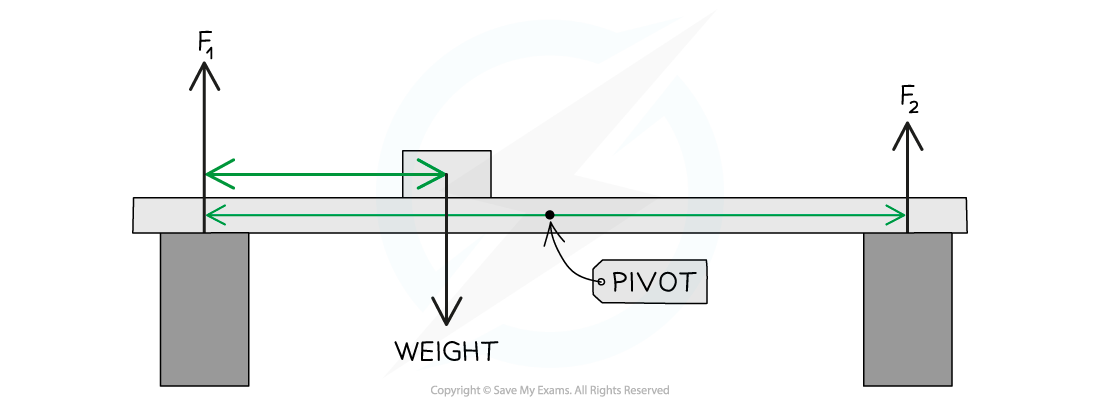
F1 and F2 upwards balance the weight of the beam downwards
- As the mass in the above diagram is moved from the left-hand side to the right-hand side of the beam, force F1 will decrease and force F2 will increase
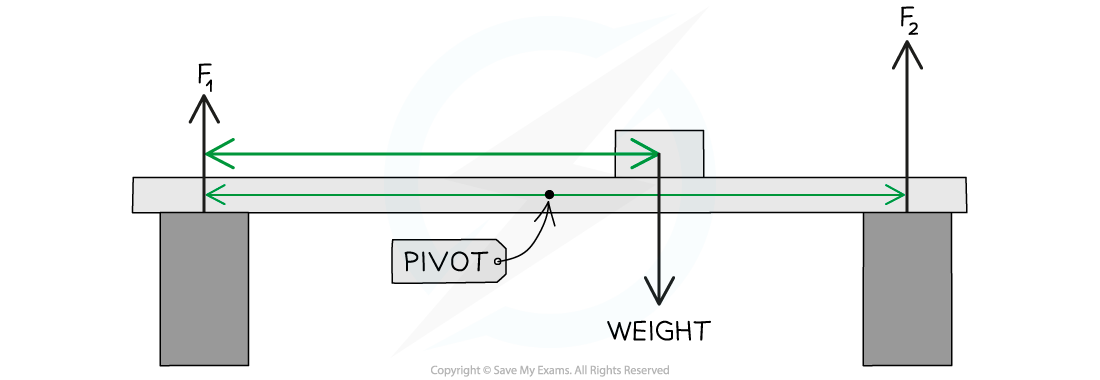
F1 decreases F2 increases keep the beam balanced
- Consider what would happen to the beam if the right-hand support was removed:
- Force F2 would be 0
- The weight of the object would supply a moment about the left-hand support, causing the beam to pivot in a clockwise direction
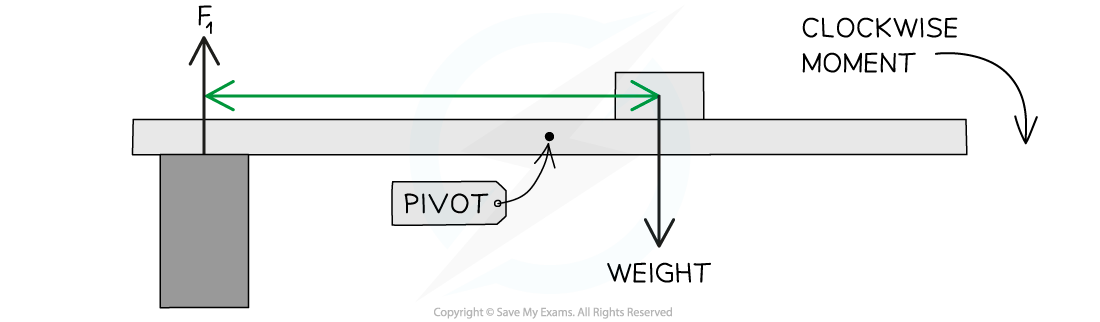
When F2 is removed the beam will rotate by the clockwise moment
- Therefore, the force F2 must therefore supply an anticlockwise moment about the left-hand support, which balances the moment supplied by the object
转载自savemyexam
以上就是关于【Edexcel IGCSE Physics 复习笔记 1.4.2 The Principle of Moments】的解答,如需了解学校/赛事/课程动态,可至翰林教育官网获取更多信息。
往期文章阅读推荐:
翰林独家 | 经济学竞赛核心精讲,一册打通NEC/IEO/USAEBO!
IGCSE全A*,A-Level阶段却崩了?别忽视IGCSE选课的重要性!


翰林AMC8视频课重磅上线!

国际竞赛真题资源免费领取






