AQA A Level Physics复习笔记6.2.1 Conditions for Simple Harmonic Motion

Conditions for Simple Harmonic Motion
- Simple harmonic motion (SHM) is a specific type of oscillation
- An oscillation is said to be SHM when:
- The acceleration is proportional to the displacement
- The acceleration is in the opposite direction to the displacement
- Examples of oscillators that undergo SHM are:
- The pendulum of a clock
- A mass on a spring
- Guitar strings
- The electrons in alternating current flowing through a wire
- These are always periodic, meaning they are repeated in regular intervals according to their frequency or time period
- Acceleration a and displacement x can be represented by the defining equation of SHM:
a ∝ −x
- An object in SHM will also have a restoring force to return it to its equilibrium position
- This restoring force will be directly proportional, but in the opposite direction, to the displacement of the object from the equilibrium position
- Note: the restoring force and acceleration act in the same direction
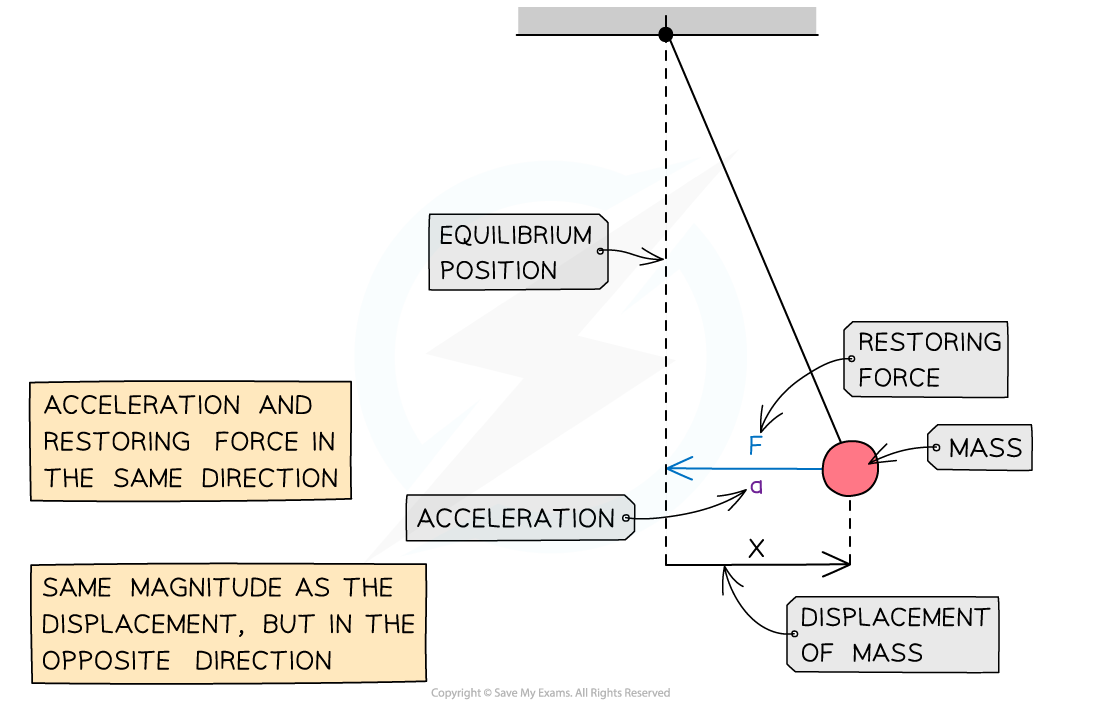
Force, acceleration and displacement of a pendulum in SHM
- This is why a person jumping on a trampoline is not an example of simple harmonic motion:
- The restoring force on the person is not proportional to their distance from the equilibrium position
- When the person is not in contact with the trampoline, the restoring force is equal to their weight, which is constant
- This does not change, even if they jump higher
Acceleration
- The acceleration of an object oscillating in simple harmonic motion is:
a = −⍵2x
- Where:
- a = acceleration (m s-2)
- ⍵ = angular frequency (rad s-1)
- x = displacement (m)
- This is used to find the acceleration of an object with a particular angular frequency ⍵ at a specific displacement x
- The equation demonstrates:
- The acceleration reaches its maximum value when the displacement is at a maximum ie. x = A (amplitude)
- The minus sign shows that when the object is displaced to the right, the direction of the acceleration is to the left and vice versa (a and x are always in opposite directions to each other)
Displacement
- The graph of acceleration against displacement is a straight line through the origin sloping downwards (similar to y = −x)
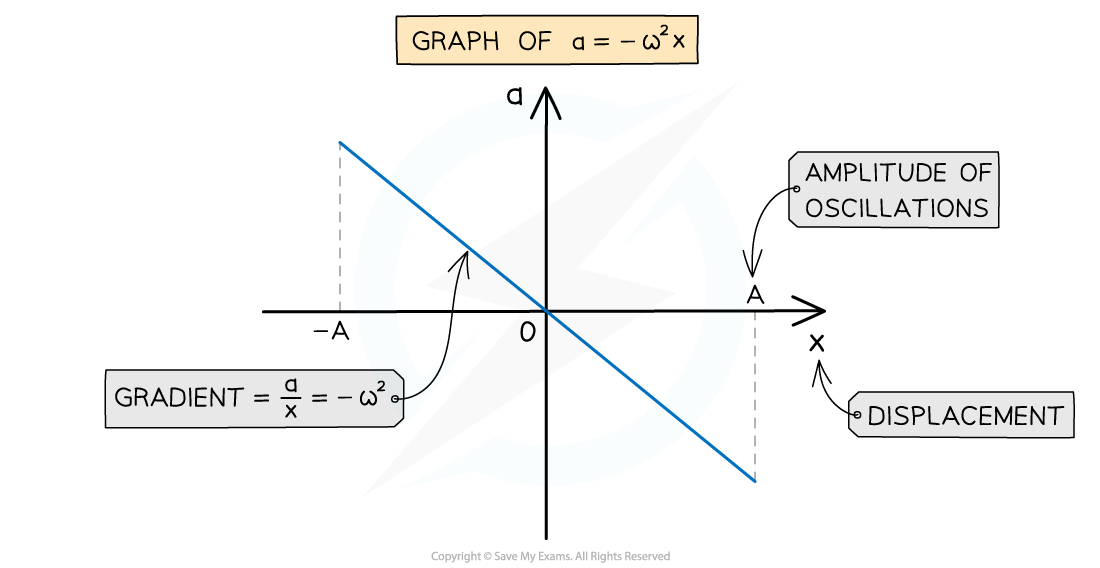
The acceleration of an object in SHM is directly proportional to the negative displacement
- The key features of the graph are:
- The gradient is equal to −⍵2
- The maximum and minimum displacement x values are the amplitudes −A and +A
- A solution to the SHM acceleration equation is the displacement equation:
x = A cos (⍵t)
- Where:
- A = amplitude (m)
- t = time (s)
- This occurs when:
- An object is oscillating from its amplitude position (x = A or x = −A at t = 0)
- The displacement will be at its maximum when cos(⍵t) equals 1 or −1, when x = A
- This equation can be used to find the position of an object in SHM with a particular angular frequency and amplitude at a moment in time
- If an object is oscillating from its equilibrium position (x = 0 at t = 0) then the displacement equation will be:
x = A sin (⍵t)
- The displacement will be at its maximum when sin(⍵t) equals 1 or −1, when x = A
- This is because the sine graph starts at 0, whereas the cosine graph starts at a maximum
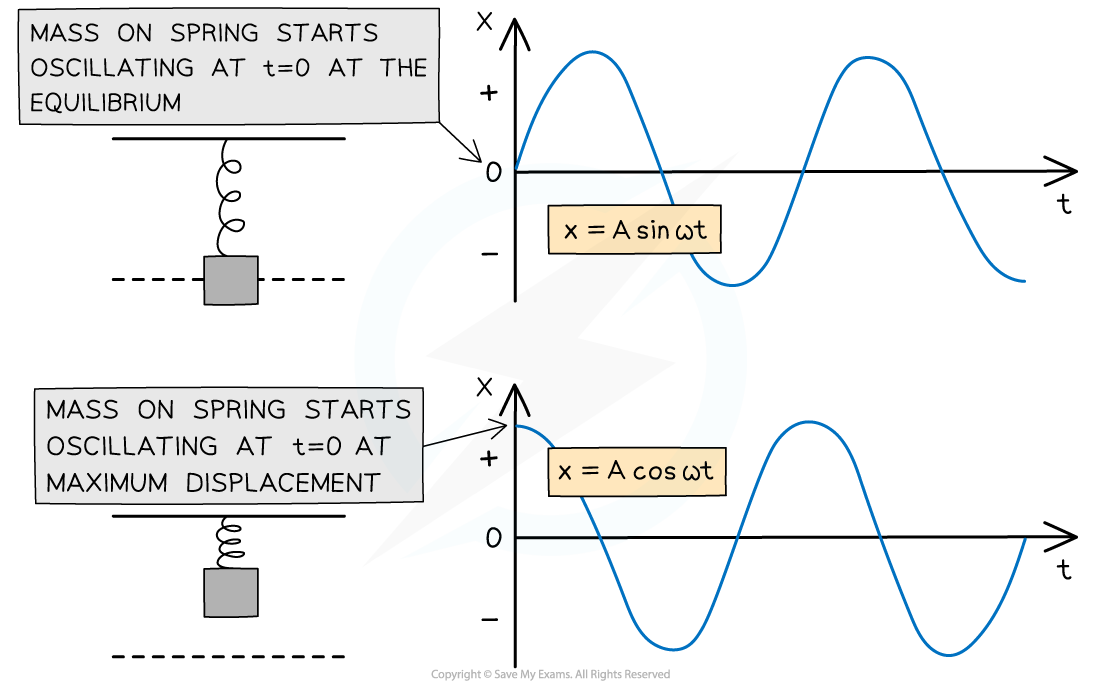
These two graphs represent the same SHM. The difference is the starting position
Speed
- The speed of an object in simple harmonic motion varies as it oscillates back and forth
- Its speed is the magnitude of its velocity
- The greatest speed of an oscillator is at the equilibrium position ie. when its displacement x = 0
- How the speed v changes with the oscillator’s displacement x in SHM is defined by:

- Where:
-
- v = speed (m s-1)
- A = amplitude (m)
- ± = ‘plus or minus’. The value can be negative or positive
- ⍵ = angular frequency (rad s-1)
- x = displacement (m)
- This equation shows that when an oscillator has a greater amplitude A, it has to travel a greater distance in the same time and hence has greater speed v
- Although the symbol v is commonly used to represent velocity, not speed, exam questions focus more on the magnitude of the velocity than its direction in SHM
Worked Example
A mass of 55 g is suspended from a fixed point by means of a spring. The stationary mass is pulled vertically downwards through a distance of 4.3 cm and then released at t = 0. The mass is observed to perform simple harmonic motion with a period of 0.8 s. Calculate the displacement x, in cm, of the mass at time t = 0.3 s.
Step 1: Write down the SHM displacement equation
Since the mass is released at t = 0 at its maximum displacement, the displacement equation will be with the cosine function:
x = Acos(⍵t)
Step 2: Calculate angular frequency

Remember to use the value of the time period given, not the time where you are calculating the displacement from
Step 3: Substitute values into the displacement equation
x = 4.3cos (7.85 × 0.3) = –3.0369… = –3.0 cm (2 s.f)
Make sure the calculator is in radians mode
The negative value means the mass is 3.0 cm on the opposite side of the equilibrium position to where it started (3.0 cm above it)
Worked Example
A simple pendulum oscillates with simple harmonic motion with an amplitude of 15 cm. The frequency of the oscillations is 6.7 Hz. Calculate the speed of the pendulum at a position of 12 cm from the equilibrium position.
Step 1: Write out the known quantities
-
- Amplitude of oscillations, A = 15 cm = 0.15 m
- Displacement at which the speed is to be found, x = 12 cm = 0.12 m
- Frequency, f = 6.7 Hz
Step 2: Oscillator speed with displacement equation
-
- Since the speed is being calculated, the ± sign can be removed as direction does not matter in this case
Step 3: Write an expression for the angular frequency
-
- Equation relating angular frequency and normal frequency:
⍵ = 2πf = 2π× 6.7 = 42.097…
Step 4: Substitute in values and calculate

v = 3.789 = 3.8 m s-1 (2 s.f)
Exam Tip
Since displacement is a vector quantity, remember to keep the minus sign in your solutions if they are negative, you could lose a mark if not! Also, remember that your calculator must be in radians mode when using the cosine and sine functions. This is because the angular frequency ⍵ is calculated in rad s-1, not degrees. You often have to convert between time period T, frequency f and angular frequency ⍵ for many exam questions – so make sure you revise the equations relating to these.
转载自savemyexams
以上就是关于【AQA A Level Physics复习笔记6.2.1 Conditions for Simple Harmonic Motion】的解答,如需了解学校/赛事/课程动态,可至翰林教育官网获取更多信息。
往期文章阅读推荐:
翰林独家 | 经济学竞赛核心精讲,一册打通NEC/IEO/USAEBO!
2026 ALEVEL 夏考A率出炉!爱德思vs牛津AQA,哪些科目真的“好出分”?


翰林AMC8视频课重磅上线!

国际竞赛真题资源免费领取






