AQA A Level Physics复习笔记5.3.2 Series & Parallel Circuits

Series & Parallel Circuits
Current
- In a series circuit, the current is the same for all components
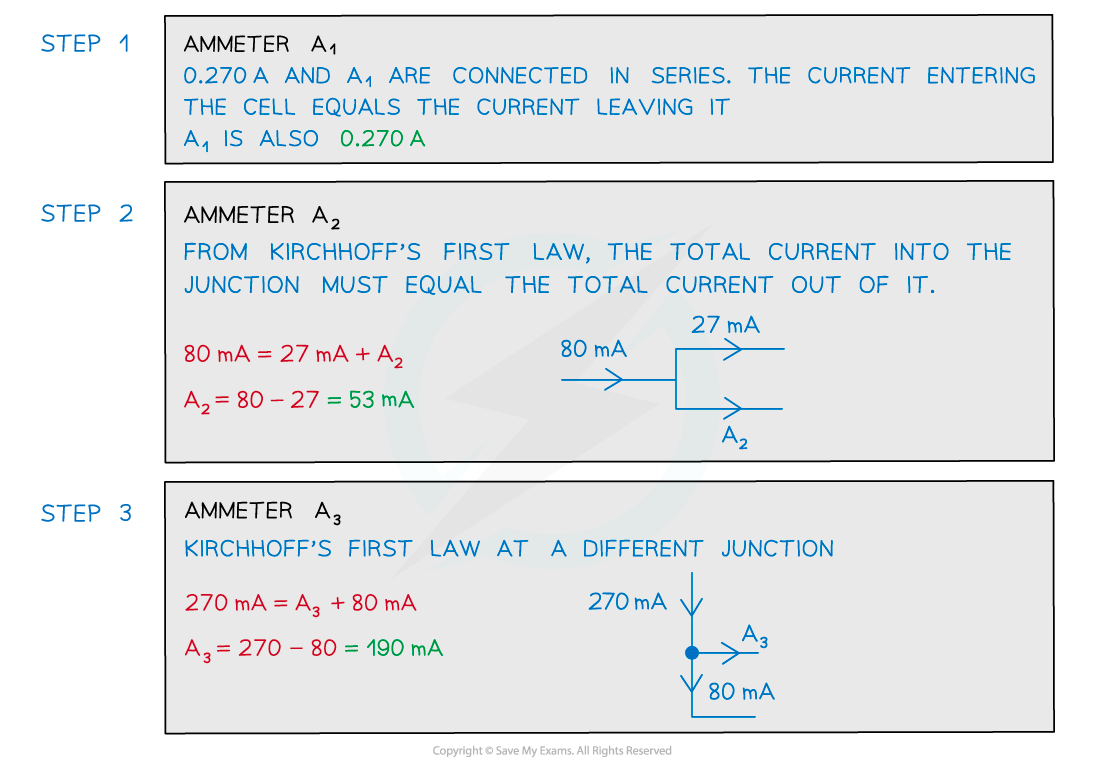
- In a parallel circuit, the current is split across the different branches (or junction). The total current into a junction must equal the total current out of a junction
- The amount of current in each branch depends on the total resistance of the components within that branch
Worked Example
For the circuit below, state the readings of ammeters A1, A2 and A3.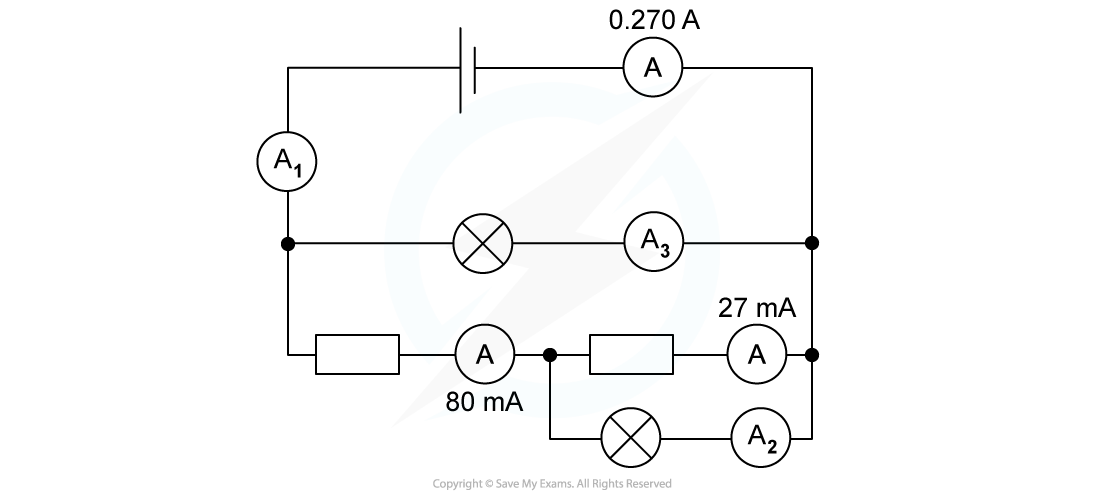
Potential Difference
- In a series circuit, the e.m.f of the power supply is shared amongst all the components in different amounts, depending on their resistance
- In a parallel circuit, the voltage of all the components in each branch is equal to the e.m.f of the power supply
Worked Example
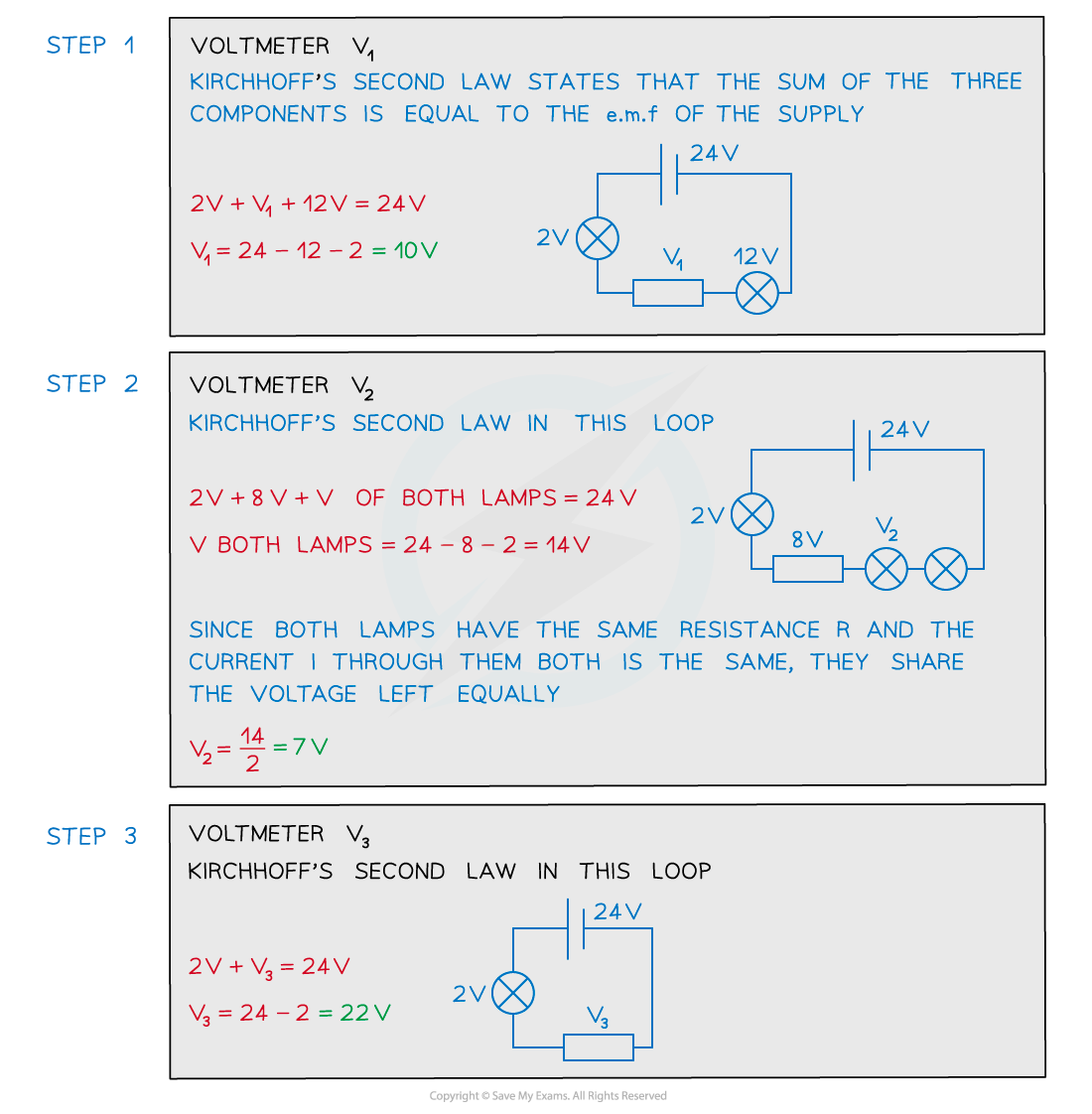
For the circuit below, state the readings of the voltmeters V1, V2 and V3.All the lamps and resistors have the same resistance.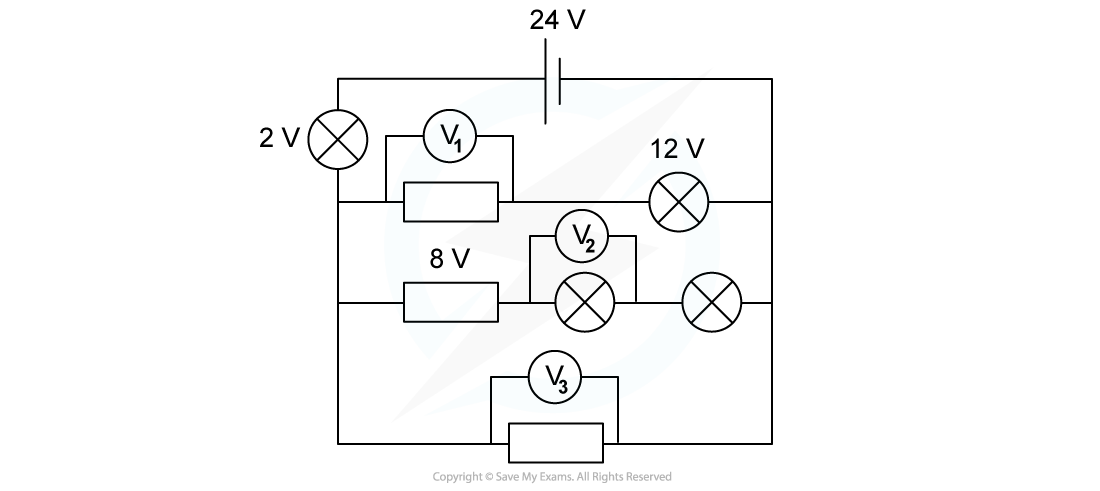
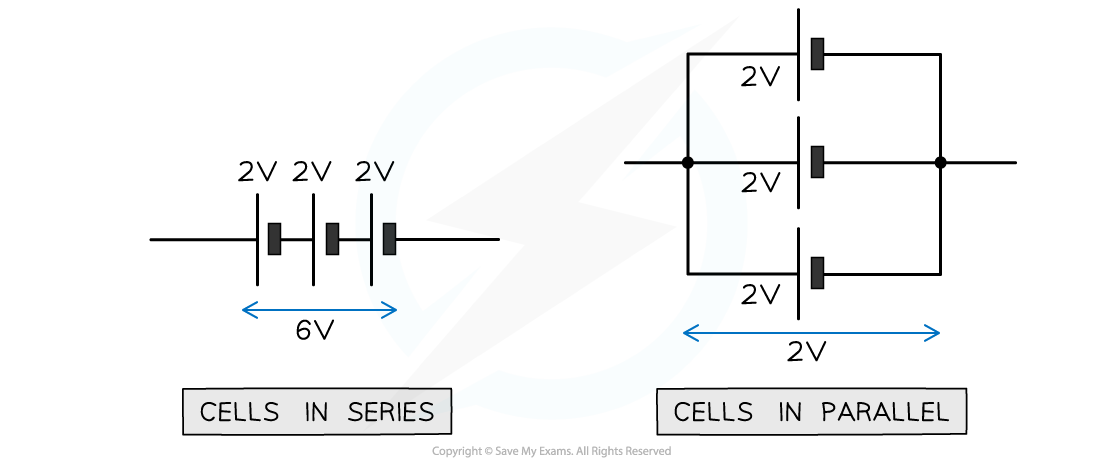
- Cells can also be connected in series or parallel
- The total voltage of the combined cells can be calculated in the same way as voltage
- If the cells are connected in series, the total voltage between the ends of the chain of cells is the sum of the potential difference across each cell
- If the cells are connected in parallel, the total voltage across the arrangement is the same as for one cell
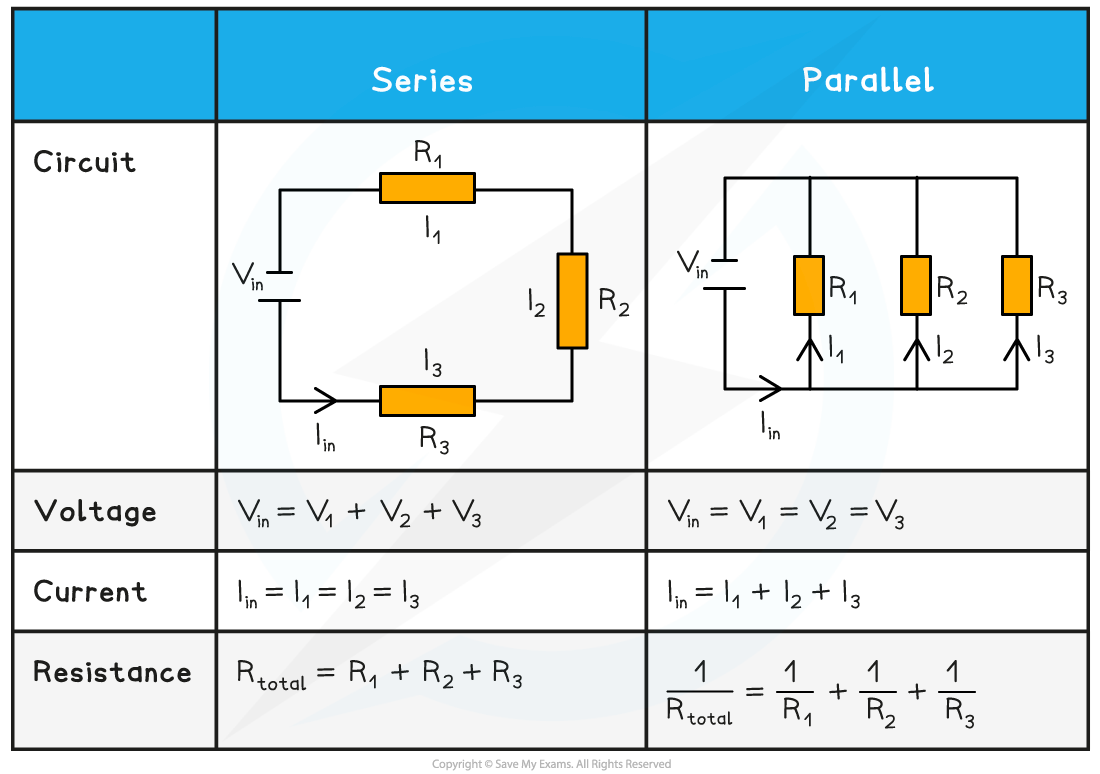
- A summary of the current, voltage and resistance within a series and parallel circuit are summarised below:
Table of Voltage, Current & Resistance in Series & Parallel Circuits
Exam Tip
The best way to practice these calculations is to understand why you have made a mistake. Common mistakes are:
- Thinking the current is the same through every branch in a parallel circuit
- Thinking the voltage is the same through all components in a series circuit
- Not taking into account multiple resistors
- Not calculating the total resistance using the appropriate parallel or series resistance equation
- The sum of the voltages of all the components in a series circuit not adding up to the e.m.f of the supply
- The current into a junction not being equal to the current out of a junction (Kirchoff’s First Law)
Don’t be afraid to annotate circuit diagrams to help with this. The more information you have about all the components, the easier it is to calculate values that are missing
Conservation of Charge & Energy
Conservation of Charge
- Charge is never used up or lost in a circuit - this is known as conservation of charge
- As a result of this, for current in a parallel circuit:
The sum of the currents entering a junction always equal the sum of the currents out of the junction
- This is sometimes known as Kirchhoff's First Law
- In a circuit:
- A junction is a point where at least three circuit paths meet
- A branch is a path connecting two junctions
- If a circuit splits into two branches, then the current before the circuit splits should be equal to the current after it has split
- In the circuit below, I = I1 + I2+ I3, where I represents the current in the circuit before it branches, and I1, I2 and I3 represent the current in the respective three branches:
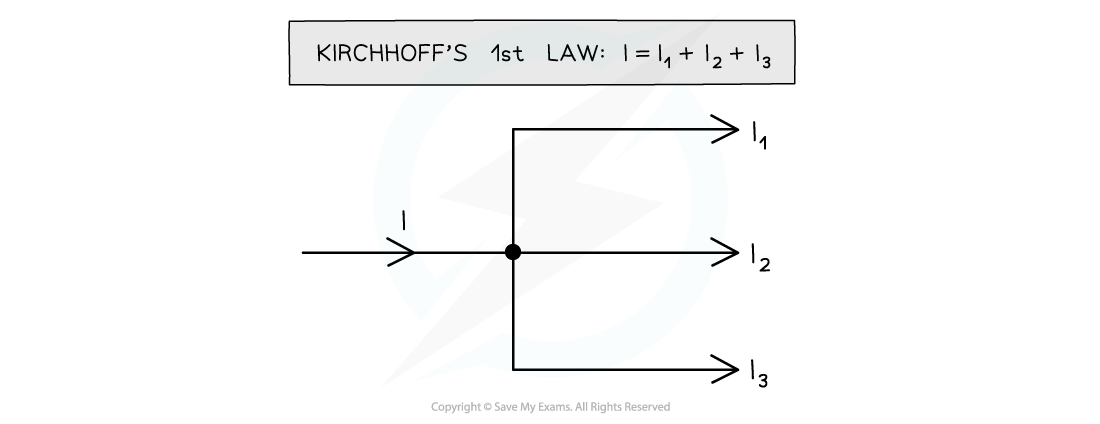
The current I into the junction is equal to the sum of the currents out of the junction
- The charge is conserved on both sides of the junction
- In a series circuit, the current is the same through all components
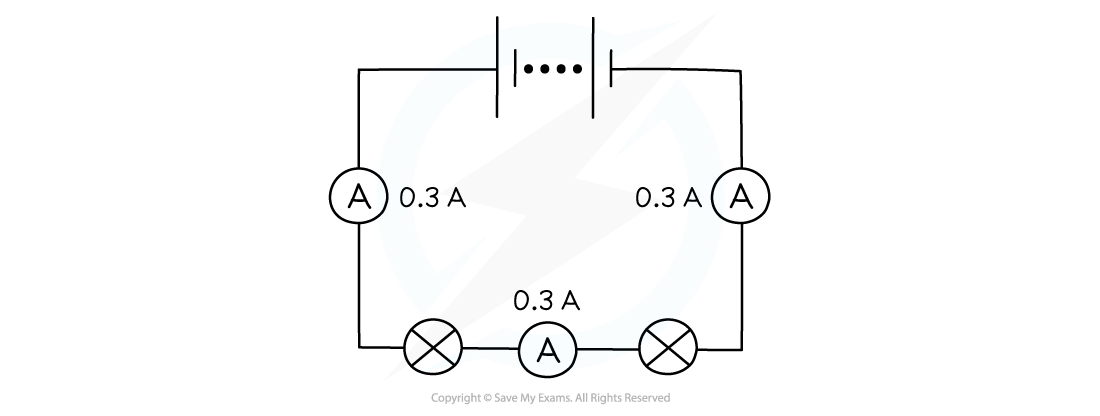
The current is the same at each point in a series circuit
- In a parallel circuit, the current divides at the junctions and each branch has a different value
- Kirchhoff’s First Law applies at each junction
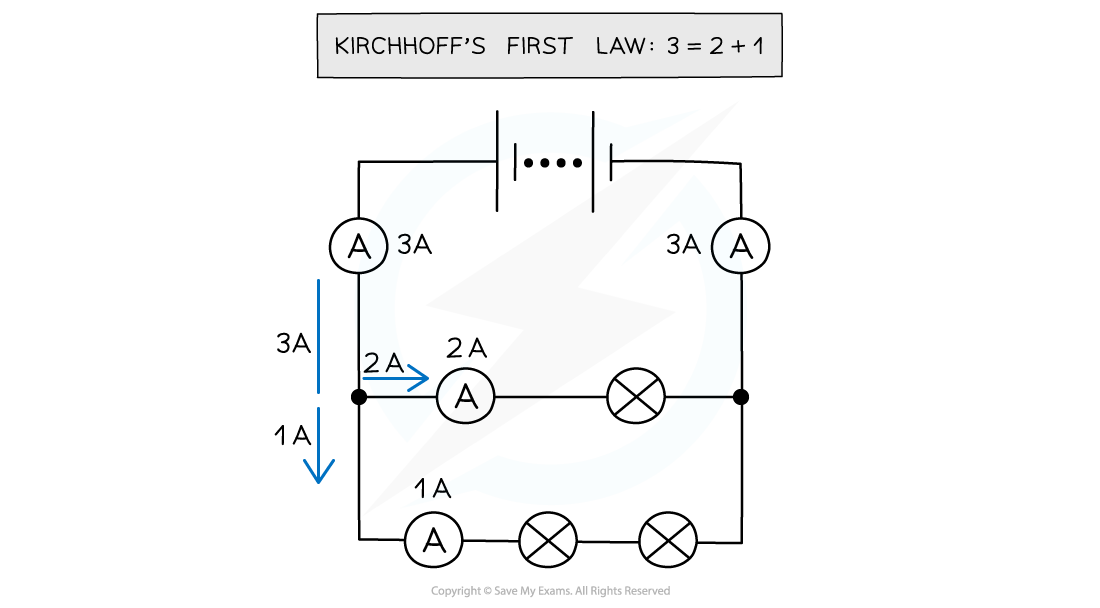
The current divides at each junction in a parallel circuit
Conservation of Energy
- Energy is never used up or lost in a circuit - this is known as conservation of energy
- As a result of this, for voltage in any circuit:
The total e.m.f. in a closed circuit equals the sum of the potential differences across each component
- This is sometimes known as Kirchhoff's Second Law
- Each closed circuit can be treated like a series circuit
- Below is a circuit explaining Kirchhoff’s Second Law with the sum of the voltages in the closed series circuit equal to the total e.m.f:
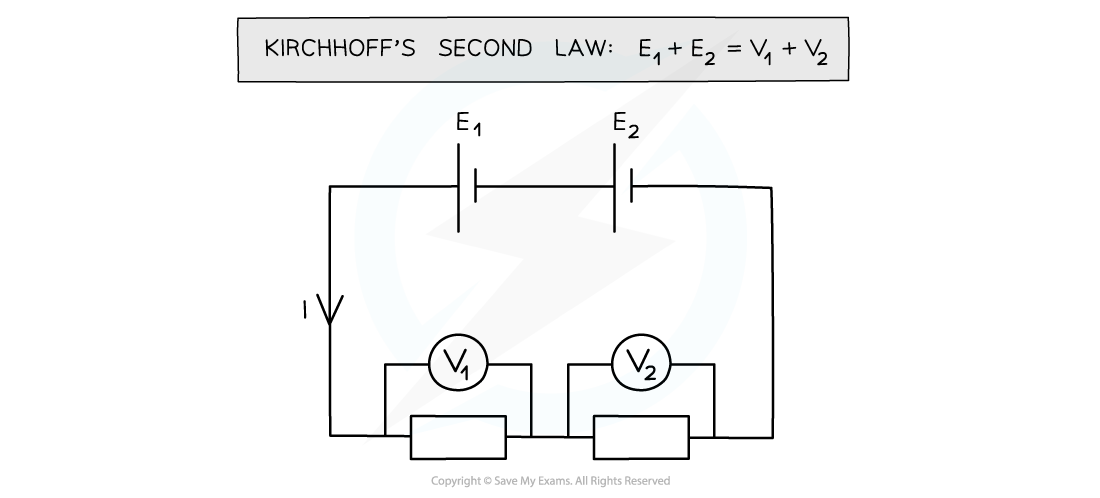
The sum of the voltages is equal to the total e.m.f from the batteries
- In a series circuit, the voltage is split across all components depending on their resistance
- The sum of the voltages is equal to the total e.m.f of the power supply
- In a parallel circuit, the voltage is the same across each closed loop
- The sum of the voltages in each closed circuit loop is equal to the total e.m.f of the power supply:
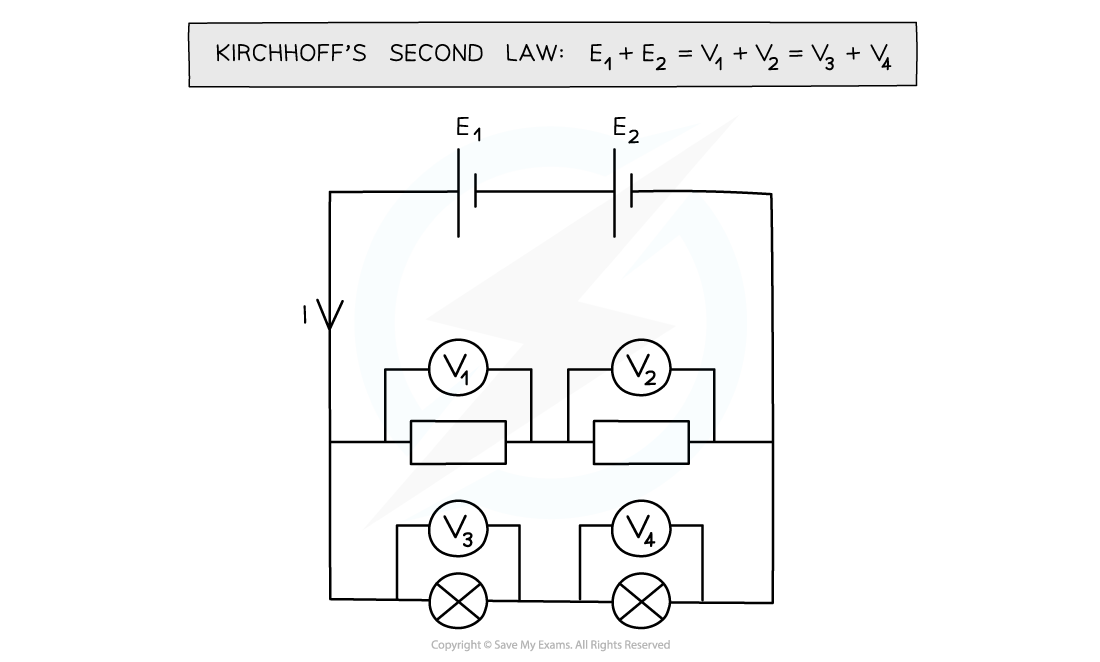
The sum of the e.m.fs in each closed loop is equal to the total e.m.f of the power supply
- A closed-circuit loop acts as its own independent series circuit and each one separates at a junction. A parallel circuit is made up of two or more of these loops
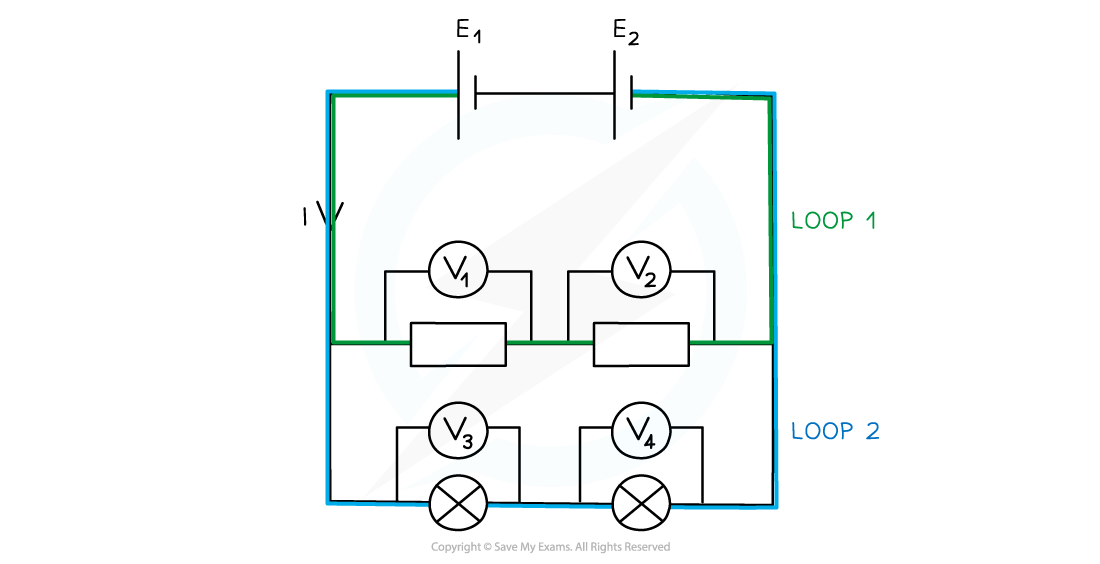
Each circuit loops acts as a separate, independent series circuit
- This makes parallel circuits incredibly useful for home wiring systems
- A single power source supplies all lights and appliances with the same voltage
- If one light breaks, voltage and current can still flow through for the rest of the lights and appliances
Exam Tip
Junctions only appear in parallel circuits and as circuits become more complex, it can be confusing as to which currents are into the junction and which are out.Drawing arrows on the diagram for the current flow (making sure it’s from positive to negative) at each junction will help with this
转载自savemyexams
以上就是关于【AQA A Level Physics复习笔记5.3.2 Series & Parallel Circuits】的解答,如需了解学校/赛事/课程动态,可至翰林教育官网获取更多信息。
往期文章阅读推荐:
翰林独家 | 经济学竞赛核心精讲,一册打通NEC/IEO/USAEBO!
2026 ALEVEL 夏考A率出炉!爱德思vs牛津AQA,哪些科目真的“好出分”?


翰林AMC8视频课重磅上线!

国际竞赛真题资源免费领取






