AQA A Level Biology复习笔记2.4.6 Osmosis in Plant Cells

Osmosis: Plant Cells
- Osmosis is the net movement of water molecules from a region of higher water potential (dilute solution) to a region of lower water potential (concentrated solution), through a partially permeable membrane
- If a plant cell is placed in pure water or a dilute solution, water will enter the plant cell through its partially permeable cell surface membrane by osmosis, as the pure water or dilute solution has a higher water potential than the plant cell
- As water enters the vacuole of the plant cell, the volume of the plant cell increases
- The expanding protoplast (living part of the cell inside the cell wall) pushes against the cell wall and pressure builds up inside the cell – the inelastic cell wall prevents the cell from bursting
- The pressure created by the cell wall also stops too much water entering and this also helps to prevent the cell from bursting
- When a plant cell is fully inflated with water and has become rigid and firm, it is described as fully turgid
- This turgidity is important for plants as the effect of all the cells in a plant being firm is to provide support and strength for the plant – making the plant stand upright with its leaves held out to catch sunlight
- If plants do not receive enough water the cells cannot remain rigid and firm (turgid) and the plant wilts
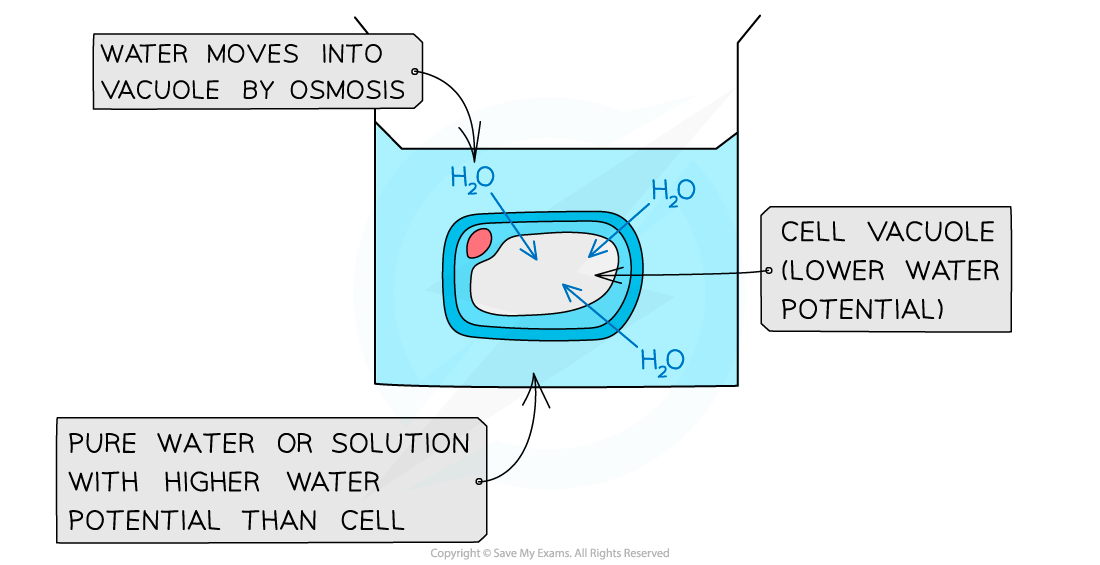
Osmosis of water into a plant cell
- If a plant cell is placed in a solution with a lower water potential than the plant cell (such as a concentrated sucrose solution), water will leave the plant cell through its partially permeable cell surface membrane by osmosis
- As water leaves the vacuole of the plant cell, the volume of the plant cell decreases
- The protoplast gradually shrinks and no longer exerts pressure on the cell wall
- As the protoplast continues to shrink, it begins to pull away from the cell wall
- This process is known as plasmolysis – the plant cell is plasmolysed
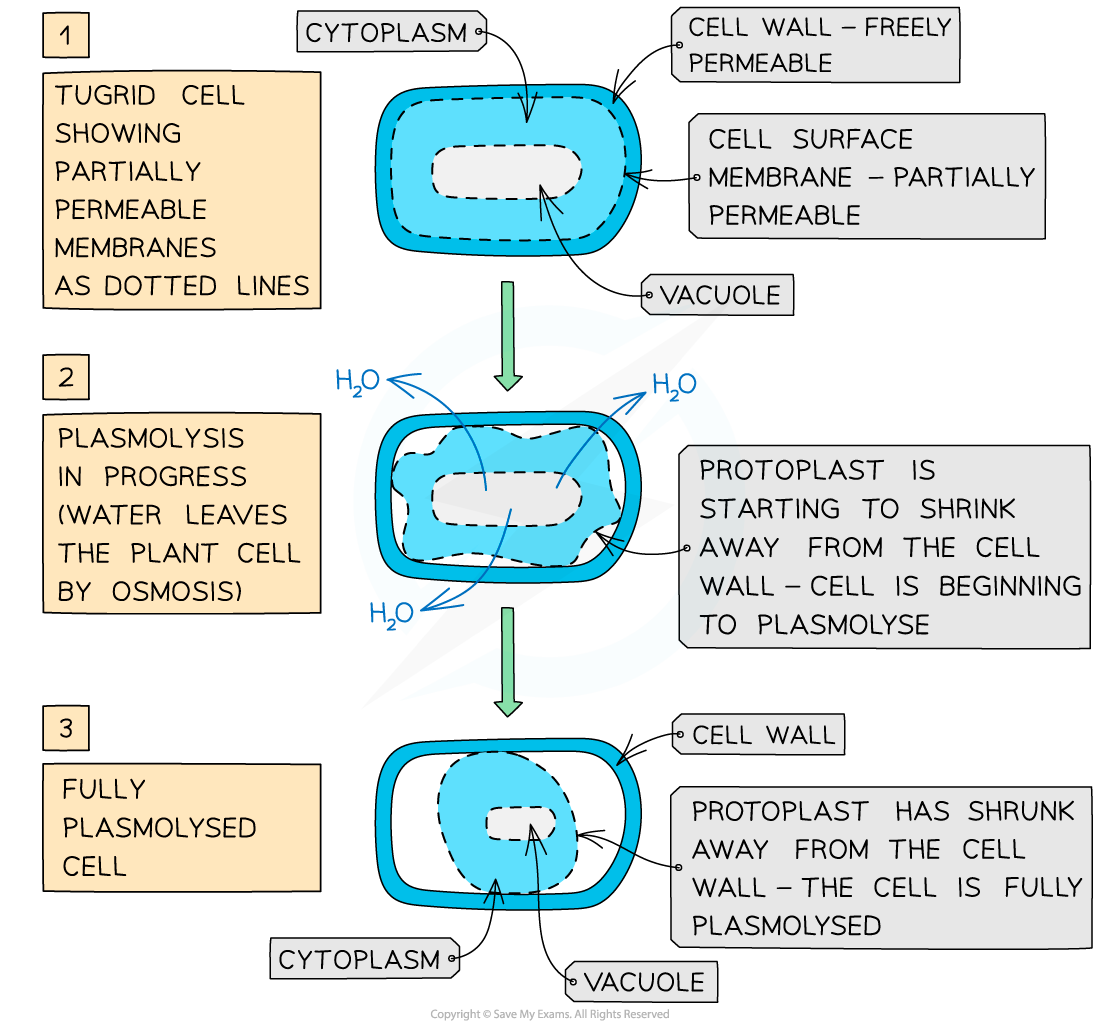
Plasmolysis of a plant cell that has been placed in a solution with a lower water potential than the cell itself
Exam Tip
Remember – plant cell membranes are composed of a phospholipid bilayer and are partially permeable (only certain molecules can cross), whereas plant cell walls are made of cellulose and are freely permeable. Thus, in a plasmolysed cell, the external solution will be exerting pressure on the protoplast, that is, there is not an empty space between the cell wall and protoplast.Pure water has a water potential of 0 kPa, so all other solutions will have negative water potentials.
转载自savemyexams
以上就是关于【AQA A Level Biology复习笔记2.4.6 Osmosis in Plant Cells】的解答,如需了解学校/赛事/课程动态,可至翰林教育官网获取更多信息。
往期文章阅读推荐:
翰林独家 | 经济学竞赛核心精讲,一册打通NEC/IEO/USAEBO!
2026 ALEVEL 夏考A率出炉!爱德思vs牛津AQA,哪些科目真的“好出分”?


翰林AMC8视频课重磅上线!

国际竞赛真题资源免费领取






