2025HIMCM全球高中生数模赛A题

2025HiMCM全球高中生数模赛A题全文如下
Problem A:Emergency Evacuation Sweeps
During emergencies such as fires or gas leaks, rapid and orderly evacuation of a building is critical for saving lives. Trained personnel responding to these emergencies (responders) often sweep a building – going from area to area and room to room – to ensure all occupants have evacuated safely or are actively moving towards the exits. This would include visually assessing, if possible, all spaces to confirm that they are empty with the goal of guaranteeing no one is left behind.
The efficiency and strategy behind these sweeps could mean the difference between safety and true peril.
Your team has been asked by the Clearing Of Multi-use Assembly Public/Private spaces (COMAP) with designing a mathematical model to optimize sweeping strategies in multi-floor buildings during emergency evacuations. The goal is to ensure all rooms are cleared in the shortest possible time, while prioritizing occupant safety and responder efficiency. Buildings vary in layout, number of floors, stairwell placement, location of exits, and occupancy patterns while responders face pressure to act quickly with sometimes limited information. These considerations must be included in your analysis.
Requirements.
1. Understand the Problem. Clearly identify key elements of this problem that would inform your model, including but not limited to:
• Criteria used to determine if a room is all-clear,
• Occupants within or layout of a room (does it matter if it is a children’s daycare versus office space versus warehouse, etc.),
• Number and type of expertise of responders needed,
• Amount and type of redundancy, if any, to incorporate into sweep strategies,
• Type of emergency,
and so on.
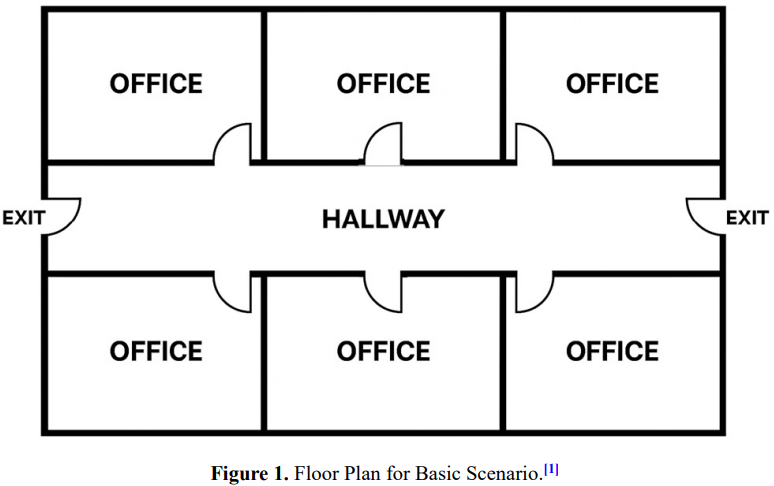
2. Create Your Building Sweep Model. Consider using a basic scenario of two fire fighters that will sweep a one-story office building with two exits on opposite sides of the building as shown in Figure 1. There are three similar sized rooms on each side of the hallway connected to the central hallway. Develop a model to simulate how the responders can sweep this building efficiently during a fire alarm. How long will it take for the two fire fighters to complete this sweep?
When building the model, teams should consider the key elements identified above such as floor plan layout, number of responders, rules of movement and sweep verification, possible presence of smoke, etc.
3. Apply Your Model. Design and analyze at least two additional building layouts with a varying number of responders. For the additional layouts, you must change the number of floors, the floor plan on each floor, and the occupants of the rooms. For each scenario, use your model to determine:
• The order of rooms to be checked (or paths used during a sweep),
• The optimal number of responders and their starting positions,
• The minimum time to fully sweep the building.
Ensure that your building layouts showcase the value of your model.
4. Expand Your Model and Reflect on Your Analysis.
a. Extend your model to include the incorporation of more realistic constraints during the sweep and other emergencies, like fires or gas leaks. Factors you might consider include:
• Communication delay or failure,
• Occupants’ awareness of an emergency (e.g., odorless gas leak, emergency in another part of the building),
• Time-varying hazards (e.g., fire spreading, decreased visibility),
• People moving dynamically during evacuation,
• Prioritization of high-risk areas (e.g., labs, childcare rooms),
• Fewer than optimal responders,
• Non-standard building layout.
b. Consider how the addition of technology, such as sensors or building automation, might impact your model. Discuss what technologies you recommend for the building layouts you considered above.
5. Share Your Model and its Results. Write a one-to-two-page letter with practical recommendations for the Local Emergency Planning Committee. This letter should include:
• An Evacuation Sweep Strategy based on your findings. It should clearly state how to plan sweeps and assign responders as well as the strategies to use to ensure redundancy and speed without sacrificing safety.
• A set of actionable recommendations for strategies. This should be based on different building types with different floor plan layouts and various types of occupants.
Your PDF solution of no more than 25 total pages should include:
• One-page Summary Sheet.
• Table of Contents.
• Your complete solution.
• One-to-two-page letter to the Local Emergency Planning Committee.
• References list.
• Report on Use of AI Tools (If used does not count toward the 25-page limit.).
Glossary
Floor Plan Layout - A diagram showing the physical structure of a building including the arrangement of rooms, connecting hallways, stairwells, and designated exits (e.g., Figure 1).
Local Emergency Planning Committee – This committee develops and implements comprehensive emergency management programs and activities, including providing information to organizations and communities.
Occupants – The people that are in the building being evacuated during a sweep. (e.g., children and teachers in a childcare room or employees in an office building).
Redundancy - The deliberate overlap in coverage or responsibility to ensure reliability and completeness. In a sweep operation, redundancy might mean assigning multiple responders or teams to recheck certain areas, or using multiple verification methods to confirm a space is clear.
Responders - Trained personnel responding to emergencies that must often sweep a building. (e.g., security guards, fire fighters, police, other law enforcement, emergency medical technician, etc.)
Rules of Movement – A set of operational procedures that govern how responders move through the environment. Examples include Responders must check/clear each room before proceeding or there are restrictions on certain paths (e.g., no use of elevators during emergencies).
Sweep Verification - The process used to confirm that a specific area has been fully searched and cleared. Verification may involve visual confirmation, marking cleared rooms, communication logs, or digital tracking systems to prevent duplication or missed areas.
Reference
[1] OpenAI. (2025). ChatGPT (Oct 15 version) [Large language model]. https://chat.openai.com/
Report on Use of AI Tools
OpenAI ChatGPT (October 15, 2025 version, ChatGPT-5)
Query: Can you draw me a floor plan of one-story office building with two exits on opposite sides of the building. Imagine there are three similar sized rooms on each side of the hallway with the rooms only connected to the central hallway.
Output: See Figure 1.
以上就是关于【2025HIMCM全球高中生数模赛A题】的解答,如需了解学校/赛事/课程动态,可至翰林教育官网获取更多信息。
往期文章阅读推荐:
2026 HiMCM数模竞赛组队!与深国交/北京二中/人大附中等名校队友一同冲刺O奖!
2026 HiMCM数模竞赛开赛时间定了!多支高配战队等你上车!


翰林AMC8视频课重磅上线!

国际竞赛真题资源免费领取






