IB DP Physics: SL复习笔记5.2.5 Resistivity

Resistivity
Resistance, Length and Cross-Sectional Area
- The resistance of a sample depends on:
- The material it is made of
- The length of the sample
- The cross-sectional area of the sample
- The resistance of a conductor (e.g. a wire) is:
- Directly proportional to its length
- Inversely proportional to its cross-sectional area
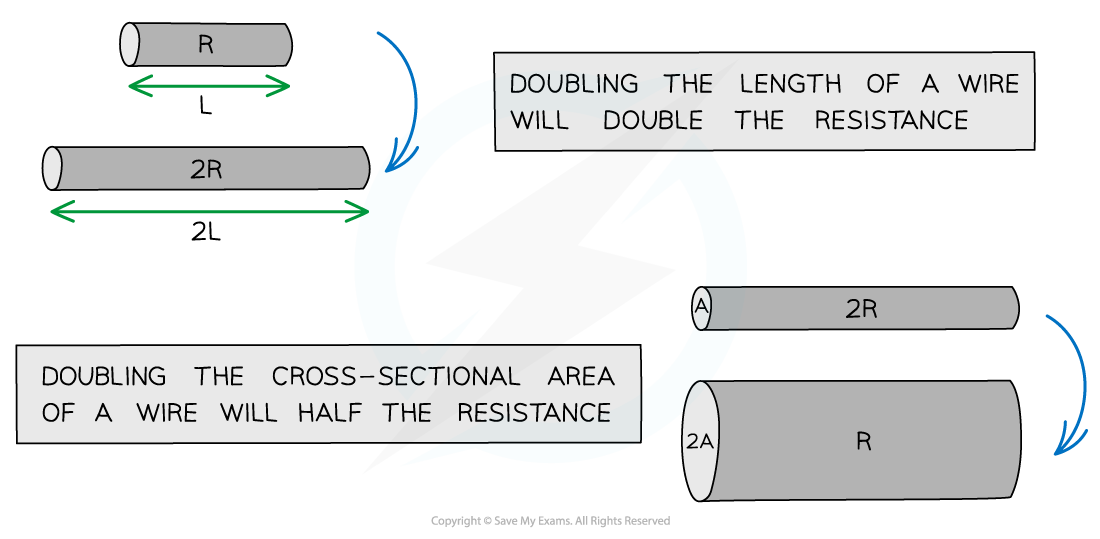 How the length and width of a wire affect its resistance
Defining Resistivity
- This leads to the definition of a new quantity, called resistivity
- Resistivity is a property describing the extent to which a material opposes the flow of electric current through it
- It is defined as follows:
The resistivity of a material is equal to the resistance per unit length of a material with unit cross-sectional area
- The equation for the resistivity is:

- Where:
- ρ = resistivity in ohm-metres (Ω m)
- R = resistance in ohms (Ω)
- A = cross sectional area of material in square metres (m2)
- L = length of material in meres (m)
Resistivity of Conductors and Insulators
- Resistivity is dependent on temperature
- In conductors, the resistivity increases with increasing temperature
- In insulators, the resistivity decreases with increasing temperature
- Since ρ ∝ R, when a wire or the filament inside a lamp heat up, their resistance increases
Resistivity of some materials at room temperature
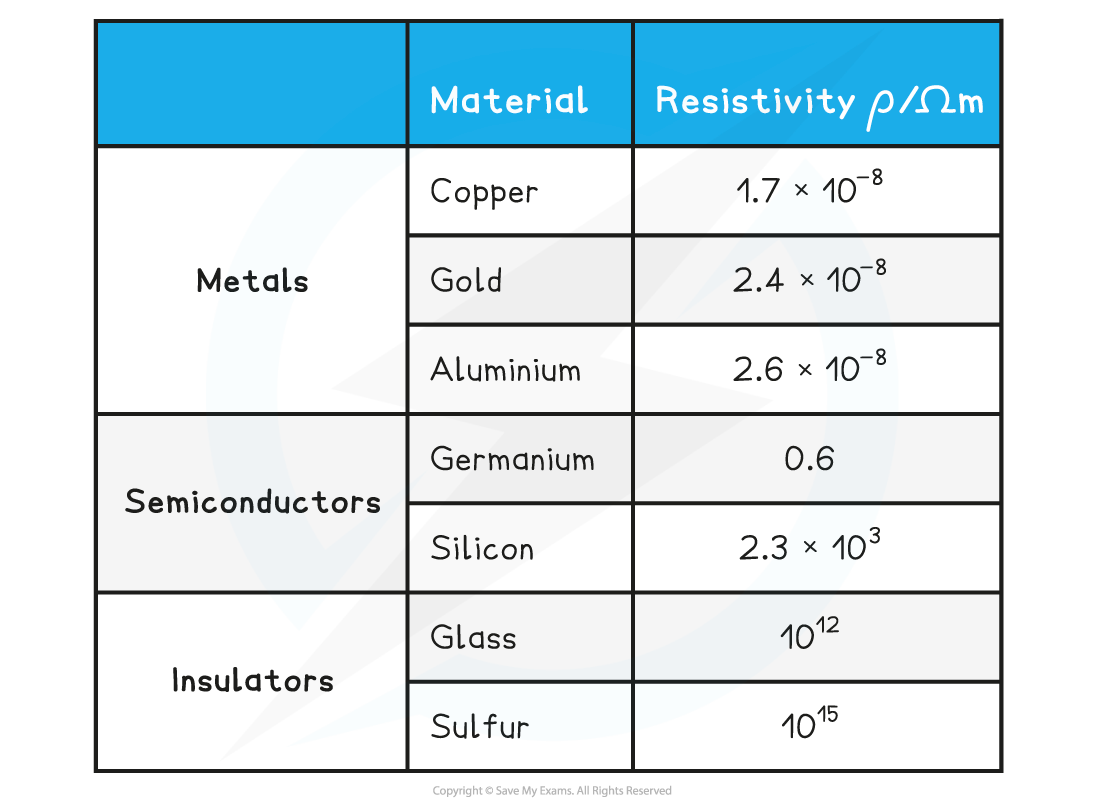
- Conductors have the lowest values of resistivity
- Wires are made from copper because of its relatively low resistivity at room temperature
- Insulators have such a high resistivity that virtually no current will flow through them
Worked Example
Two electrically-conducting cylinders made from copper and aluminium respectively.
Their dimensions are shown below.
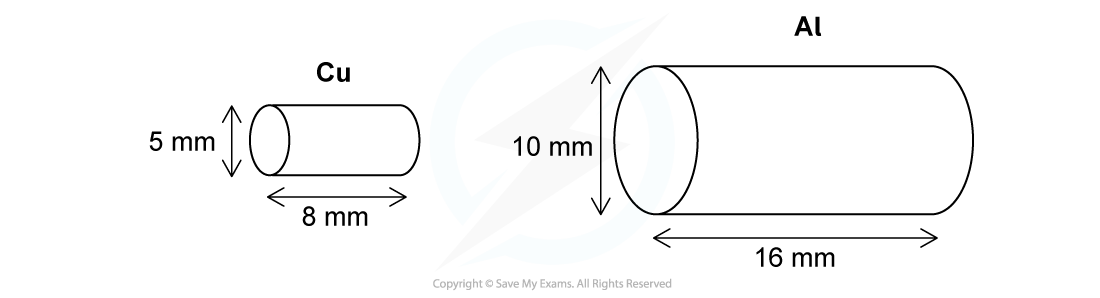
Copper resistivity = 1.7 × 10⁻⁸ Ω m
Aluminium resistivity = 2.6 × 10⁻⁸ Ω mDetermine which cylinder is a better conductor.
Step 1: Write down the known quantities
-
- Copper (Cu):
- Diameter, dCu = 5 mm = 5 × 10⁻³ m
- Length, LCu = 8 mm = 8 × 10⁻³ m
- Resistivity, ρCu = 1.7 × 10⁻⁸ Ω m
- Copper (Cu):
-
- Aluminium (Al):
- Diameter, dAl = 10 mm = 10 × 10–3 m
- Length, LAl = 16 mm = 16 × 10–3 m
- Resistivity, ρAl = 2.6 × 10⁻⁸ Ω m
- Aluminium (Al):
Step 2: A conductor is better if it has a lower resistance
Step 3: Write down the equation for resistivity
Step 4: Rearrange the above equation to calculate the resistance R

Step 5: Substitute the numbers into the above equation to calculate the resistance of copper RCu and the resistance of aluminium RAl
-
- The cross-sectional area A is calculated from the diameter d as follows:
- A = π(d/2)2
- The cross-sectional area A is calculated from the diameter d as follows:


Step 6: Compare the two values of the resistance
-
- The cylinder with the lower resistance is the better conductor
RCu = 6.9 × 10⁻⁶ Ω
RAl = 5.3 × 10⁻⁶ Ω
RAl < RCu
The aluminium cylinder is the better conductor.
Exam Tip
You won’t need to memorise the value of the resistivity of any material, these will be given in the exam question. The equation for resistivity is given in the data booklet.Remember, if the cross-sectional area is a circle (e.g. in a wire), it is proportional to the diameter squared. This means if the diameter doubles, the area quadruples causing the resistance to drop by a quarter.
转载自savemyexams
以上就是关于【IB DP Physics: SL复习笔记5.2.5 Resistivity】的解答,如需了解学校/赛事/课程动态,可至翰林教育官网获取更多信息。
往期文章阅读推荐:
翰林独家 | 经济学竞赛核心精讲,一册打通NEC/IEO/USAEBO!
2026 AMC10/12美国数学竞赛新赛季!【翰林教育 × 清华大学出版社】独家教材全面发售!


翰林AMC8视频课重磅上线!

国际竞赛真题资源免费领取






