AQA A Level Physics复习笔记6.3.2 Free & Forced Oscillations

Free & Forced Oscillations
Free Oscillations
- Free oscillations occur when there is no transfer of energy to or from the surroundings
- This happens when an oscillating system is displaced and then left to oscillate
- In practice, this only happens in a vacuum. However, anything vibrating in air is still considered a free vibration as long as there are no external forces acting upon it
- Therefore, a free oscillation is defined as:
An oscillation where there are only internal forces (and no external forces) acting and there is no energy input
- A free vibration always oscillates at its resonant frequency
Forced Oscillations
- In order to sustain oscillations in a simple harmonic system, a periodic force must be applied to replace the energy lost in damping
- This periodic force does work on the resistive force decreasing the oscillations
- It is sometimes known as an external driving force
- These are known as forced oscillations (or vibrations), and are defined as:
Oscillations acted on by a periodic external force where energy is given in order to sustain oscillations
- Forced oscillations are made to oscillate at the same frequency as the oscillator creating the external, periodic driving force
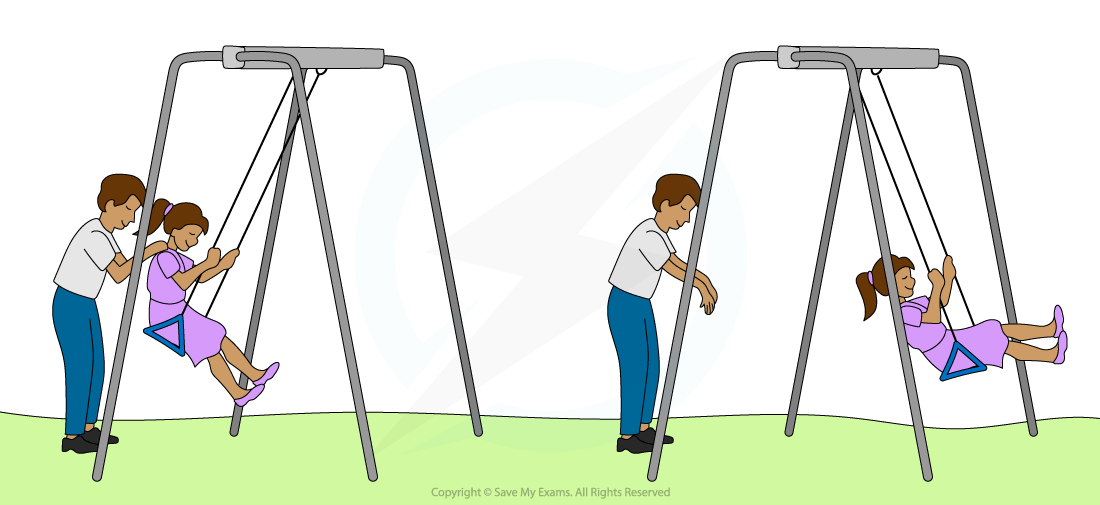
- For example, when a child is on a swing, they will be pushed at one end after each cycle in order to keep swinging and prevent air resistance from damping the oscillations
- These extra pushes are the forced oscillations, without them, the child will eventually come to a stop
Worked Example
State whether the following are free or forced oscillations:
(i) Striking a tuning fork
(ii) Breaking a glass from a high pitched sound
(iii) The interior of a car vibrating when travelling at a high speed
(iv) Playing the clarinet
(i) Striking a tuning fork
This is a free vibration. When a tuning fork is struck, it will vibrate at its natural frequency and there are no other external forces
(ii) Breaking a glass from a high pitched sound
This is a forced vibration. The glass is forced to vibrate at the same frequency as the sound until it breaks. The frequency of the high-pitched sound is the external driving frequency
(iii) The interior of a car vibrating when travelling at a particular speed
This is a forced vibration. The interior of the car vibrates at the same frequency as the wheels travelling over a rough surface at a high speed
(iv) Playing the clarinet
This is a forced vibration. The air from the player's lungs is used to sustain the vibration in the air column in a clarinet to create and hold a sound. The air column inside the clarinet mimics the vibrations at the same frequency as the air forced into the mouthpiece of the clarinet (the reed).
Exam Tip
Avoid writing 'a free oscillation is not forced to oscillate'. Mark schemes are mainly looking for a reference to internal and external forces and energy transfers
转载自savemyexams
以上就是关于【AQA A Level Physics复习笔记6.3.2 Free & Forced Oscillations】的解答,如需了解学校/赛事/课程动态,可至翰林教育官网获取更多信息。
往期文章阅读推荐:
翰林独家 | 经济学竞赛核心精讲,一册打通NEC/IEO/USAEBO!
2026 ALEVEL 夏考A率出炉!爱德思vs牛津AQA,哪些科目真的“好出分”?


翰林AMC8视频课重磅上线!

国际竞赛真题资源免费领取






