AQA A Level Biology复习笔记3.4.6 Cardiac Output

Maths Skill: Using the Cardiac Output Equation
- Cardiac output (CO) is the term used to describe the volume of blood that is pumped by the heart (the left and right ventricle) per unit of time
- An average adult has a cardiac output of roughly 4.7 litres of blood per minute when at rest
- Individuals who are fitter often have higher cardiac outputs due to having thicker and stronger ventricular muscles in their hearts
- Cardiac output increases when an individual is exercising
- This is so that the blood supply can match the increased metabolic demands of the cells
- The CO of an individual can be calculated using their heart rate and stroke volume
- Heart rate is the number of times a heart beats per minute
- This can also be described as the number of cardiac cycles per minute
- Stroke volume is the volume of blood pumped out of the left ventricle during one cardiac cycle
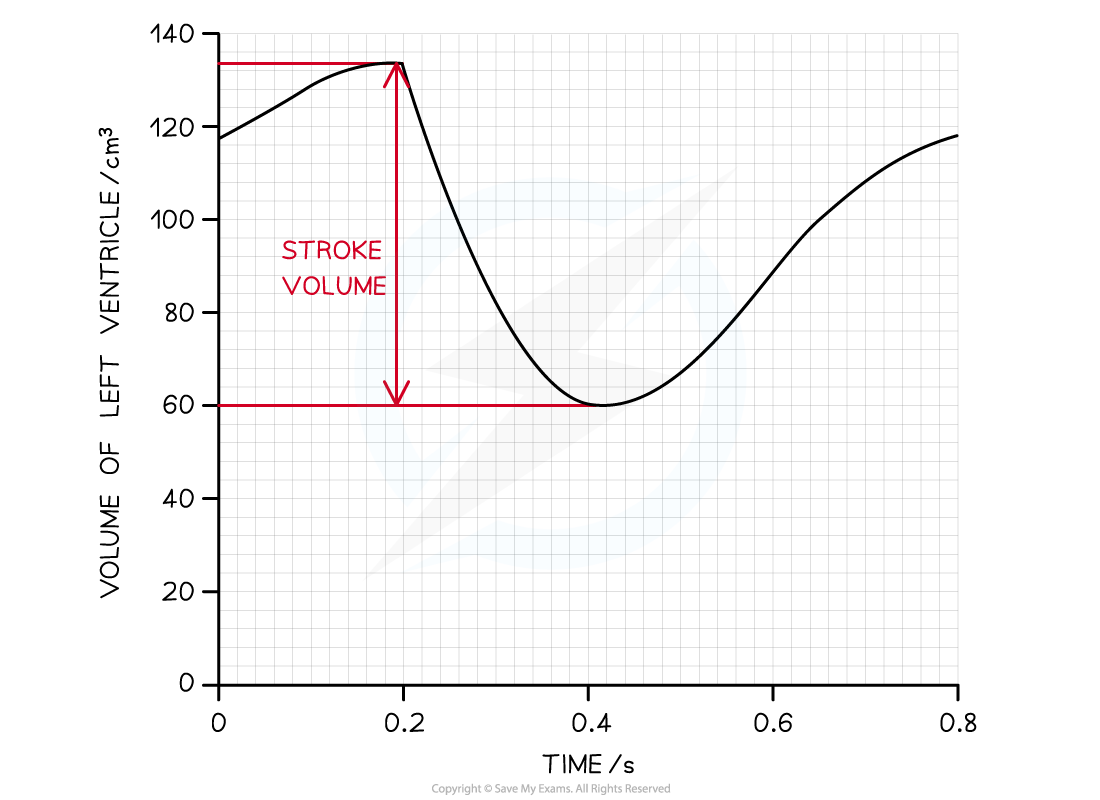
Image showing the changes in volume of the left ventricle within one cardiac cycle.
Calculating cardiac output
- Cardiac output is found by multiplying the heart rate by the stroke volume:
Cardiac output = heart rate x stroke volume
- The equation can be rearranged to find the heart rate and stroke volume if required
Worked Example
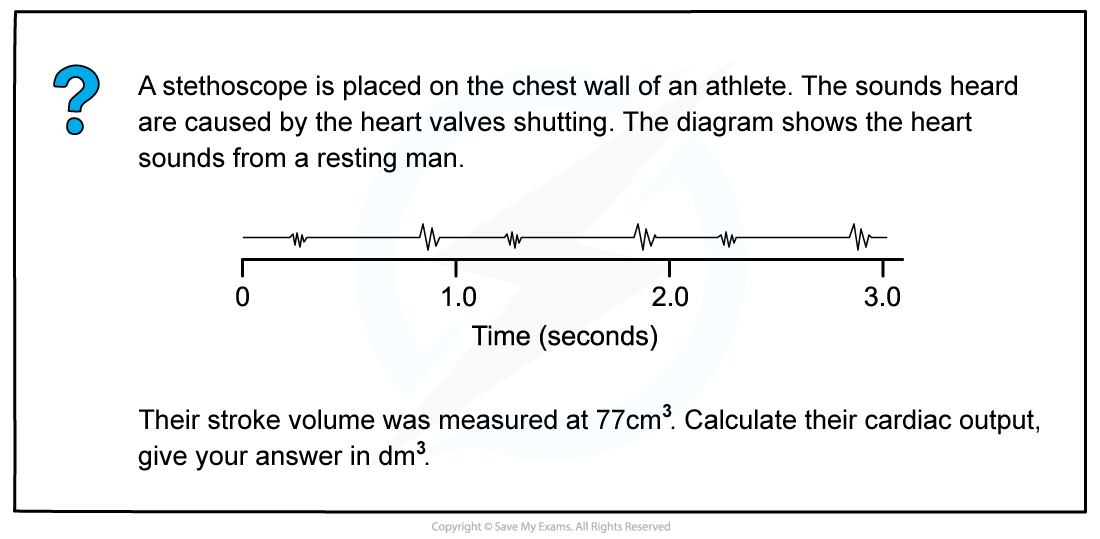
Image showing the sounds of the heart valves closing.
Step 1: Find the heart rate
1 cardiac cycle (atrial systole, ventricular systole and diastole) takes 1 second
To find the number of cardiac cycles completed in a minute, multiply by 60
60 x 1 = 60 bpm
Step 2: Insert relevant figures into the equation
Cardiac output = heart rate x stroke volume
Cardiac output = 60 x 77 = 4,620 cm3
CO = 4.62 dm3
Worked Example
An individual has a cardiac output of 4.3 dm3 and a heart rate of 72 bpm. Find their stroke volume. Give your answer in cm3.
Step 1: Rearrange the equation
Cardiac output = heart rate x stroke volume
Stroke volume = cardiac output ÷ heart rate
Step 2: Insert relevant figures into the equation
4.3 ÷ 72 = 0.0597 dm3
Stroke volume = 59.7 cm3
Exam Tip
1 dm3 is equal to 1000 cm3. It can be useful to convert all the figures found in the question into the same units before starting your workout, that way you are less likely to make any mistakes!Most cardiac cycle graphs show the changes in pressure in the left ventricle, left atrium and aorta. Remember that in order to work out the stroke volume you need to know the change in volume, not the change in pressure!
转载自savemyexams
以上就是关于【AQA A Level Biology复习笔记3.4.6 Cardiac Output】的解答,如需了解学校/赛事/课程动态,可至翰林教育官网获取更多信息。
往期文章阅读推荐:
哈佛商学院2026假期书单曝光!十余位教授私藏书单,本本是“商科天花板”!


翰林AMC8视频课重磅上线!

国际竞赛真题资源免费领取






